
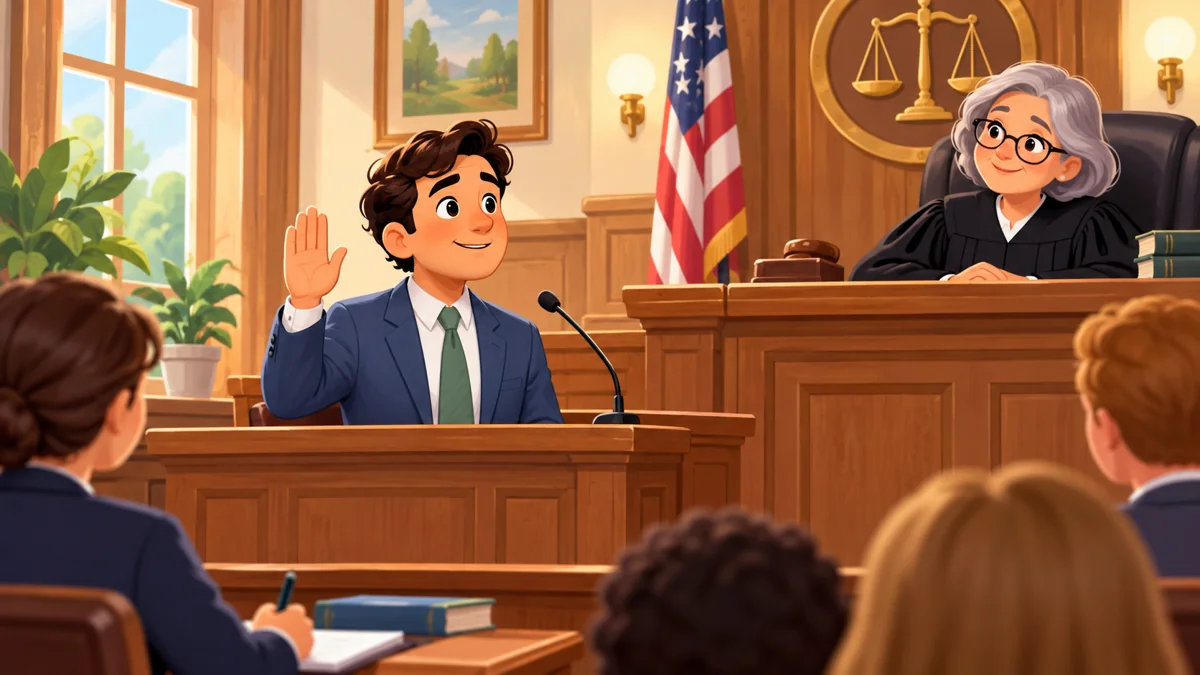
In law, testimony means a witness’s factual statement or opinion given under oath or affirmation in a legal proceeding. Testimony is evidence, but not every statement is testimony: the witness must generally be presented through an authorized process, subject to questioning, evidentiary rules, and credibility testing. False material testimony may expose a witness to perjury charges.
Key Facts About Legal Testimony
- Testimony is evidence from a witness, delivered orally or, in some settings, through a sworn written statement.
- A witness normally takes an oath or affirmation before answering questions under penalty of legal consequences.
- Lay witnesses generally testify from personal knowledge, while qualified experts may offer opinions based on specialized knowledge.
- Cross-examination tests credibility, bias, memory, consistency, and the foundation for a witness’s claims.
- False testimony is not automatically perjury; prosecutors generally must prove a knowingly false, material statement made under a legally sufficient oath.
- Federal depositions ordinarily last one day and seven hours under Federal Rule of Civil Procedure 30, subject to exceptions and court orders.
What Does Testimony Mean in Law?
Legal testimony is a witness’s statement made in a proceeding to help establish, explain, or dispute a fact. The statement may concern what the witness personally perceived, what a qualified expert concluded, or, in limited circumstances, what the witness reasonably inferred from an observed event.
Testimony has two dimensions. Its content may support a claim or defense, while its procedure determines whether the court can consider it. A relevant account can still be excluded because it lacks personal knowledge, contains inadmissible hearsay, violates privilege, or comes from an unqualified expert.
Testimony, evidence, and a statement
Testimony is one type of evidence. Other evidence includes documents, photographs, physical objects, electronically stored information, admissions, and stipulated facts.
An ordinary conversation, police interview, social-media post, or unsworn letter is usually a statement rather than courtroom testimony. That statement may later become evidence through another rule, such as an admission, a prior inconsistent statement, or a business-record exception. The label depends on the legal rule and the proceeding.
| Term | Meaning | Typical setting | Main legal question |
|---|---|---|---|
| Testimony | Witness evidence under oath or affirmation | Trial, hearing, deposition | Can the witness properly testify? |
| Statement | A person’s oral, written, or recorded assertion | Conversation, report, interview | Is the statement admissible? |
| Admission | A party’s statement offered against that party | Civil or criminal case | Does a hearsay rule apply? |
| Affidavit | Signed written statement sworn before an authorized officer | Motion, investigation, application | Can the court accept it without live cross-examination? |
| Declaration | Signed statement, sometimes unsworn under statute | Federal filings, investigations | Does the governing statute permit it? |
How Does Testimony Work in Court?
Courtroom testimony normally follows a controlled sequence: the witness is identified, sworn, questioned by the calling party, challenged by the opposing party, and sometimes questioned again for clarification. The judge controls admissibility, while the jury or judge evaluates credibility and weight.
A witness does not simply narrate everything known about a dispute. Lawyers ask questions within procedural limits, and opposing counsel can object. The court may require the witness to answer, exclude the answer, strike it from the record, or limit the purpose for which the jury may consider it.
The testimony process step by step
- Witness identification and disclosure: A party may identify a witness during discovery, or a subpoena may require attendance and production of specified materials.
- Oath or affirmation: The clerk, judge, or other authorized officer asks the witness to promise truthful testimony. An affirmation provides a nonreligious alternative to an oath.
- Direct examination: The calling lawyer asks questions designed to establish foundation and elicit admissible facts. Leading questions are generally restricted on direct examination.
- Objections: Counsel may object to form, relevance, hearsay, speculation, lack of foundation, privilege, or improper opinion. The judge sustains or overrules the objection.
- Cross-examination: Opposing counsel tests the account using leading questions, prior statements, documents, bias evidence, and contradictions.
- Redirect examination: The original lawyer may clarify testimony or address damage created during cross-examination.
- Recross-examination: The court may allow limited further questioning about new matters raised on redirect.
| Examination stage | Primary lawyer | Typical question style | Main purpose |
|---|---|---|---|
| Direct | Calling party | Open-ended, nonleading | Build factual foundation |
| Cross | Opposing party | Leading, controlled | Test reliability and credibility |
| Redirect | Calling party | Clarifying questions | Explain harmful answers |
| Recross | Opposing party | Limited leading questions | Test new clarification |
| Judicial questioning | Judge | Court-controlled | Clarify unclear or incomplete evidence |
What does an objection do?
An objection asks the judge to prevent, limit, or correct evidence that violates a rule. A sustained objection blocks the question or answer; an overruled objection permits the testimony to continue, although a later ruling may change its use.
A witness should not argue about an objection. The witness normally waits for the ruling, then answers if directed. If inadmissible testimony has already been spoken, counsel may ask the court to strike it, but jurors may still have heard and remembered the statement.
What Are the Main Types of Testimony?
The main witness categories are lay testimony and expert testimony, while the main delivery formats are live testimony, deposition testimony, and sworn written testimony. The category controls what the witness may say; the format controls how the evidence is presented and challenged.
Lay or fact witness testimony
A lay witness testifies from personal knowledge acquired through perception. Federal Rule of Evidence 602 requires evidence sufficient to support a finding that the witness personally knows the matter.
A lay witness may usually describe seeing a vehicle run a red light, hearing a threat, smelling smoke, or observing a person’s physical condition. Federal Rule of Evidence 701 can permit limited opinions rationally based on perception, such as whether someone appeared intoxicated, when the opinion helps the fact finder and does not rely on specialized knowledge.
A lay witness generally cannot diagnose a disease, calculate a construction defect, or reconstruct a collision using technical methods without qualifying as an expert.
Expert witness testimony
An expert witness uses specialized knowledge, skill, experience, training, or education to help the fact finder understand evidence or decide a fact. Under Federal Rule of Evidence 702, the proponent must show that the expert is qualified and that the opinion is relevant and based on reliable principles and methods reliably applied.
Qualification alone does not guarantee admission. A physician may be qualified generally but lack a reliable basis for a particular causation opinion. Courts may conduct a Daubert reliability analysis in federal cases, considering factors such as testability, peer review, error rates, standards, and general acceptance, although the analysis is flexible.
| Feature | Lay witness | Expert witness |
|---|---|---|
| Knowledge basis | Personal observation | Specialized education, training, skill, or experience |
| Opinion scope | Limited perception-based opinions | Technical or scientific opinions within expertise |
| Qualification hearing | Usually unnecessary | Possible under Rule 702 and Daubert |
| Compensation | Statutory fee and expenses may apply | Contract rate, often hundreds of dollars per hour |
| Main weakness | Memory, perception, bias | Methodology, assumptions, financial dependence |
| Typical example | Eyewitness to a collision | Accident-reconstruction engineer |
Is Deposition Testimony the Same as Trial Testimony?
Deposition testimony is sworn testimony taken outside court, usually during discovery, while trial testimony is presented to the judge or jury as part of the adjudicative hearing. A deposition transcript can be used for impeachment, admissions, motion practice, or substantive purposes allowed by the applicable rules.
A deposition is not a rehearsal with no legal effect. The witness answers under oath, counsel creates a transcript, and inconsistent answers can later affect credibility. The court may admit deposition testimony when a witness is unavailable or when a rule permits its use, but the exact conditions vary.
| Issue | Deposition | Trial testimony |
|---|---|---|
| Location | Office, conference room, or authorized remote setting | Courtroom or authorized hearing location |
| Decision maker present | Usually attorneys and court reporter | Judge, jury, attorneys, clerk |
| Federal time limit | Normally 1 day and 7 hours under Rule 30 | Court schedule and trial order |
| Questioning | Direct-style questioning by examining lawyer | Direct, cross, redirect, recross |
| Main purpose | Discovery and preservation | Persuade fact finder and establish proof |
| Objections | Made on the record, often with instructions | Ruled on immediately by judge |
Federal Rule of Civil Procedure 30 also creates a presumptive limit of ten depositions per side, although parties may stipulate to changes or seek a court order. State courts and criminal proceedings may use different limits.
Is an Affidavit Considered Testimony?
An affidavit is sworn written evidence, but it does not always function like live testimony. An affidavit can establish facts for a motion or administrative process, yet the opposing party may challenge it because the witness was not available for contemporaneous cross-examination.
Federal practice also recognizes unsworn declarations under 28 U.S.C. § 1746, which generally use language such as “I declare under penalty of perjury that the foregoing is true and correct.” The statute has specific wording and execution requirements.
| Form | Sworn or certified? | Cross-examination at creation? | Common use |
|---|---|---|---|
| Live testimony | Oath or affirmation | Yes | Trial or hearing |
| Deposition | Oath or affirmation | Yes | Discovery and preservation |
| Affidavit | Sworn before authorized officer | No | Motions and applications |
| § 1746 declaration | Unsworn, under penalty of perjury | No | Federal filings |
| Recorded interview | Usually not sworn | No | Investigation and impeachment |
An affidavit is especially vulnerable when it contains hearsay, legal conclusions, missing foundation, or facts outside the signer’s personal knowledge. A court may consider a properly supported affidavit at one stage and still require live testimony later.
What Makes Testimony Admissible and Persuasive?
Admissibility asks whether the court may consider testimony; weight asks how much reliance the fact finder should place on it. A witness can provide admissible testimony that receives little weight because the account is inconsistent, biased, implausible, poorly perceived, or contradicted by reliable records.
| Requirement | Practical test | Example failure |
|---|---|---|
| Personal knowledge | Did the witness perceive the fact? | Repeating what an unknown person said |
| Relevance | Does the fact affect a disputed issue? | Unrelated workplace history |
| Competency | Can the witness understand and communicate? | Inability to perceive the event |
| Foundation | Is the basis for the answer established? | Identifying an object without seeing it clearly |
| Rule compliance | Does hearsay or privilege apply? | Repeating an out-of-court diagnosis |
| Expert reliability | Are method and application reliable? | Unsupported causal conclusion |
Can testimony contain hearsay?
Yes. Testimony is the method of presenting a witness, while hearsay is a category of out-of-court statements offered for the truth of what they assert. A witness may testify about personally observed conduct without hearsay, yet create a hearsay problem by repeating another person’s assertion.
Hearsay has numerous exclusions and exceptions, including opposing-party statements, present-sense impressions, excited utterances, business records, and statements against interest. The exception depends on the statement, purpose, declarant, circumstances, and applicable jurisdiction.
Can a witness refuse to testify?
A witness may refuse or limit an answer when a recognized privilege applies, such as the Fifth Amendment privilege against compelled self-incrimination, attorney-client privilege, spousal privileges, or protections for confidential communications. Privilege is specific to the legal relationship and facts; embarrassment alone ordinarily does not justify refusal.
A subpoena generally requires compliance unless the court quashes or modifies it. A witness who ignores a valid subpoena may face contempt, but courts often address objections, privilege claims, disability, scheduling conflicts, and undue burden through motions.
What Happens if Testimony Changes?
Changed testimony creates a credibility issue, and the opposing party may use an earlier deposition, statement, document, or recorded account to impeach the witness. A changed answer is not automatically perjury because memory can improve, questions can differ, and honest correction is legally distinct from intentional falsehood.
A witness who recognizes an error should correct it promptly through counsel or the proceeding’s permitted procedure. Attempting to preserve an inaccurate answer usually creates a larger problem than admitting uncertainty.
How should witnesses handle memory gaps?
A witness should say “I do not recall” when that is accurate, rather than guess. A witness may sometimes review a document to refresh recollection, but refreshing memory does not automatically make the document evidence and does not permit the witness to adopt facts unsupported by memory.
Practitioner rule: precise uncertainty is usually more credible than false precision. Dates, distances, and conversations are common sources of accidental overstatement.
When Does False Testimony Become Perjury?
False testimony may constitute perjury when a person knowingly makes a materially false statement under a legally sufficient oath or affirmation in a proceeding covered by the governing statute. A mistake, confusion, ambiguous question, immaterial exaggeration, or honestly held incorrect memory may not satisfy the required mental state.
Federal perjury statutes include 18 U.S.C. § 1621, which generally requires a willful declaration under oath of a material matter known to be untrue. The federal maximum penalty can include imprisonment for up to five years, but state definitions, classifications, limitation periods, and penalties differ. The AI Overview’s statement that false testimony is always a serious felony is therefore too broad.
| Situation | Usually perjury? | Why |
|---|---|---|
| Honest memory mistake | Usually no | Lacks knowing falsity |
| Guess stated as certainty | Potentially | Knowledge and materiality matter |
| False answer about a material fact | Potentially yes | Core statutory elements may exist |
| False answer to an ambiguous question | Uncertain | Ambiguity may undermine willfulness |
| Irrelevant exaggeration | Usually no | Materiality may be absent |
| Corrected answer after realizing error | Usually not for the correction | Prompt correction supports lack of intent |
Perjury is not the only consequence of inaccurate testimony. A witness may face impeachment, loss of credibility, sanctions, contempt, employment consequences, or separate obstruction-related allegations depending on conduct and jurisdiction.
How Much Do Witnesses and Experts Cost?
Ordinary witness compensation is usually governed by statute or court rule, while expert compensation is negotiated and varies substantially by specialty, location, preparation burden, and litigation risk. Federal court witness attendance compensation is generally set by statute, and mileage is separately governed; state amounts may differ.
The figures below are planning ranges, not universal prices. A lawyer should confirm the current fee schedule and local rule before budgeting.
| Cost item | Typical United States planning figure | Main variable | Payment structure |
|---|---|---|---|
| Federal fact-witness attendance | $40 per day under 28 U.S.C. § 1821 | Statutory updates and travel | Daily fee plus allowed travel |
| Fact-witness travel | Statutory mileage rate | Distance and transport mode | Reimbursement |
| Expert document review | $250-$600 per hour | Specialty and complexity | Hourly |
| Expert deposition | $400-$1,000+ per hour | Specialty, preparation, location | Hourly, often minimum blocks |
| Expert trial appearance | $3,000-$15,000 per day | Expertise and scheduling | Daily fee plus expenses |
| Complex expert engagement | $10,000-$50,000+ total | Number of reports and depositions | Retainer plus invoices |
Ethical rules commonly prohibit contingent expert fees tied to the outcome because payment can compromise independence. The engagement letter should address preparation, travel, waiting time, cancellation, deposition minimums, exhibits, and trial testimony.
What Are the Most Common Testimony Mistakes?
The most damaging witness mistakes are guessing, volunteering answers, arguing with counsel, adopting a lawyer’s wording without understanding it, and failing to distinguish personal knowledge from assumptions. These errors can create contradictions that opposing counsel later presents as evidence of unreliability.
- Answering beyond the question: Stop after answering the precise question unless clarification is necessary.
- Guessing: Give an estimate only when the question requests one and label it as an estimate.
- Arguing: State the fact calmly; do not attempt to win the dispute with the lawyer.
- Using absolute language: Words such as “always” and “never” create avoidable impeachment opportunities.
- Reading undisclosed material: Ask counsel whether notes, emails, or reports may be reviewed before testimony.
- Discussing testimony afterward: Do not discuss substantive testimony with other witnesses when a court’s sequestration order applies.
A witness should listen fully, pause briefly, request clarification, and answer truthfully. Preparation may include reviewing relevant records, but counsel cannot lawfully script false answers or coach a witness to evade a question.
How Do Civil and Criminal Testimony Differ?
Civil testimony usually concerns private claims such as contracts, negligence, employment, or property disputes, while criminal testimony concerns alleged offenses prosecuted by the government. Criminal cases add constitutional protections, including the defendant’s privilege against self-incrimination and the Sixth Amendment confrontation right in applicable circumstances.
| Issue | Civil case | Criminal case |
|---|---|---|
| Initiating party | Private plaintiff or claimant | Government prosecutor |
| Burden of proof | Usually preponderance of evidence | Beyond a reasonable doubt |
| Defendant testimony | May affect civil fact findings | Defendant may remain silent |
| Discovery | Often broader and rule-based | Rules vary by jurisdiction and case type |
| Witness protection | Subpoena and protective orders | Subpoena, immunity, and constitutional limits |
| Main fact finder | Judge or civil jury | Judge or criminal jury |
Grand-jury testimony is a special criminal proceeding. The witness may testify under oath, but the accused and defense counsel generally do not participate in the same way they do at trial, and secrecy rules apply.
What Is the Bottom Line on Testimony Meaning in Law?
The legal meaning of testimony is sworn or affirmed witness evidence offered in a proceeding to establish facts or provide admissible specialized opinions. Testimony differs from ordinary statements, affidavits, depositions, and hearsay because each form has different rules for oath, personal knowledge, questioning, authentication, and use.
For a witness, truthful precision matters more than persuasive storytelling. For a litigant, testimony should be evaluated alongside documents, physical evidence, credibility, privilege, and the burden of proof. The exact result depends on the court, jurisdiction, proceeding, and evidentiary rule involved.
Frequently Asked Questions
Does testimony have to be given in a courtroom?
No. Testimony may be given at a deposition, administrative hearing, arbitration, grand-jury proceeding, or other authorized legal process. Courtroom testimony is usually subject to immediate judicial rulings and live cross-examination, while written declarations may lack contemporaneous questioning and therefore receive different treatment.
Can a child give legal testimony?
Yes. A child may testify if the court finds sufficient ability to perceive, remember, communicate, and understand the obligation to tell the truth. Age alone does not decide admissibility. The judge may use age-appropriate questioning, protective procedures, or remote testimony when permitted by law.
Can a witness review notes before testifying?
A witness may review records during preparation, but counsel should determine what may be used and whether the opposing party can inspect the material. Reviewing a document to refresh recollection differs from relying on the document as the witness’s memory, and different evidence rules may apply.
Is testimony recorded?
Usually, formal testimony is recorded by a court reporter, audio system, video system, or transcript process authorized for the proceeding. Depositions commonly produce a certified transcript. Informal interviews may be recorded, but recording alone does not convert an interview into sworn testimony.
Can testimony be used in another case?
Sometimes. A deposition transcript, prior testimony, affidavit, or statement may be usable in another proceeding only if the governing rules permit it and requirements such as relevance, authentication, unavailability, party opportunity to examine, and privilege are satisfied. A lawyer should not assume that sworn testimony transfers automatically.
Does a witness need a lawyer?
A witness is not always required to have separate counsel, but independent legal advice may be important when testimony could create criminal exposure, waive privilege, reveal confidential information, or conflict with a party’s interests. A party’s lawyer represents the party, not necessarily every witness the party calls.