

A shareholder is a person, company, or institution that owns shares representing an equity interest in a corporation. Share ownership may provide voting rights, dividend eligibility, access to company information, and a claim on remaining assets after creditors are paid, but the exact rights depend on the share class, corporate documents, and applicable law.
Key Facts at a Glance
- A shareholder owns equity in a corporation, not a guaranteed repayment claim.
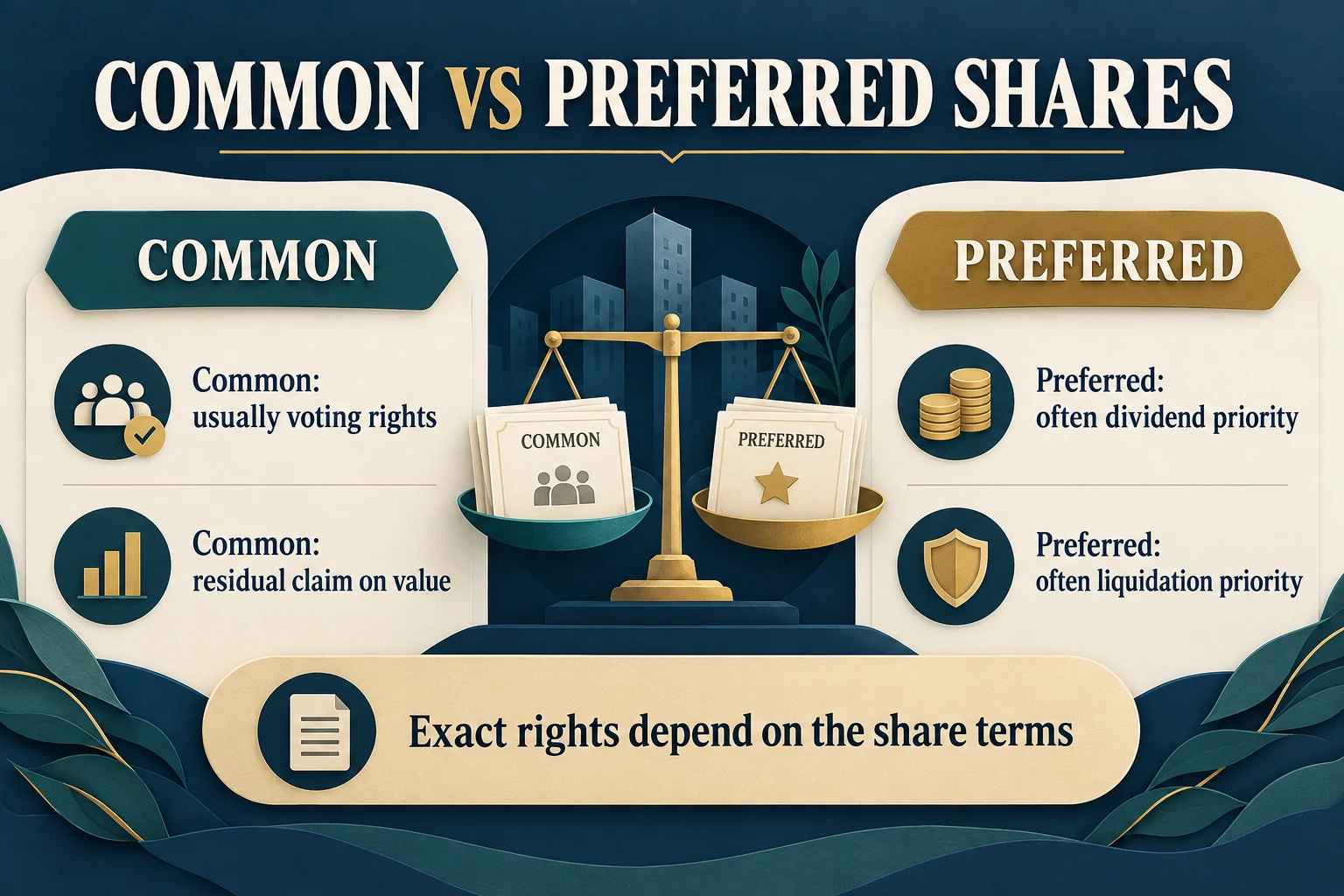
- Common shareholders usually vote and receive residual profits after priority claims are satisfied.
- Preferred shareholders commonly receive dividend or liquidation priority, although voting rights may be limited.
- Shareholders normally have limited liability, so their loss is usually limited to the amount invested.
- Issuing new shares can reduce an existing shareholder’s ownership percentage and voting influence.
- Owning 51% does not automatically guarantee control because voting classes, agreements, quorum rules, and local law can change the result.
What Does Shareholder Meaning in Business Include?
Shareholder meaning in business refers to the legal and economic position of owning shares in a corporation. A shareholder may be an individual founder, an employee, a venture-capital fund, a pension fund, or another corporation, and the ownership may be direct or held through a nominee or brokerage account.
A share represents a unit of equity. Equity is different from debt because the company generally does not promise to repay a shareholder on a fixed schedule. A shareholder’s return depends on dividends, share-price appreciation, a sale of the business, or distributions after liquidation.
The corporation is a separate legal entity. That separation usually prevents shareholders from being personally responsible for ordinary corporate debts. Courts can nevertheless examine fraud, undercapitalization, commingling of funds, and failure to respect corporate formalities when a claimant asks to pierce the corporate veil.
| Term | Meaning | Typical consequence |
|---|---|---|
| Shareholder | Legal or beneficial owner of corporate shares | May receive votes, dividends, and sale proceeds |
| Equity | Ownership interest remaining after liabilities | Value rises or falls with company performance |
| Stockholder | Alternative term for shareholder | Common in U.S. corporate language |
| Beneficial owner | Person receiving economic benefit | May differ from the registered owner |
| Registered holder | Name recorded on the company register | Usually receives formal notices and voting materials |
What Is a Shareholder Not?
A shareholder is not automatically an employee, director, officer, lender, or business manager. A person can hold 2% of a company without working there, while a chief executive can manage the corporation without owning any shares.
A shareholder also does not own each company asset personally. The corporation owns its office, equipment, bank account, patents, and inventory. The shareholder owns shares in the legal entity that owns those assets.
How Does a Shareholder Make or Lose Money?
A shareholder generally earns money through dividends, capital gains, or a distribution during a merger or liquidation. A shareholder loses money when the market value falls, dividends are reduced, additional shares dilute ownership, or the company fails before equity holders receive anything.
The return mechanism depends on the company’s stage and financial policy. A mature utility may distribute regular dividends, while a technology startup may retain every dollar for hiring and product development. Retained earnings can increase the company’s value, but they do not create an automatic cash payment to shareholders.
| Return source | How it works | Typical timing | Main risk |
|---|---|---|---|
| Cash dividend | Company distributes declared cash per share | Quarterly, annually, or irregularly | Board may reduce or cancel it |
| Capital gain | Share is sold above purchase price | At sale or acquisition | Price may decline before sale |
| Stock dividend | Company issues additional shares | Declaration date and record date | More shares do not guarantee more value |
| Buyback | Company repurchases shares | Program-dependent | Remaining ownership may rise, but price can fall |
| Liquidation distribution | Residual assets reach shareholders | After business closure | Creditors and preferred claims rank first |
Do Shareholders Always Receive Dividends?
No. A corporation can retain earnings instead of paying dividends, subject to corporate law, solvency requirements, share terms, and any contractual obligations. Common shareholders usually have no right to demand a dividend merely because the company is profitable.
Preferred shares may carry a stated dividend, but “preferred” does not always mean guaranteed. Cumulative preferred shares may accumulate unpaid dividends, while non-cumulative shares may lose an unpaid distribution permanently, depending on the governing terms.
What Rights Does a Shareholder Have?
A shareholder may have voting, economic, information, transfer, and litigation rights, but no single universal package applies to every corporation. The articles of incorporation, bylaws, share terms, shareholder agreements, and local corporate statute determine the practical scope.
Common rights include:
- Voting for directors or on specified resolutions.
- Receiving declared dividends tied to the share class.
- Reviewing defined corporate records.
- Receiving notice of shareholder meetings.
- Selling or transferring shares, subject to restrictions.
- Receiving a residual distribution after higher-ranking claims.
- Bringing a derivative or direct claim in appropriate circumstances.
Shareholders usually do not direct daily operations. Directors oversee corporate strategy and appoint or supervise senior officers. A shareholder with voting control can often influence director appointments, but that influence is different from personally signing contracts or managing staff.
| Right | Common-share example | Important limitation |
|---|---|---|
| Voting | One vote per share at an annual meeting | Non-voting classes may have no ordinary vote |
| Dividend | Participation after declaration | No automatic payment from profits |
| Inspection | Access to permitted records | Purpose and procedure may be restricted |
| Transfer | Sale through a broker | Private shares may require approval |
| Information | Meeting materials and reports | Scope differs between public and private companies |
| Residual assets | Claim after creditors and preferred holders | Often zero in insolvency |
What Are the Main Types of Shareholders?
The main shareholder categories are common shareholders, preferred shareholders, controlling shareholders, minority shareholders, institutional shareholders, and employee or founder shareholders. These categories describe rights, ownership scale, or identity, and one investor can fit several categories at once.
An institutional investor can be a minority shareholder, while a founder can hold common shares with super-voting rights. Classification therefore requires examining both the investor and the security.
Common and Preferred Shares Compared
| Feature | Common shares | Preferred shares | Dual-class common | RSUs |
|---|---|---|---|---|
| Typical vote | One vote per share | Often limited or none | Multiple votes possible | Usually no vote before settlement |
| Dividend position | Residual | Stated priority | Usually common economics | Depends on settlement terms |
| Liquidation position | Usually last | Senior to common | Usually same as related common | Not a share until settled |
| Main user | Public investors, founders | Income or venture investors | Founder-controlled companies | Employees and executives |
| Main risk | Volatility and dilution | Terms may restrict upside | Control concentration | Vesting or forfeiture |
Restricted stock units require special care. An RSU is normally a contractual promise to deliver shares or cash after vesting and settlement; it is not generally a current shareholding before settlement. The holder may have no voting right before the shares are issued.
Shareholder Versus Stakeholder: What Is the Difference?
A shareholder owns shares, while a stakeholder is any person or group affected by the business or able to affect its outcomes. Employees, customers, suppliers, lenders, regulators, local communities, directors, and shareholders can all be stakeholders.
The distinction matters because corporate decisions can affect stakeholders without giving them shareholder rights. An employee may have wages and employment protections but no vote. A lender may have repayment rights under a loan agreement but no equity ownership.
| Party | Owns equity? | Primary claim | Typical influence |
|---|---|---|---|
| Shareholder | Yes | Residual value, dividends, votes | Elections and shareholder resolutions |
| Creditor | No | Contractual repayment | Covenants and enforcement |
| Employee | Usually no | Wages and employment benefits | Operational knowledge and labor rights |
| Customer | No | Product or service performance | Revenue and reputation |
| Director | Not necessarily | Governance role and duties | Board decisions |
| Regulator | No | Compliance and public interest | Licenses, penalties, rules |

Does Owning 51% Guarantee Control?
Owning 51% of voting shares often provides practical control over ordinary shareholder resolutions, but 51% does not guarantee absolute control. Control can change because of separate voting classes, attendance and quorum rules, shareholder agreements, statutory thresholds, classified boards, or votes that exclude a conflicted holder.
A holder with 40% can sometimes control a company if the remaining shares are widely dispersed and only a minority attends meetings. Conversely, a holder with 51% of economic shares may lack control if another class carries ten votes per share.
A 75% approval requirement is not universal. Mergers, constitutional amendments, asset sales, and voluntary liquidation may require a supermajority, but the applicable percentage comes from the jurisdiction and corporate documents.
What Does a Controlling Shareholder Control?
A controlling shareholder may influence director elections, strategic direction, major transactions, and executive appointments through voting power. The shareholder usually still acts through the corporation’s formal organs, rather than bypassing the board and directly owning company property.
Controlling shareholders can owe duties under local law, especially when using control to approve related-party transactions, squeeze out minority owners, or divert corporate opportunities. The specific duty and remedy depend on the jurisdiction.
What Is Shareholder Dilution?
Shareholder dilution occurs when a company issues new shares and an existing holder does not acquire enough of the new issuance to preserve the previous ownership percentage. Dilution can reduce voting power, dividend participation, and the percentage of sale proceeds, although a successful capital raise may increase the total value of the company.
Example: an investor owns 100 of 1,000 shares, or 10%. The company issues 500 new shares. If the investor buys none, the investor still owns 100 shares but only 6.67% of the enlarged 1,500-share total.
| Event | Before event | After event | Investor result |
|---|---|---|---|
| Existing shares | 1,000 | 1,000 | No change in share count |
| New issuance | 0 | 500 | Company raises capital |
| Investor shares | 100 | 100 | Percentage falls |
| Ownership percentage | 10.00% | 6.67% | 3.33 percentage-point reduction |
| Preemptive purchase | 100 | 150 | Percentage remains 10.00% |
Preemptive rights can allow an investor to buy a proportional allocation in a new issue. These rights may be absent from public-company shares and may be waived, excluded, or limited by contract in private financings.
Can a Shareholder Lose More Than the Investment?
A shareholder normally cannot lose more than the amount invested in the shares because limited liability separates personal assets from corporate liabilities. Personal exposure can increase when the shareholder gives a guarantee, commits fraud, receives improper distributions, or uses the company as a personal alter ego.
Commingling personal and corporate funds is evidence that can support a veil-piercing argument, but commingling alone does not automatically make a shareholder liable everywhere. Courts examine the full relationship, including records, capitalization, decision-making, and misuse of the corporate form.
What Happens to Shareholders When a Company Fails?
Shareholders are residual claimants in insolvency. Secured creditors, administrative expenses, employees with priority claims, unsecured creditors, and preferred equity may rank ahead of common shareholders, depending on the insolvency regime and security terms.
Common equity often receives nothing when liabilities exceed asset value. Shareholders may still have rights to notices, votes on certain restructuring matters, or a distribution if assets remain after all senior claims are settled.
What Rules Apply to Public and Private Shareholders?
Public shareholders generally trade through regulated markets and receive standardized disclosures, while private-company shareholders face transfer restrictions, valuation uncertainty, and more negotiated governance. Public shares may be liquid within market hours; private shares can take months to sell or may have no available buyer.
In the United States, beneficial ownership reporting commonly applies when a person or group acquires more than 5% of a covered class of registered voting equity. Schedule 13D and Schedule 13G have different eligibility, disclosure, and amendment rules, and SEC deadlines and requirements can change.
Private-company shareholders should review the articles, cap table, investor rights agreement, right-of-first-refusal provisions, drag-along clauses, tag-along rights, and buy-sell terms before investing.
| Issue | Public company | Private company |
|---|---|---|
| Sale process | Exchange or broker transaction | Negotiated transfer or approved buyer |
| Price visibility | Quoted market price | Valuation round, appraisal, or negotiation |
| Transfer restriction | Market rules and trading windows | ROFR, board approval, lockups |
| Information | Periodic regulatory filings | Contractual and statutory access |
| Ownership disclosure | Regulatory thresholds may apply | Cap table and filings vary by jurisdiction |
| Exit timeframe | Seconds to market days | Months to years, or no exit |
How Should a Person Evaluate a Shareholding?
A person evaluating shares should examine legal rights, ownership percentage, financial statements, dilution terms, exit restrictions, and the company’s ability to meet senior claims. The purchase price alone cannot reveal whether the equity is attractive.
Use this review sequence:
- Confirm the issuer and exact share class.
- Verify the number of issued and fully diluted shares.
- Read voting, dividend, conversion, and liquidation terms.
- Model dilution from options, warrants, convertible notes, and planned funding.
- Check transfer restrictions, ROFR provisions, and buyout mechanisms.
- Review debt, cash, revenue, profitability, and cash runway.
- Identify who controls the board and major decisions.
- Record tax, custody, brokerage, and legal costs separately.
An expert rule of thumb is to model ownership on a fully diluted basis, not only against currently issued shares. Options and convertible instruments can materially change the percentage an investor appears to own today.
What Is a Shareholder Agreement For?
A shareholder agreement sets private-company rules that may not appear in the articles or bylaws. It can address board appointments, reserved matters, transfer restrictions, tag-along rights, drag-along rights, information access, deadlocks, and buyout procedures.
A shareholder agreement cannot override every mandatory corporate statute. Parties should compare the agreement with the articles, financing documents, and local law before relying on a protection.
Common Shareholder Mistakes
Several mistakes repeatedly create avoidable disputes:
- Treating a percentage in a pitch deck as a legal ownership record.
- Confusing issued shares with fully diluted ownership.
- Assuming preferred shares always carry votes or guaranteed dividends.
- Assuming 51% provides control despite a super-voting founder class.
- Ignoring vesting, forfeiture, repurchase, and tax terms in employee equity.
- Failing to document loans, guarantees, transfers, and related-party payments.
- Believing a private-company share can be sold whenever the owner chooses.
One counterintuitive point matters most: a larger percentage can be less valuable than a smaller percentage with stronger liquidation preferences, anti-dilution protection, or information rights. Economic value depends on the distribution waterfall, not ownership percentage alone.
Frequently Asked Questions
Is a shareholder an owner of the company?
A shareholder is an owner of an equity interest in the corporation, but not usually a direct owner of corporate property. The corporation owns its assets, while the shareholder owns shares that may provide votes, distributions, and a residual claim. The extent of ownership rights depends on the share class and governing documents.
Can one person be both a shareholder and a director?
Yes. A founder, investor, or employee can hold shares and serve as a director at the same time. The roles remain legally distinct: the shareholder exercises rights attached to shares, while the director participates in board governance and must follow applicable fiduciary and statutory duties.
Do shareholders have to work in the business?
No. Shareholders can be passive investors with no employment, management, or board role. A private company may impose contractual obligations on a founder or employee shareholder, but share ownership alone does not require the person to perform work.
Can a shareholder sell shares without permission?
Public shareholders can usually sell through the market, subject to trading rules, lockups, and insider restrictions. Private-company shares may require approval, offer them first to existing holders under an ROFR, or remain subject to vesting and contractual transfer limits.
What happens if shareholders disagree?
The result depends on voting power, reserved matters, board structure, and dispute provisions. A shareholder agreement may require mediation, arbitration, a buy-sell process, or a deadlock vote. Minority owners may also have statutory oppression or derivative remedies, but the available remedy varies by jurisdiction.
Are shareholders responsible for company taxes?
The corporation generally pays its own taxes as a separate taxpayer, while shareholders may owe tax on dividends, capital gains, or equity compensation. Personal liability can arise from separate conduct, such as withholding-tax violations, guarantees, fraud, or other statutory responsibilities.
The Bottom Line
Shareholder meaning in business is the legal and economic status created by owning corporate shares. Shareholders may vote, receive declared dividends, benefit from appreciation, and claim residual assets, but those rights vary by share class, corporate documents, ownership structure, and jurisdiction. Common shareholders bear the greatest residual risk, while preferred investors may receive priority at the cost of limited voting or upside. Before investing, verify the cap table, rights, dilution exposure, transfer rules, and insolvency priority rather than relying on ownership percentage alone.