
Business scalability is the ability of a company to increase revenue, customers, or output without increasing costs and operational complexity at the same rate. A scalable business model uses repeatable products, processes, technology, capital, or distribution to support substantial growth while protecting margins, quality, and cash flow.
Key Facts About Business Scalability
- Scalability measures how efficiently a business handles additional volume, not how quickly revenue rises.
- A scalable company grows revenue faster than its variable operating costs over a defined range.
- Software can add customers at low marginal cost, while physical goods remain constrained by inventory, logistics, and production capacity.
- A business can scale revenue while losing money if customer acquisition costs, support costs, or working capital rise too quickly.
- Scalability is usually a design characteristic, not a permanent label; a company may scale well at 10,000 customers and fail at 100,000.
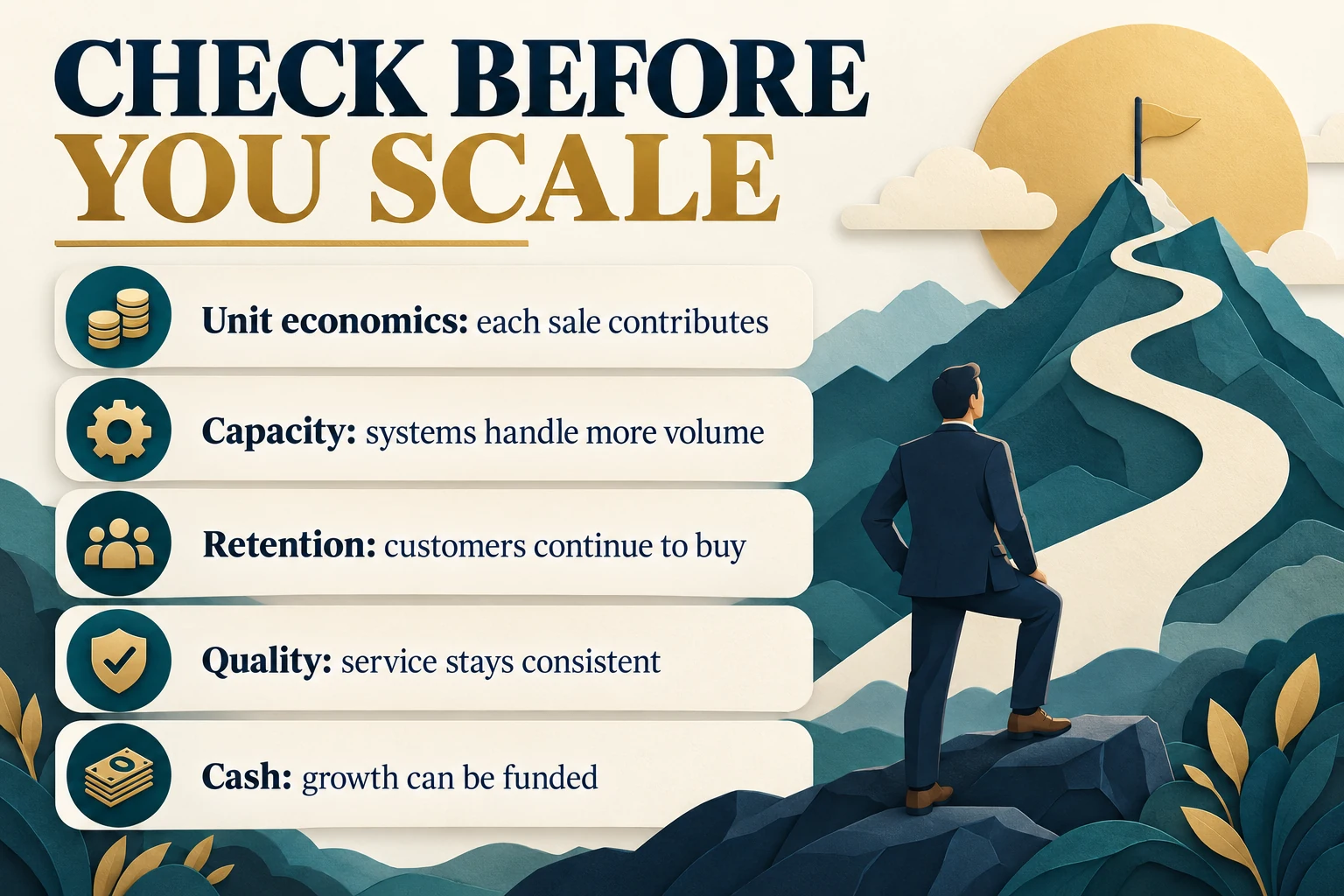
- The most useful tests combine contribution margin, capacity, retention, payback period, quality, and cash requirements.
What Does Scalability Mean in Business?
Business scalability means that a company can expand its revenue or output without a proportional increase in total costs, headcount, management effort, or operational risk. A scalable company normally has repeatable delivery, predictable demand, strong unit economics, and enough capacity to absorb additional volume.
The key comparison is incremental revenue versus incremental cost. If serving 1,000 additional customers creates $100,000 in revenue and $30,000 in additional delivery costs, the incremental contribution is $70,000. If serving those customers requires $120,000 of new labor, facilities, and support expense, growth has occurred, but scalability has not.
Scalability has a boundary. A cloud software platform may add users without adding one employee per user, but database capacity, customer support, security, and sales operations still create thresholds. A scalable business therefore reduces the cost and complexity of additional volume; it does not eliminate costs entirely.
Scalability Versus Growth
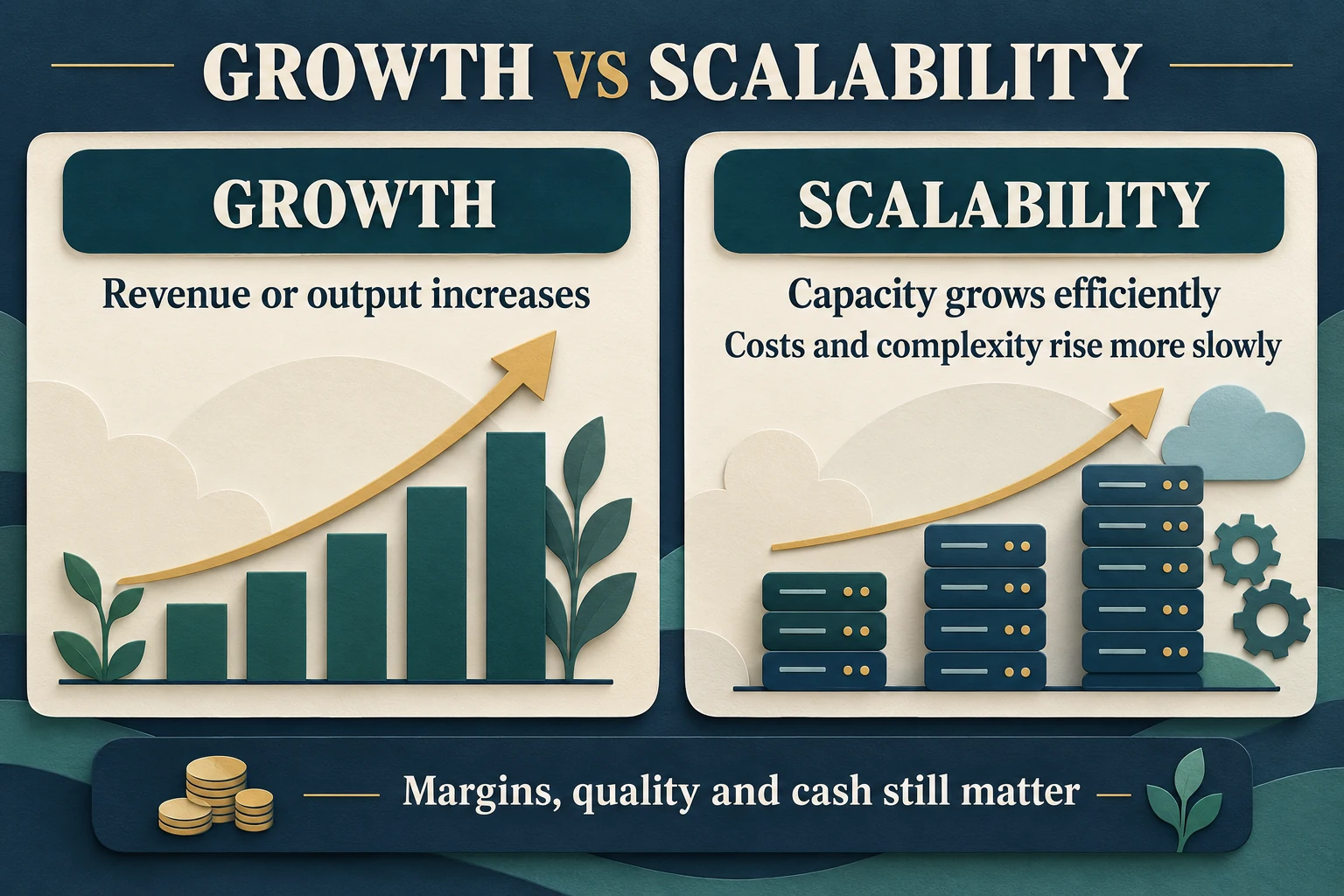
Growth describes an increase in revenue, customers, employees, assets, or market share. Scalability describes the relationship between that increase and the resources required to achieve it.
| Business result | Revenue change | Cost change | Interpretation |
|---|---|---|---|
| Proportional growth | 25% | 25% | Growth without operating leverage |
| Efficient scaling | 25% | 10% | Stronger margin potential |
| Labor-constrained growth | 25% | 35% | Negative scalability |
| Fixed-cost leverage | 25% | 5% | High incremental operating leverage |
A consulting firm that doubles revenue by doubling billable employees has grown, but its delivery model has limited scalability. A software company that increases annual recurring revenue by 50% while adding 15% to hosting and support costs has stronger scalability.
How Does a Scalable Business Model Work?
A scalable business model converts fixed investment into repeatable capacity, allowing additional sales to produce more contribution after the initial infrastructure is in place. The mechanism usually combines operating leverage, standardization, automation, distribution efficiency, and customer retention.
Suppose a company spends $500,000 building a platform and incurs $4 in variable cost per active customer. At 10,000 customers, platform cost contributes $50 per customer. At 100,000 customers, the same fixed investment contributes $5 per customer, although hosting, support, and compliance costs may rise.
Contribution margin reveals whether the mechanism is working:
Contribution margin = Revenue – Variable costs
Contribution margin percentage = Contribution margin ÷ Revenue × 100
Fixed costs do not automatically create scalability. A factory with expensive machinery may still have poor economics if materials, shipping, maintenance, and labor rise almost one-for-one with sales. Scalability depends on the entire cost structure and the capacity limits around it.
What Is Operating Leverage?
Operating leverage is the effect of fixed costs on profit when revenue changes. High fixed costs create more downside during weak demand, but they can expand profit faster when sales rise above the break-even point.
| Cost category | Example | Behavior as volume rises | Scalability implication |
|---|---|---|---|
| Fixed cost | Software platform, lease | Remains stable within capacity | Supports operating leverage |
| Variable cost | Payment processing, materials | Rises with each sale | Limits incremental margin |
| Step-fixed cost | Support team, warehouse | Jumps at capacity thresholds | Creates scaling cliffs |
| Semi-variable cost | Cloud hosting, delivery | Rises partly with volume | Requires capacity forecasting |
A company should model step-fixed costs rather than treating all expenses as fixed or variable. Adding a support team at 20,000 customers can make the next 10,000 customers profitable, while adding another warehouse can temporarily reduce cash flow even when long-term economics improve.
What Are the Main Types of Scalability?
The main types of business scalability are product, operational, financial, and demand scalability. A business needs enough strength in each relevant category because a failure in one layer can restrict the entire growth system.
Product Scalability
Product scalability means delivering a consistent customer outcome without redesigning the product for every buyer. Software, downloadable media, subscription content, standardized equipment, and productized services usually have stronger product scalability than bespoke work.
A consulting company can improve product scalability by replacing open-ended projects with a fixed diagnostic, defined deliverables, a standard onboarding process, and a repeatable reporting template. Customization may remain available, but it should be priced as an exception rather than embedded in every sale.
Operational Scalability
Operational scalability means that processes, people, systems, and facilities can handle higher volume without equivalent increases in effort or error rates. Useful components include documented procedures, role clarity, workflow automation, queue management, quality checks, and capacity thresholds.
Operational scalability is not synonymous with automation. A poorly designed process can be automated and still produce inaccurate invoices, weak customer experiences, or regulatory violations at greater speed.
Financial Scalability
Financial scalability means that the company can fund growth without creating an unsustainable cash deficit. Revenue growth can consume cash when inventory must be purchased before customer payment, annual contracts require implementation labor, or suppliers demand deposits.
Financial analysis should include gross margin, contribution margin, operating cash flow, working-capital requirements, customer acquisition payback, and debt obligations. Profitability alone is insufficient when rapid growth increases receivables and inventory faster than cash collections.
Demand Scalability
Demand scalability means that acquisition channels can reach additional qualified customers without customer acquisition cost rising beyond the unit-economics limit. A founder’s personal network may generate the first 100 customers but cannot necessarily support 10,000 customers.
| Scalability layer | Typical constraint | Useful control | Failure signal |
|---|---|---|---|
| Product | Custom work | Standard packages | Delivery redesign per customer |
| Operations | Capacity bottleneck | Workflow and staffing model | Backlog or error increase |
| Finance | Working capital | Cash forecast and payment terms | Revenue rises while cash falls |
| Demand | Channel saturation | Multiple acquisition channels | CAC rises faster than LTV |
How Do You Measure Business Scalability?
Measure business scalability by comparing incremental revenue, incremental cost, capacity, quality, and cash consumption at successive volume levels. No single metric proves scalability because a business can show attractive margins while suffering from weak retention, poor capacity, or unsustainable acquisition costs.
| Metric | Formula or measurement | Typical interpretation | Warning threshold |
|---|---|---|---|
| Contribution margin | Revenue minus variable cost | Economics of one additional sale | Below 30% for a high-support offer |
| LTV:CAC | Customer lifetime value ÷ acquisition cost | Acquisition efficiency | Below 3:1 is commonly constrained |
| CAC payback | CAC ÷ monthly gross profit | Time to recover acquisition spend | Above 12-18 months creates cash pressure |
| Revenue per employee | Revenue ÷ average employees | Labor productivity | Declining during volume growth |
| Defect or churn rate | Failed units or lost customers ÷ total | Quality and retention | Rising with customer volume |
| Capacity utilization | Actual output ÷ practical capacity | Remaining operating headroom | Above 80-85% leaves limited buffer |
The thresholds are decision aids, not universal laws. A venture-backed software company may accept a longer payback period than a bootstrapped agency, while a regulated medical provider may prioritize safety and compliance over maximum utilization.
A Practical Scalability Scorecard
Track each metric monthly and compare performance at different customer or order volumes. The strongest evidence comes from cohort data, because aggregate averages can hide worsening economics among newer customers.
A useful scorecard includes:
- Revenue growth compared with variable-cost growth.
- Gross margin and contribution margin by product or customer segment.
- New-customer CAC, retention, expansion revenue, and payback.
- Orders or cases processed per employee and per system.
- Support tickets per customer and median resolution time.
- Defect, refund, cancellation, and complaint rates.
- Cash runway under base, high-growth, and low-demand scenarios.
How Much Does It Cost to Scale a Business?
The cost of scaling depends on the business model, capacity bottleneck, sales channel, and working-capital cycle. Typical initial scale investments range from $5,000-$20,000 for a small productized service, $20,000-$100,000 for a modest e-commerce expansion, and $50,000-$250,000 or more for a software product requiring substantial development.
| Business model | Typical scale investment | Main cost driver | Common time horizon |
|---|---|---|---|
| Productized service | $5,000-$30,000 | Documentation, delivery staff, software | 3-12 months |
| Agency | $20,000-$100,000 | Hiring, sales, project systems | 6-18 months |
| E-commerce | $20,000-$150,000 | Inventory, logistics, marketing | 6-24 months |
| SaaS | $50,000-$500,000+ | Product, infrastructure, sales | 12-36 months |
| Marketplace | $100,000-$1,000,000+ | Two-sided acquisition and trust systems | 18-48 months |
These are planning ranges, not guarantees. A business with long payment terms may require more working capital than a business with lower setup costs and immediate customer payment.
A scaling budget should separate one-time investment from recurring cost. A new website is a one-time expense, while customer support, cloud hosting, payment fees, fulfillment, and additional management become recurring commitments.
Which Business Models Scale Best?
Software, digital products, standardized subscriptions, licensed intellectual property, and marketplaces often have stronger scalability than labor-intensive bespoke services. The best model depends on marginal cost, repeatability, distribution, retention, and the capital required to reach customers.
| Model | Typical gross-margin range | Marginal delivery cost | Main constraint | Geographic expansion |
|---|---|---|---|---|
| SaaS | 70%-90% | Low after infrastructure | Acquisition and support | Usually high |
| Digital course | 70%-95% | Very low | Demand and differentiation | High |
| Productized service | 40%-70% | Moderate labor | Specialist capacity | Moderate |
| E-commerce | 30%-60% | Inventory and fulfillment | Stock and shipping | Moderate |
| Custom agency | 30%-60% | High labor | Skilled employees | Moderate to low |
| Physical clinic | 20%-50% | High labor and premises | Licensed capacity | Low |
Gross-margin ranges vary by sector, accounting policy, returns, implementation work, and channel fees. A high gross margin does not guarantee a scalable business if sales, compliance, support, or retention costs are excessive.
Is a Service Business Scalable?
A service business can scale when it standardizes delivery, separates expertise from routine execution, and creates capacity that does not depend entirely on one expert. Productized services, recurring retainers, training programs, licensing, and software-enabled delivery can all improve service scalability.
Traditional bespoke services remain constrained when every project requires a unique scope, senior-level labor, and founder approval. The most practical transformation is often partial rather than total: retain premium custom work while moving repeatable tasks into templates, junior roles, automation, or self-service products.
A service business should not force software-like economics onto work that depends on judgment, trust, or regulated professional responsibility. The correct goal may be higher utilization, better pricing, and controlled capacity rather than unlimited volume.
Scalability Versus Economies of Scale: What Is the Difference?
Scalability is the ability to handle more volume efficiently; economies of scale are the lower average costs that may result from larger volume. A business can have one without the other, although scalable systems often create economies of scale.
| Concept | Primary question | Example | Main limitation |
|---|---|---|---|
| Scalability | Can volume rise without proportional resources? | Cloud software adds users | Infrastructure thresholds |
| Economies of scale | Does average cost fall as output rises? | Bulk manufacturing lowers unit cost | Volume may reduce flexibility |
| Scope economies | Can related products share resources? | One sales team sells four products | Coordination complexity |
| Operating leverage | How does profit respond to revenue? | Fixed platform cost spreads | Losses increase when demand falls |
A large manufacturer may achieve lower component prices through economies of scale but remain difficult to scale quickly because new factories require permits and construction. A digital product may scale rapidly while receiving limited additional supplier discounts.
How Do You Make a Small Business More Scalable?
Make a small business more scalable by identifying its binding constraint, standardizing repeatable work, automating low-judgment tasks, assigning decision rights, and validating unit economics before adding volume. The work should proceed in sequence because marketing cannot repair a delivery process that already fails at current demand.
Step 1: Audit the Current System
Map the customer journey from acquisition through renewal or repeat purchase. Record the time, owner, software, error rate, and handoff for every recurring activity.
Look for work that depends on one person, requires duplicate data entry, waits in an approval queue, or changes scope after the sale. Those points are usually more important than visible equipment or branding investments.
Step 2: Choose the Binding Constraint
Select the bottleneck that limits profitable volume. Common constraints include qualified leads, sales capacity, onboarding time, production throughput, cash, specialist labor, or customer support.
Do not optimize a nonbinding activity. Increasing advertising while implementation is backlogged creates more delay, refunds, and reputational damage.
Step 3: Standardize the Offer and Process
Define the customer segment, scope, inputs, outputs, price, delivery time, acceptance criteria, and exception policy. A written standard operating procedure should allow a trained employee to complete the normal workflow without asking the founder for routine decisions.
Step 4: Automate After Simplifying
Automate repetitive actions with tools such as HubSpot or Salesforce for customer relationship management, Stripe for billing, Zapier or Make for workflow connections, and an enterprise resource planning platform for inventory or finance when transaction complexity justifies it.
Automation should follow process simplification. Otherwise, the company encodes unnecessary approvals and inconsistent data into a faster system.
Step 5: Delegate With Controls
Transfer execution before transferring accountability. Use role-based access, approval limits, checklists, exception reporting, and weekly quality audits so delegation does not become invisible risk.
Outsource non-core work when an external provider offers specialized capability at lower total cost, but retain control over customer data, brand standards, compliance, and critical intellectual property.
Step 6: Stress-Test the Model
Model 2x and 10x volume scenarios. Include hiring delays, supplier price changes, service failures, refunds, late customer payments, infrastructure upgrades, and a 15%-25% demand shortfall.
The model is ready for the next growth step when contribution margin remains positive, service quality stays within target, and cash reserves cover the investment period.
What Are the Risks of Scaling Too Early?
Premature scaling occurs when a company expands marketing, hiring, infrastructure, or inventory before proving that customers retain, pay, and generate acceptable contribution margin. The result is often faster cash consumption rather than durable growth.
| Failure mode | Observable symptom | Likely cause | Corrective action |
|---|---|---|---|
| Premature hiring | Payroll rises before demand | Forecast based on ambition | Use contractors or staged hiring |
| Quality collapse | Refunds and complaints rise | Process lacks capacity | Add controls before volume |
| CAC inflation | Acquisition cost rises monthly | Narrow channel or weak conversion | Improve offer and diversify channels |
| Cash squeeze | Sales rise but bank balance falls | Inventory or receivables grow | Shorten terms and forecast cash |
| Founder bottleneck | Every decision awaits one person | No decision rights | Define thresholds and ownership |
| Tool sprawl | Employees duplicate records | Systems lack integration | Create one source of truth |
One useful practitioner rule is to scale the constraint, not the ambition. If onboarding takes five days and demand doubles, the first investment should reduce onboarding time or increase onboarding capacity, not necessarily double advertising.
A second rule is to protect quality at the point where customers experience it. Average response time, defect rate, renewal rate, and refund rate often reveal scaling damage earlier than monthly revenue.
How Can a Startup Scale Without Losing Quality?
A startup can scale without losing quality by defining measurable service standards, instrumenting the customer journey, separating normal cases from exceptions, and releasing capacity in controlled increments. Growth should occur in batches large enough to test economics but small enough to reverse mistakes.
Set explicit thresholds for response time, uptime, delivery accuracy, defect rate, refund rate, and customer retention. Assign an owner to each metric and establish the action required when performance crosses its limit.
For software, capacity planning should include database load, API limits, security monitoring, incident response, and support volume. For physical products, it should include supplier lead time, defect sampling, warehouse accuracy, returns, and transportation variability.
Quality is part of scalability economics. A 10% increase in sales that creates a 30% increase in refunds can reduce contribution margin even when acquisition metrics initially look attractive.
What Are the Advantages and Limits of High Scalability?
High scalability can increase margins, geographic reach, enterprise value, and strategic flexibility, but it also increases exposure to upfront investment, competition, infrastructure failure, and demand uncertainty. Low-scalability models can produce faster cash flow and stronger customization, even when their long-term revenue ceiling is lower.
| Attribute | Highly scalable model | Less scalable model |
|---|---|---|
| Revenue ceiling | Potentially high | Usually tied to labor or locations |
| Initial investment | Often $50,000-$500,000+ | Often $5,000-$50,000 |
| Marginal cost | Low or moderate | Moderate or high |
| Cash-flow speed | May take 12-36 months | Can begin within weeks |
| Customization | Limited or priced separately | Usually high |
| Main risk | Large upfront loss | Capacity and owner dependence |
Scalability is not automatically desirable. A profitable specialist firm may rationally preserve scarcity, control quality, and serve a narrow market. Scaling can weaken the customer relationship, reduce craft quality, or create compliance risk when the operating model cannot support volume.
What Should Different Businesses Prioritize?
Solo entrepreneurs should usually standardize their offer and remove routine founder work before investing heavily in paid acquisition. Mid-sized companies should focus on management layers, integrated systems, decision rights, and cross-functional capacity. Venture-backed startups should prioritize retention, contribution margin, and payback rather than revenue growth alone.
| Business situation | First priority | Metric to protect | Avoid |
|---|---|---|---|
| Solo consultant | Productized service | Delivery hours per client | Unlimited customization |
| Small agency | Scope and staffing model | Gross margin per project | Hiring ahead of bookings |
| Mid-market firm | Process ownership and ERP | Order cycle time | Founder approvals |
| SaaS startup | Retention and payback | Net revenue retention | Unprofitable acquisition |
| E-commerce brand | Inventory and cash cycle | Stockout and return rate | Buying excessive stock |
What Is a 90-Day Scalability Plan?
A practical 90-day scalability plan begins with measurement, then fixes the largest constraint, and finally tests additional volume under controlled financial and quality thresholds. The plan should produce evidence, not merely more activity.
| Period | Main action | Deliverable | Decision gate |
|---|---|---|---|
| Days 1-30 | Audit customers, costs, and workflows | Bottleneck map and baseline metrics | Select one constraint |
| Days 31-60 | Standardize and automate | SOPs, ownership, and workflow changes | Test at 1.25x volume |
| Days 61-90 | Stress-test demand and capacity | Scenario model and quality report | Approve, revise, or pause expansion |
During the first month, calculate contribution margin by offer and customer segment. During the second month, remove duplicate steps and document exception handling. During the third month, increase volume gradually while tracking cash, service levels, retention, and employee workload.
The plan should end with a clear decision. Continue scaling when economics and quality hold; redesign the constraint when either deteriorates; pause expansion when the business cannot fund or control the next volume level.
Frequently Asked Questions
Is scalability the same as profitability?
No. Profitability means revenue exceeds total costs during a period, while scalability describes how costs behave when volume increases. A profitable consultancy may have limited scalability because each new client requires equivalent expert labor. A software company may be scalable but unprofitable while it funds product development and customer acquisition.
What is a scalable product?
A scalable product delivers a consistent outcome to additional customers without requiring proportional redesign, labor, or physical resources. Software subscriptions, digital downloads, standardized equipment, and structured training programs can be scalable. A product remains constrained when every customer requires unique engineering, manual implementation, or dedicated support.
Can a brick-and-mortar business scale?
Yes, but physical businesses usually scale through repeatable locations, standardized operating procedures, purchasing power, franchising, technology, and management systems. Restaurants, clinics, and retail stores remain constrained by premises, staff, permits, inventory, and local demand, so their expansion typically requires more capital than digital distribution.
What is negative scalability?
Negative scalability occurs when additional volume increases costs, errors, customer support, or management complexity faster than revenue. Examples include a marketplace with rising fraud, an agency that adds low-margin clients, or an e-commerce brand that expands orders while returns and expedited shipping consume the gross margin.
What is the best first scalability metric?
Contribution margin per incremental customer or order is usually the best first metric because it shows whether additional volume creates economic value before fixed overhead. Pair that metric with retention, capacity utilization, customer acquisition payback, and cash conversion to avoid mistaking low-quality revenue for scalable growth.
When should a business stop scaling?
A business should pause scaling when retention falls, contribution margin turns negative, service quality breaches its target, cash runway becomes unsafe, or the next capacity investment cannot be funded. A pause is not necessarily failure. It can protect the operating model while the company fixes its bottleneck.
The Bottom Line
Scalability meaning in business is the capacity to increase revenue or output while controlling the proportional growth of cost, labor, complexity, and risk. The strongest scalable businesses combine repeatable products, efficient operations, defensible demand channels, healthy unit economics, and sufficient cash. Measure those conditions at each volume threshold before committing to faster growth.