
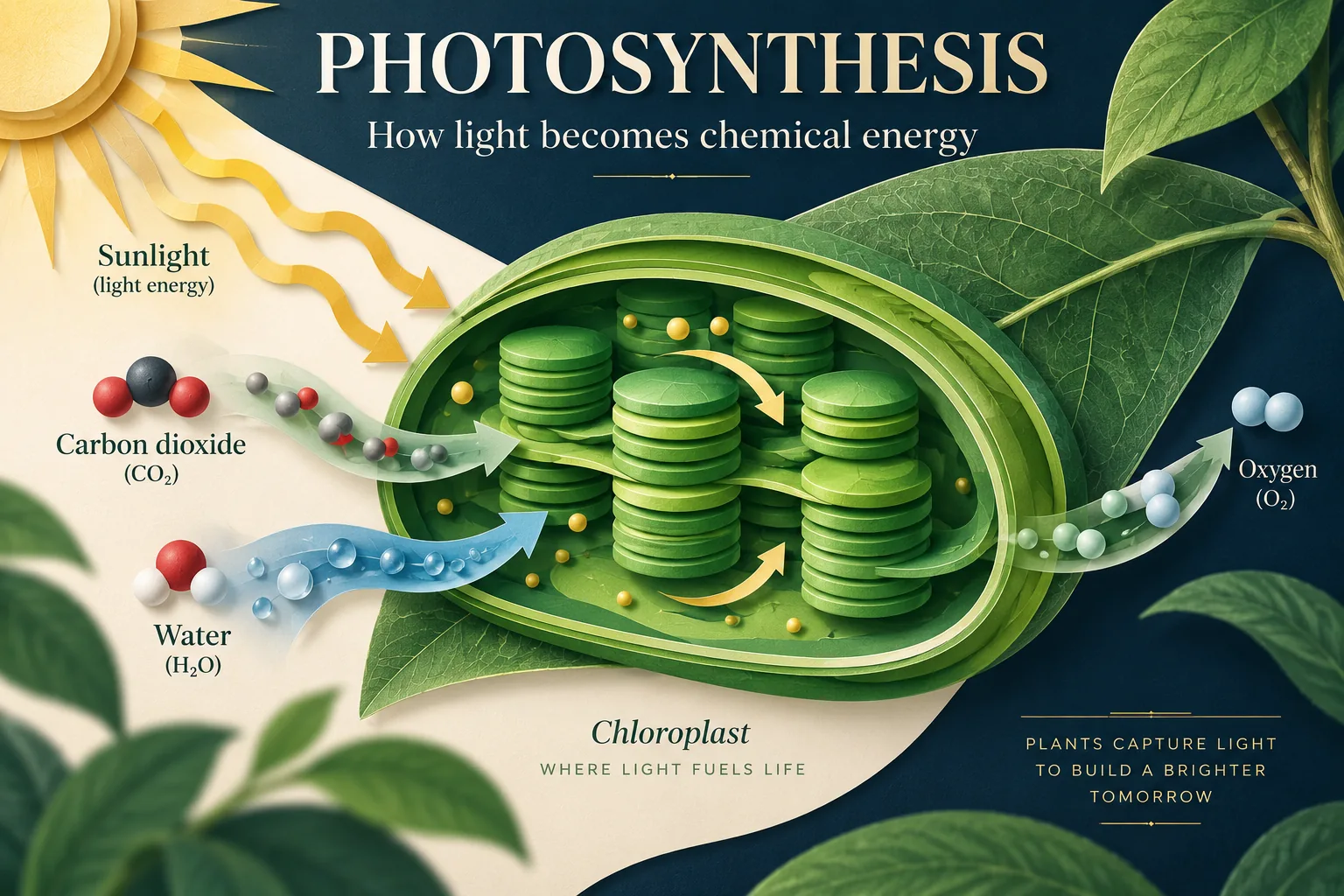
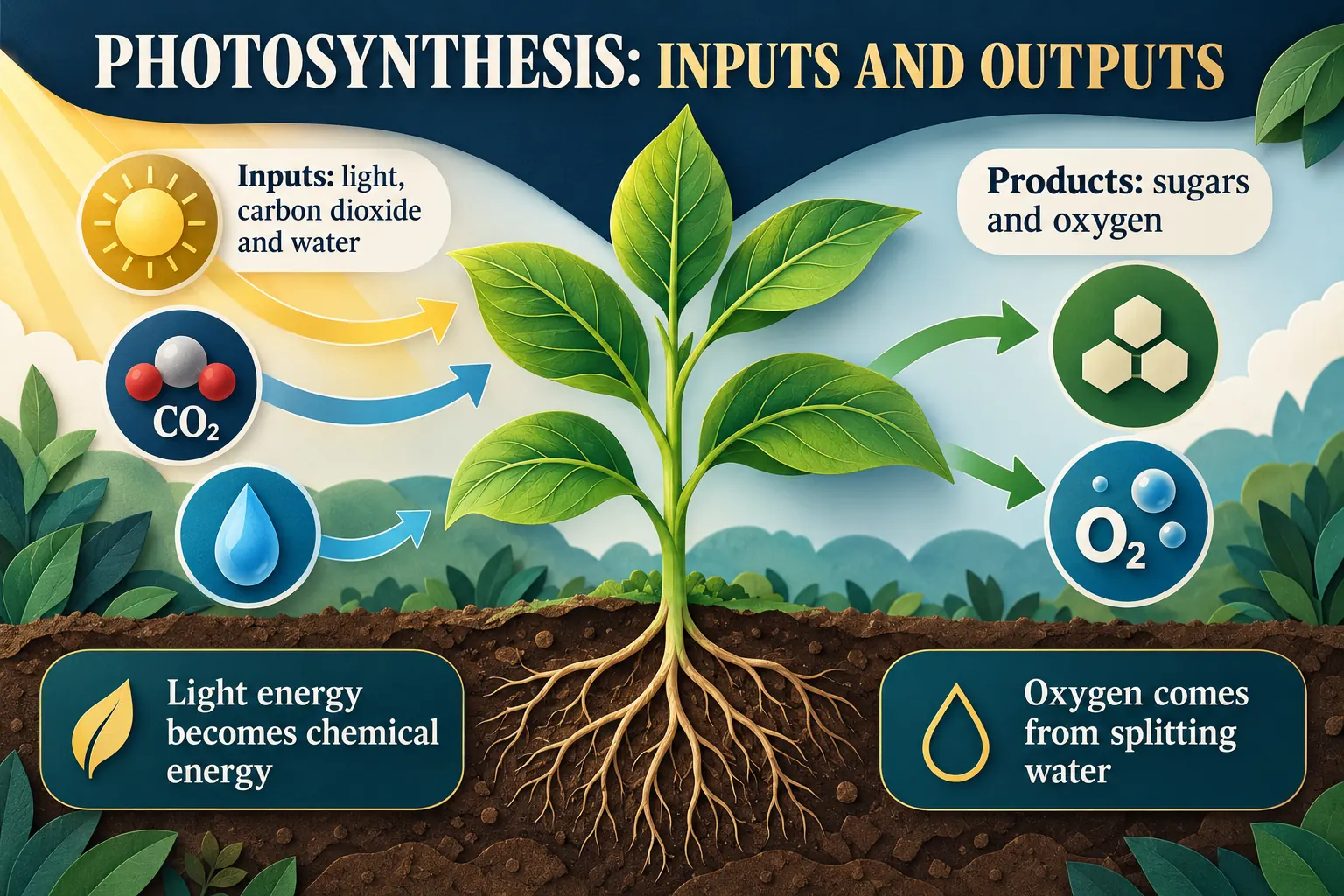
Photosynthesis is the biochemical process in which plants, algae, and some bacteria convert light energy into chemical energy by using carbon dioxide and water to make organic molecules. Oxygenic photosynthesis releases oxygen when water is split, while the resulting ATP and NADPH power carbon fixation and sugar production.
Photosynthesis at a Glance
- Photosynthesis stores radiant light energy in chemical bonds, mainly in carbohydrates.
- Oxygenic photosynthesis uses water as an electron source and releases molecular oxygen.
- Chloroplasts contain the thylakoid membranes and stroma where plant photosynthesis occurs.
- Light reactions produce ATP and NADPH; the Calvin cycle uses both compounds to assimilate carbon dioxide.
- C3, C4, and CAM pathways differ mainly in carbon fixation, water conservation, and photorespiration control.
- Photosynthesis supplies most food-web energy and removes approximately 100-115 petagrams of carbon from the atmosphere each year, depending on the estimate and accounting method.
What Does Photosynthesis Mean in Science?
Photosynthesis means the light-driven biological conversion of inorganic materials into energy-rich organic compounds. In plants, algae, and cyanobacteria, the process captures photons, moves electrons through membrane proteins, produces ATP and NADPH, and uses those products to incorporate carbon dioxide into molecules such as G3P, sucrose, starch, and cellulose.
The word combines “photo,” meaning light, with “synthesis,” meaning construction. The scientific process is more specific than simply “plants making food.” Photosynthesis creates chemical energy that cells can use later, even when light is unavailable.
Photosynthesis also changes planetary chemistry. Oxygenic photosynthesis introduced oxygen into Earth’s atmosphere over geological time, while modern photosynthetic organisms continue to influence atmospheric carbon dioxide, oxygen, climate, agriculture, and aquatic food webs.
What Is the Photosynthesis Equation?
The simplified net equation is:
[ 6CO_2 + 6H_2O + light\ energy \rightarrow C_6H_{12}O_6 + 6O_2 ]
The equation states that six carbon dioxide molecules and six water molecules can produce one glucose-equivalent molecule and six oxygen molecules when light energy drives the reactions. The equation is a summary of net inputs and outputs, not a literal single-step reaction.
Plants first produce G3P, a three-carbon sugar. Enzymatic pathways then use G3P to form glucose equivalents, sucrose for transport, starch for storage, cellulose for cell walls, and other carbon compounds.
Where Does Photosynthesis Occur?
Plant and algal photosynthesis occurs mainly in chloroplasts, while cyanobacterial photosynthesis occurs on internal thylakoid membranes within the cell. Chloroplasts contain chlorophyll, electron-transfer proteins, ATP synthase, and carbon-fixing enzymes.
| Organism | Photosynthetic location | Main light-absorbing pigment | Oxygen produced? |
|---|---|---|---|
| Leaf mesophyll cell | Chloroplast thylakoid membrane | Chlorophyll a and b | Yes |
| Green alga | Chloroplast thylakoid membrane | Chlorophyll a and accessory pigments | Yes |
| Cyanobacterium | Internal thylakoid membrane | Chlorophyll a and phycobilins | Yes |
| Purple sulfur bacterium | Cell membrane or internal membrane | Bacteriochlorophyll | No |
| Green sulfur bacterium | Specialized internal membrane | Bacteriochlorophyll | No |
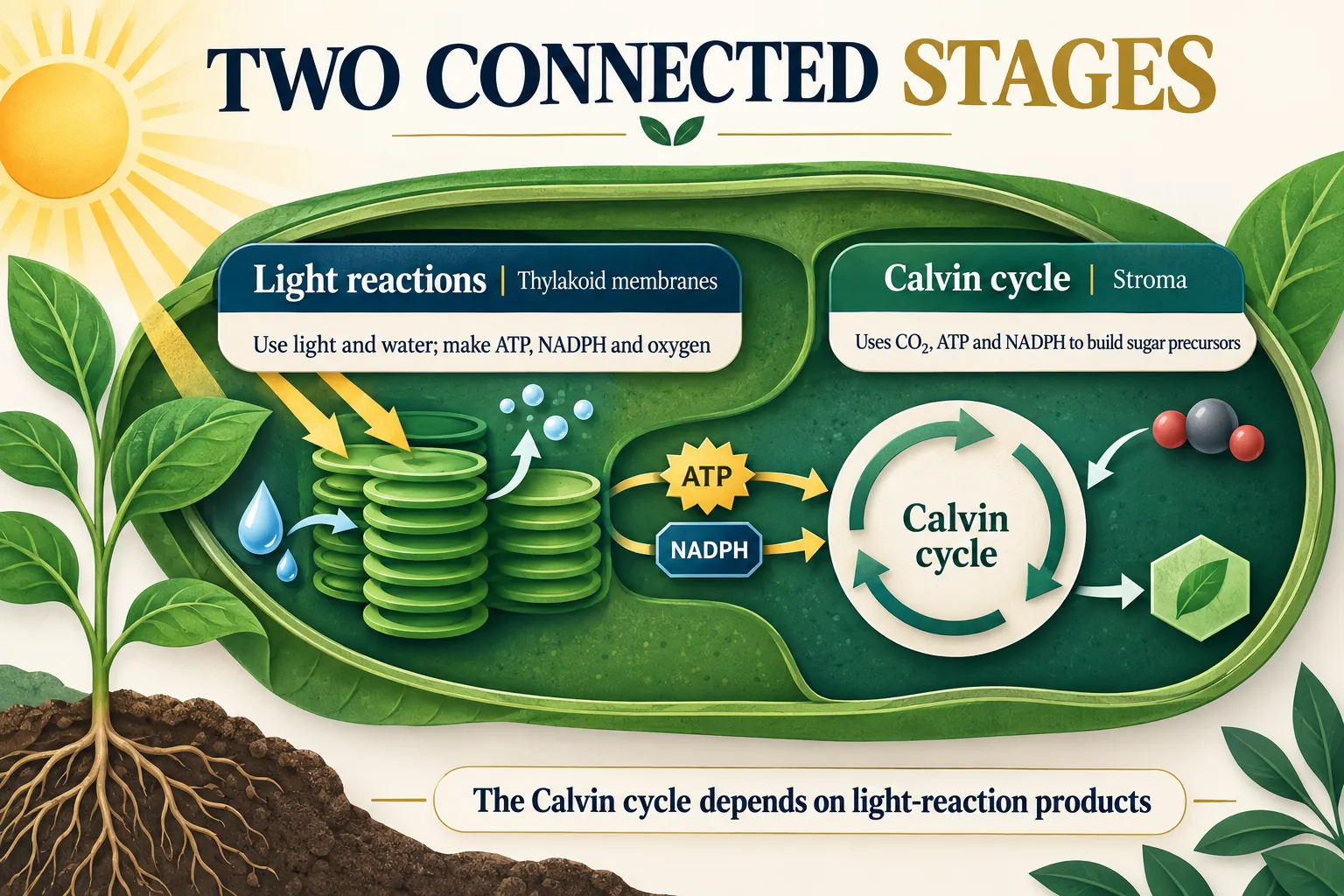
In a chloroplast, the light reactions occur in thylakoid membranes. The Calvin cycle takes place in the surrounding fluid, called the stroma.
How Do the Two Stages of Photosynthesis Work?
Photosynthesis has two linked stages: light-dependent reactions and carbon-fixation reactions. Light-dependent reactions convert photon energy into ATP and NADPH in thylakoid membranes, while the Calvin cycle uses ATP and NADPH in the stroma to convert carbon dioxide into G3P.
The stages are physically separate but chemically dependent. Carbon fixation can continue briefly without direct light if stored ATP and NADPH remain available, but it cannot continue indefinitely in darkness.
What Happens During the Light-Dependent Reactions?
The light-dependent reactions use chlorophyll, water, electron carriers, and two photosystems to produce ATP, NADPH, and oxygen. The sequence begins when photons excite chlorophyll electrons and ends when electrons reduce NADP+ to NADPH.
- Photosystem II absorbs light. Chlorophyll transfers energized electrons to an electron carrier.
- Water is split. The oxygen-evolving complex replaces lost electrons using water: [ 2H_2O \rightarrow 4H^+ + 4e^- + O_2 ]
- Electrons move through carriers. Electron transport releases energy that pumps protons into the thylakoid lumen.
- ATP synthase uses the gradient. Protons flow back into the stroma through ATP synthase, which phosphorylates ADP to ATP.
- Photosystem I absorbs additional light. Electrons receive another energy boost.
- NADPH is formed. Ferredoxin and NADP+ reductase transfer electrons and hydrogen to NADP+, producing NADPH.
The released oxygen comes from water, not from carbon dioxide. Oxygen-isotope experiments using labeled water demonstrated this source by tracing the isotope into molecular oxygen.
Photon absorption and initial electron excitation occur on approximately femtosecond timescales. Electron transfer through reaction centers occurs rapidly, while complete carbon assimilation and sugar allocation take longer and vary with temperature, light, species, and metabolic demand.
What Happens During the Calvin Cycle?
The Calvin cycle uses ATP and NADPH to fix carbon dioxide into G3P, a three-carbon carbohydrate. The cycle has three functional phases: carbon fixation, reduction, and regeneration of the carbon acceptor RuBP.
| Calvin cycle phase | Main reactant | Main product | Energy input |
|---|---|---|---|
| Carbon fixation | CO2 and RuBP | 3-PGA | None directly |
| Reduction | 3-PGA | G3P | ATP and NADPH |
| Sugar release | G3P | Carbohydrate precursor | Previously supplied ATP and NADPH |
| RuBP regeneration | Remaining G3P | RuBP | ATP |
RuBisCO attaches carbon dioxide to ribulose-1,5-bisphosphate, or RuBP. The unstable six-carbon intermediate splits into two molecules of 3-phosphoglycerate, known as 3-PGA.
ATP supplies chemical energy, and NADPH supplies reducing power. After several cycle turns, some G3P leaves the cycle for carbohydrate synthesis, while the remaining molecules regenerate RuBP.
A common classroom simplification says six turns produce one glucose molecule. More precisely, six carbon dioxide molecules must be fixed to yield the net carbon required for one six-carbon glucose equivalent, while the cycle continuously regenerates its carbon acceptor.
How Do Plants Turn Photosynthetic Products Into Food?
Photosynthetic carbon becomes transport sugar, storage carbohydrate, structural material, or respiratory fuel. G3P can enter pathways that produce sucrose in leaves, starch in chloroplasts, cellulose in cell walls, lipids in seeds, and amino acids after combination with nitrogen compounds.
Sucrose travels through phloem from source tissues, such as mature leaves, to sink tissues, such as roots, fruits, seeds, and growing shoots. Starch accumulates when production exceeds immediate export or respiration.
Photosynthesis does not provide energy only to the plant that performs it. Herbivores obtain chemical energy by eating plant tissue, and predators obtain it through food-web transfer. Decomposers eventually return carbon to soil and atmosphere through respiration and decay.
What Are the Main Photosynthetic Pathways?
C3, C4, and CAM photosynthesis are carbon-fixation strategies adapted to different combinations of temperature, light, water availability, and atmospheric carbon dioxide. C3 plants use the Calvin cycle directly, C4 plants concentrate carbon dioxide around RuBisCO, and CAM plants separate carbon capture from carbon fixation by time.
| Pathway | First stable product | Stomatal pattern | Typical advantage | Representative plants |
|---|---|---|---|---|
| C3 | 3-PGA, a three-carbon compound | Mostly open during daylight | Lower ATP cost in cool, moist conditions | Wheat, rice, soybean, oak |
| C4 | Oxaloacetate, a four-carbon compound | Open during daylight with strong regulation | Lower photorespiration in heat and bright light | Maize, sugarcane, sorghum |
| CAM | Organic acids stored overnight | Open mainly at night | Strong water conservation | Cactus, pineapple, agave |
How Does C3 Photosynthesis Work?
C3 photosynthesis fixes carbon dioxide directly through RuBisCO in mesophyll cells. The pathway uses less extra ATP than C4 photosynthesis, so C3 plants can perform efficiently when temperatures are moderate, water is available, and oxygen does not strongly compete with carbon dioxide.
Most trees and many temperate crops use C3 photosynthesis. Wheat, rice, oats, beans, and soybean are important examples.
C3 plants become less efficient under hot, dry conditions. Stomatal closure reduces carbon dioxide entry while oxygen concentration rises inside leaves, increasing RuBisCO’s oxygenation reaction and photorespiration.
How Does C4 Photosynthesis Reduce Photorespiration?
C4 photosynthesis first fixes carbon dioxide into a four-carbon compound in mesophyll cells, then transports that compound into bundle-sheath cells, where carbon dioxide is released near RuBisCO. This concentration mechanism improves carbon fixation in hot, bright environments.
C4 plants spend extra ATP to operate the carbon-concentrating pump. That cost is worthwhile when high temperature and drought would otherwise cause substantial photorespiration.
| C4 feature | Typical consequence |
|---|---|
| Mesophyll carbon capture | Initial carbon dioxide concentration |
| Bundle-sheath decarboxylation | High local carbon dioxide near RuBisCO |
| Kranz anatomy in many species | Distinct mesophyll and bundle-sheath arrangement |
| Extra ATP demand | Greater energy cost per fixed carbon molecule |
| Reduced photorespiration | Higher productivity during heat and strong light |
Maize, sugarcane, sorghum, and many warm-season grasses use C4 photosynthesis. C4 plants are not automatically superior because C3 plants can outperform them in cool environments or under low light.
How Does CAM Photosynthesis Conserve Water?
CAM photosynthesis opens stomata at night, when evaporation is lower, and stores captured carbon dioxide as organic acids. During the day, stomata remain mostly closed while stored acids release carbon dioxide for the Calvin cycle.
CAM provides exceptional water conservation but limits carbon uptake to the amount that can be captured and stored overnight. Many CAM plants therefore grow more slowly than well-watered C3 or C4 plants.
Pineapple, agave, jade plant, and cacti provide familiar examples. CAM is especially useful in deserts, saline habitats, and epiphytic environments where water arrives unpredictably.
How Does Photosynthesis Compare With Anoxygenic Photosynthesis?
Oxygenic photosynthesis uses water as an electron donor and releases oxygen, whereas anoxygenic photosynthesis uses substances such as hydrogen sulfide, hydrogen, or ferrous iron and does not release oxygen. Anoxygenic pathways occur in specialized bacteria living in low-oxygen environments.
| Feature | Oxygenic photosynthesis | Anoxygenic photosynthesis |
|---|---|---|
| Typical organisms | Plants, algae, cyanobacteria | Purple bacteria, green sulfur bacteria |
| Electron donor | Water | Hydrogen sulfide, hydrogen, or iron |
| Oxygen output | Molecular oxygen produced | No molecular oxygen produced |
| Photosystem arrangement | Usually two photosystems | Usually one reaction center |
| Habitat example | Sunlit terrestrial or aquatic surfaces | Sulfur-rich, oxygen-poor water layers |
Anoxygenic photosynthesis demonstrates that light-driven carbon metabolism does not require water or oxygen release. Oxygenic photosynthesis is more ecologically transformative because water is abundant and oxygen accumulates as a byproduct.
What Factors Limit the Rate of Photosynthesis?
Photosynthesis is limited by the scarcest required resource, but the limiting factor changes with time and conditions. Light intensity, carbon dioxide concentration, temperature, water status, leaf nutrients, and leaf age can each control the observed rate.
| Limiting factor | Low-level effect | Excess-level effect | Practical response |
|---|---|---|---|
| Light intensity | Insufficient ATP and NADPH production | Photoinhibition and heat stress | Adjust light distance or shading |
| Carbon dioxide | Reduced carbon fixation | Stomatal and nutrient constraints | Improve ventilation or controlled enrichment |
| Temperature | Slower enzyme activity | Protein stress and higher photorespiration | Maintain species-appropriate range |
| Water availability | Stomatal closure | Root or tissue damage when excessive | Irrigate according to substrate and species |
| Nitrogen | Less chlorophyll and RuBisCO | Salinity or nutrient imbalance | Test substrate before fertilizing |
| Leaf age | Low pigment and enzyme capacity | Senescence and nutrient remobilization | Maintain healthy canopy turnover |
The law of the minimum is useful but incomplete. Increasing one resource cannot overcome a different severe constraint, and several moderate stresses can interact more strongly than one isolated stress.
Why Does RuBisCO Cause Photorespiration?
RuBisCO causes photorespiration because it can bind oxygen instead of carbon dioxide, especially when leaf temperature rises or stomata close during drought. The oxygenation reaction creates a compound that must be recycled through chloroplasts, peroxisomes, and mitochondria, consuming energy and releasing previously fixed carbon.
Photorespiration is not simply useless waste. The pathway protects cells from harmful metabolic imbalances and recovers part of the carbon skeleton, but it reduces net carbon gain.
C4 plants suppress photorespiration by concentrating carbon dioxide around RuBisCO. Genetic engineering projects have investigated faster RuBisCO variants and photorespiration bypasses, but field performance depends on water, nutrients, temperature, development, and ecological interactions.
What Is Photoinhibition?
Photoinhibition is the decline in photosynthetic capacity caused by light exposure that exceeds a leaf’s ability to use or dissipate absorbed energy. Photosystem II, particularly its D1 reaction-center protein, is frequently damaged and must be repaired.
Photoinhibition can occur under intense sunlight, cold conditions, drought, or combinations of stress. A plant may protect itself through non-photochemical quenching, leaf movement, pigment changes, antioxidant systems, and D1 repair.
More light is therefore not always better. At low intensity, light limits photosynthesis; at moderate intensity, the rate rises; near saturation, additional light produces little gain; beyond the stress threshold, performance falls.
How Efficient Is Photosynthesis?
Typical whole-crop solar-to-biomass efficiency is approximately 1-2% under field conditions, while theoretical values for idealized systems can be several percent higher. Efficiency varies with wavelength, canopy architecture, respiration, temperature, water supply, nutrient status, harvestable tissue, and measurement method.
| Efficiency or carbon metric | Typical value or range | What the metric means |
|---|---|---|
| Field crop solar conversion | 1-2% | Stored biomass energy divided by incident solar energy |
| C4 theoretical biological ceiling | Approximately 4.5-6% | Modelled upper range under ideal assumptions |
| Annual global carbon fixation | Approximately 100-115 Pg carbon | Broad estimate of photosynthetic carbon assimilation |
| Photon excitation | About 10^-15 seconds | Initial light absorption event |
| Light-reaction sequence | Microseconds to milliseconds | Electron transfer and proton-gradient formation |
These figures should not be treated as universal constants. Gross primary production measures total carbon fixation, whereas net primary production subtracts plant respiration. Ocean coverage, seasonal vegetation, and accounting methods also change global estimates.
Energy is lost through reflected light, wavelengths that pigments do not absorb efficiently, heat dissipation, respiration, photorespiration, maintenance, and tissues that do not become harvestable biomass.
How Is Photosynthesis Measured?
Scientists measure photosynthesis mainly with gas exchange, chlorophyll fluorescence, isotope tracing, and biomass accumulation. Gas-exchange instruments quantify carbon dioxide uptake and water-vapor loss, while fluorescence reveals how efficiently photosystem II uses absorbed light.
| Method | Primary measurement | Typical equipment cost | Best use |
|---|---|---|---|
| Infrared gas exchange | CO2 uptake and transpiration | $30,000-$65,000 | Leaf-level photosynthetic rate |
| Chlorophyll fluorescence | Photosystem II performance | $2,000-$25,000 | Stress and photoinhibition screening |
| Carbon isotope tracing | Carbon movement and source | $1,000-$10,000 per analysis series | Pathway and allocation studies |
| Biomass harvest | Net growth over time | $100-$2,000 for basic setup | Crop or experiment outcome |
| Oxygen electrode | Oxygen evolution | $3,000-$15,000 | Aquatic or isolated-tissue studies |
Costs are typical research-market ranges and vary by manufacturer, chamber type, software, calibration requirements, and used-equipment availability. A gas-exchange measurement provides a rate under a defined chamber condition; it does not automatically predict field yield.
How Should Weak Photosynthesis Be Diagnosed?
Weak photosynthesis should be diagnosed by checking the environment before adding fertilizer or increasing light. Measure substrate moisture, leaf temperature, light at canopy level, carbon dioxide availability, root health, and signs of pests or disease.
| Visible or measured symptom | Likely mechanism | First diagnostic check | Common correction |
|---|---|---|---|
| Pale new leaves | Iron or nitrogen limitation | Substrate pH and tissue pattern | Correct pH or nutrient imbalance |
| Brown leaf margins | Salt stress or water deficit | Substrate electrical conductivity | Flush salts or adjust irrigation |
| Bleached patches after relocation | Photoinhibition or sunburn | Recent light change | Acclimate gradually and shade temporarily |
| Slow growth in wet soil | Root oxygen shortage | Drainage and root condition | Reduce saturation and improve aeration |
| Midday wilt with moist soil | Heat load or root damage | Root temperature and roots | Reduce heat and inspect roots |
| High humidity with poor gas exchange | Low vapor-pressure deficit or disease risk | Air movement and leaf wetness | Improve ventilation and spacing |
A practitioner rule is to change one major variable at a time. Simultaneously increasing water, fertilizer, light, and carbon dioxide makes the result impossible to interpret and can create several new stresses.
Can Greenhouses Increase Photosynthesis With Carbon Dioxide?
Controlled carbon dioxide enrichment can increase photosynthesis in many greenhouse crops when light, temperature, water, and nutrients are adequate. Typical enrichment targets range from approximately 800-1,200 parts per million during active daylight, compared with outdoor air near 420 parts per million in recent conditions.
Carbon dioxide enrichment is not a universal yield switch. The benefit declines when light is weak, roots are restricted, temperature is unsuitable, or nutrients limit new biomass.
| Greenhouse condition | Typical target or constraint | Consequence |
|---|---|---|
| Outdoor CO2 baseline | About 420 ppm | Variable by location and ventilation |
| Enriched daytime range | 800-1,200 ppm | Often increases carbon assimilation |
| Sealed-house monitoring | Continuous sensor feedback | Prevents excessive concentration |
| Low-light winter crop | Reduced enrichment response | Light limits carbohydrate production |
| Poor ventilation | CO2 accumulation and humidity | Can increase management risk |
Carbon dioxide should be managed as part of a complete crop system. Enrichment cannot replace adequate photons, root oxygen, water control, or balanced nutrition.
Why Is Photosynthesis Important to Earth?
Photosynthesis supports nearly every major food web by converting external energy into biomass. It also supplies atmospheric oxygen, removes carbon dioxide temporarily or permanently into biomass and sediments, and provides raw materials for food, fiber, timber, fuel, and medicines.
The ecological effects operate at several scales:
- Cellular scale: ATP and carbohydrates support growth, repair, and reproduction.
- Organism scale: Plants allocate carbon to roots, leaves, flowers, seeds, and storage tissues.
- Ecosystem scale: Primary production determines how much energy is available to consumers.
- Planetary scale: Photosynthetic carbon exchange influences atmospheric composition and climate.
Photosynthesis does not permanently remove all captured carbon. Respiration, decomposition, combustion, and land-use change return much of it to the atmosphere, while a smaller fraction enters long-lived wood, soil organic matter, sediments, or fossil deposits.
Frequently Asked Questions
Can Plants Photosynthesize at Night?
Plants cannot use ordinary sunlight at night, so light-dependent reactions stop when photons are unavailable. Some carbon-fixation enzymes may remain active briefly using stored ATP and NADPH, and CAM plants open their stomata at night to capture carbon dioxide, but CAM carbon fixation is completed mainly during daylight.
Is Photosynthesis the Same as Cellular Respiration?
Photosynthesis and cellular respiration are complementary but chemically different processes. Photosynthesis stores energy by producing organic carbon, while cellular respiration breaks organic molecules down to produce ATP. Plant cells perform respiration day and night, including during daylight when photosynthesis is also active.
Why Are Leaves Usually Green?
Leaves appear green because chlorophyll absorbs red and blue wavelengths more strongly than green wavelengths. Reflected and transmitted green light reaches the observer. Accessory pigments, including carotenoids and anthocyanins, modify leaf color and protect photosynthetic tissues from excess light.
Do Plants Get Their Food From Soil?
Plants obtain mineral nutrients and water from soil, but most of the dry carbon in plant biomass comes from atmospheric carbon dioxide. Photosynthesis converts carbon dioxide into organic molecules, while roots supply nitrogen, phosphorus, potassium, sulfur, and other minerals needed to build and regulate those molecules.
Why Does Photosynthesis Slow During Drought?
Drought causes stomata to close, reducing water loss but also restricting carbon dioxide entry into leaves. Higher leaf temperature and internal oxygen concentration can then increase photorespiration, while severe water stress damages membranes, enzymes, roots, and transport systems.
What Is the Main Difference Between Photosynthesis and Chemosynthesis?
Photosynthesis uses light energy to drive carbon fixation, whereas chemosynthesis uses energy released by inorganic chemical reactions. Nitrifying, sulfur-oxidizing, and hydrogen-oxidizing microorganisms can build organic matter without sunlight, making chemosynthesis important in deep-sea vents, sediments, and dark subsurface habitats.
The Bottom Line
Photosynthesis meaning in science is the light-powered conversion of carbon dioxide and water into energy-rich organic compounds, with oxygen released by oxygenic organisms. Light reactions produce ATP and NADPH, the Calvin cycle fixes carbon into G3P, and C3, C4, CAM, and anoxygenic pathways adapt the process to different environments. Understanding the equation requires understanding its limits: photosynthesis is a linked network of electron transfer, carbon metabolism, water regulation, and ecological exchange.