
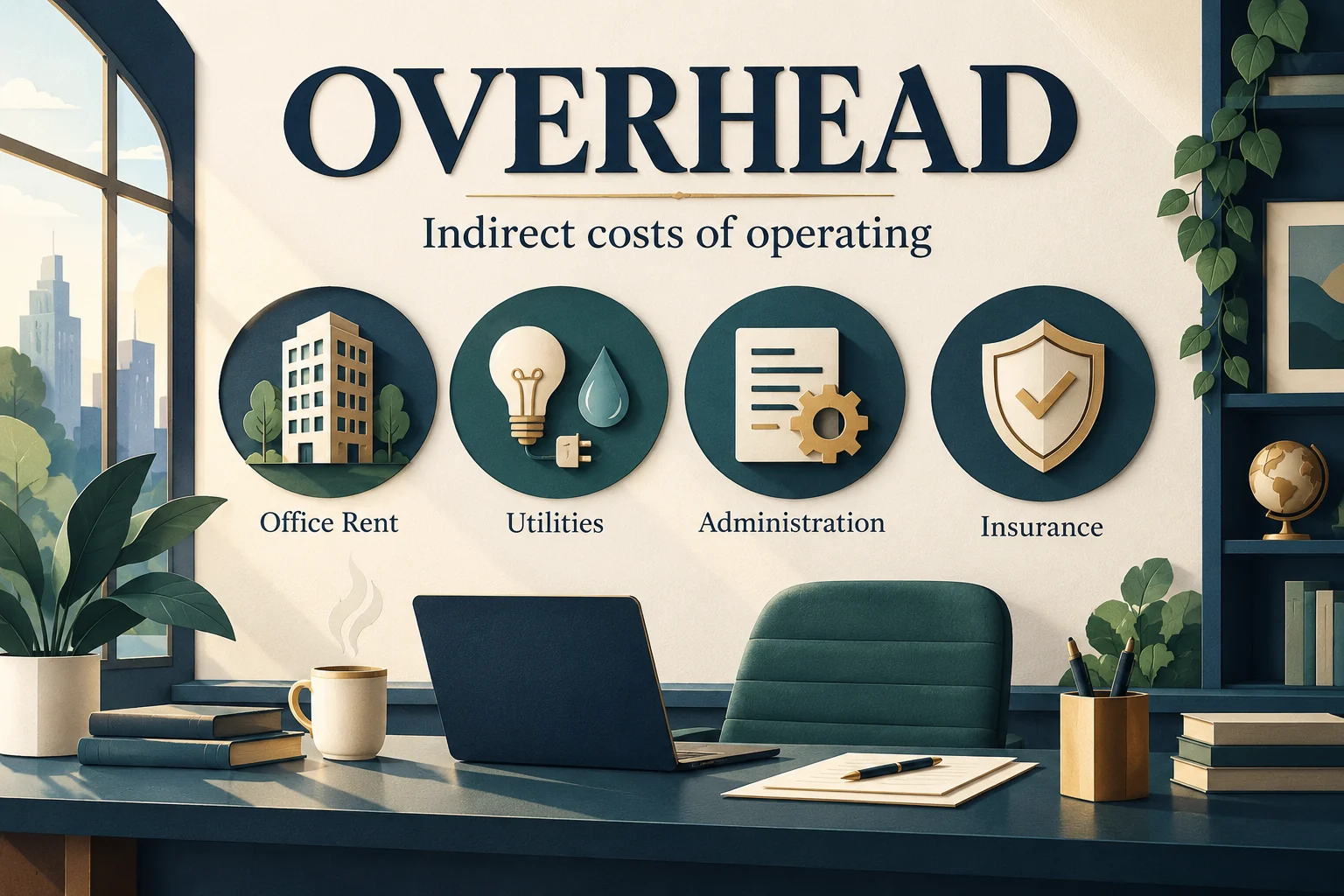
Overhead in business means the indirect, ongoing costs required to operate but not traceable economically to one specific product, project, or service. Rent, accounting, insurance, office software, and administrative salaries are common overhead costs, while product materials and job-specific labor are usually direct costs.
Key Facts at a Glance
Business overhead supports operations without becoming an identifiable part of one sale.
Overhead can be fixed, variable, or semi-variable according to how it changes with activity.
The overhead rate equals an overhead cost pool divided by a selected base such as revenue, labor hours, or machine hours.
A high overhead rate does not automatically mean poor management because hospitals, manufacturers, and software firms have different cost structures.
Product pricing should recover direct costs, allocated overhead, and the required profit margin.
Overhead allocation supports internal decisions, but allocation alone does not create cash or guarantee that a price is competitive.
What Is the Meaning of Overhead in Business?
Overhead is the portion of operating cost that cannot be assigned conveniently and economically to one specific output. A bakery can trace flour to a batch and a baker’s production time to that batch, but the store lease, liability insurance, bookkeeping, and manager’s administrative time support many products at once.
The term has two related uses. In managerial accounting, overhead often means indirect production costs, such as factory rent, maintenance, utilities, and production supervision. In everyday business planning, overhead may mean the broader recurring operating burden, including office rent, software, payroll administration, insurance, and marketing.
Overhead is not synonymous with waste. A compliance team, secure data center, or quality-control department may produce no individually sellable unit while protecting revenue and reducing operational risk.
Direct Costs Versus Overhead
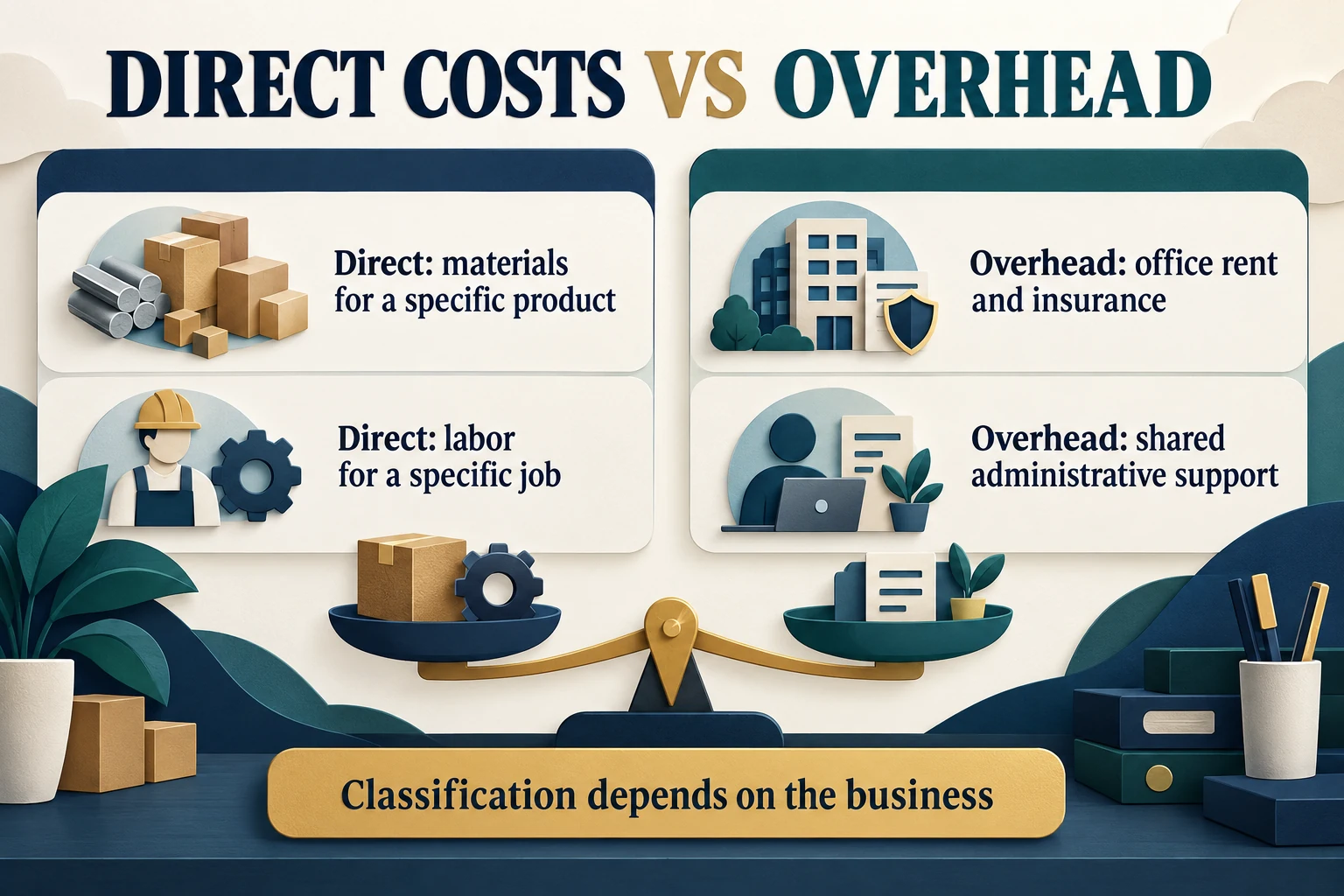
Direct costs can be traced to a cost object, such as a product, customer, contract, or project, at a reasonable measurement cost. Overhead supports multiple cost objects and therefore requires an allocation method or remains a period expense.
| Cost item | Typical classification | Traceable object | Example |
|---|---|---|---|
| Flour | Direct material | One bakery batch | $45 of flour for 300 loaves |
| Production baker wages | Direct labor | One production run | 6 hours at $22 per hour |
| Factory electricity | Manufacturing overhead | Multiple product lines | $2,400 monthly utility bill |
| Shop rent | Operating overhead | Entire location | $6,000 monthly lease |
| Project subcontractor | Direct project cost | Client project | $3,200 for one contract |
| Bookkeeper salary | Administrative overhead | Entire business | $4,500 monthly payroll |
The same item can change classification. A delivery driver dedicated to one customer contract may be a direct cost, while a general fleet manager is overhead. Packaging used in a predictable quantity for every unit may be direct material, but shared warehouse packaging supplies are often treated as indirect overhead.
How Does Business Overhead Work?
Business overhead enters the accounting system through cost pools, receives an allocation base when management needs product or project profitability, and ultimately influences pricing, margins, and break-even volume. The accounting treatment depends on whether the cost belongs to manufacturing inventory or to the period in which the business incurs it.
A manufacturing company may include factory overhead in inventory under applicable accounting rules, then recognize that cost through cost of goods sold when products sell. Administrative rent and corporate legal fees generally remain operating expenses rather than inventoriable manufacturing costs. Internal management reports can use broader allocations, but financial statements must follow the relevant accounting framework.
The Overhead Allocation Lifecycle
- Define the cost object. Choose the product, customer, project, department, or service being analyzed.
- Create cost pools. Group similar indirect costs, such as factory utilities, facilities, administration, or customer support.
- Select a driver. Use machine hours, labor hours, square footage, purchase orders, tickets, or another activity that explains resource consumption.
- Calculate the rate. Divide the cost pool by the expected activity base.
- Apply the rate. Assign overhead to products or projects according to their measured activity.
- Compare actual and applied costs. Investigate under-absorption, over-absorption, volume changes, and spending variances.
A logical driver matters more than mathematical complexity. Allocating all corporate costs by revenue may be simple, but activity-based costing can produce a better answer when products consume purchasing, support, or engineering resources very differently.
What Are the Main Types of Overhead?
The main overhead types are fixed, variable, and semi-variable, classified by how cost changes as activity changes. A functional classification, such as manufacturing, selling, and administrative overhead, describes where a cost belongs rather than how it behaves.
| Overhead type | Cost behavior | Typical examples | Management question |
|---|---|---|---|
| Fixed overhead | Total cost stays stable within a relevant capacity range | Lease, salaried administrator, annual software contract | Can capacity be used more fully? |
| Variable overhead | Total cost changes with activity | Usage-based cloud storage, indirect supplies, machine power | What activity drives the increase? |
| Semi-variable overhead | Fixed base plus activity-related component | Utilities, phone plans, maintenance contracts | At what volume does the variable portion accelerate? |
| Step-fixed overhead | Stable until a capacity threshold, then jumps | Additional supervisor, warehouse, support shift | When is the next capacity block justified? |
Fixed Overhead
Fixed overhead remains broadly unchanged over a defined period and operating range. A $10,000 monthly lease remains $10,000 whether a facility produces 5,000 units or 7,000 units, although lease escalators, property taxes, and expansion can change the longer-term amount.
Fixed cost per unit falls as volume rises. That creates operating leverage: profitable growth can improve margins quickly, but a demand decline leaves the business paying the same contractual costs. Fixed overhead should therefore be evaluated against capacity, cash reserves, contract duration, and break-even volume, not a universal percentage target.
Variable and Semi-Variable Overhead
Variable overhead changes with activity but is not necessarily traceable to one unit. Examples include indirect factory supplies, transaction fees, usage-based cloud computing, and warehouse consumables.
Semi-variable costs combine a minimum charge with activity usage. The high-low method provides a quick estimate:
Variable rate = (Highest cost – Lowest cost) / (Highest activity – Lowest activity)
If monthly utilities are $4,800 at 2,000 machine hours and $6,000 at 3,500 hours, the estimated variable rate is $0.80 per machine hour. Estimated fixed cost is $3,200, calculated as $4,800 minus $1,600 of variable cost at the low activity level. The method is useful for an initial estimate, but unusual months and nonlinear tariffs can distort it.
How Do You Calculate Overhead?
Calculate overhead by defining the relevant cost pool, removing costs that are directly traceable to the selected object, and dividing the remaining pool by a meaningful denominator. The resulting rate is only useful when the denominator reflects how the business consumes resources.
Overhead as a Percentage of Revenue
The broad overhead-to-revenue ratio is:
Overhead rate = Total overhead costs / Gross revenue × 100
For example, a consulting firm with $240,000 in annual overhead and $800,000 in revenue has a 30% overhead rate. That means $0.30 of each revenue dollar supports indirect operations under the chosen definition.
The ratio can mislead when revenue includes pass-through expenses, seasonal sales, or unusually low utilization. A business should also track overhead against gross profit, contribution margin, billable hours, and cash collections.
Overhead per Unit or Labor Hour
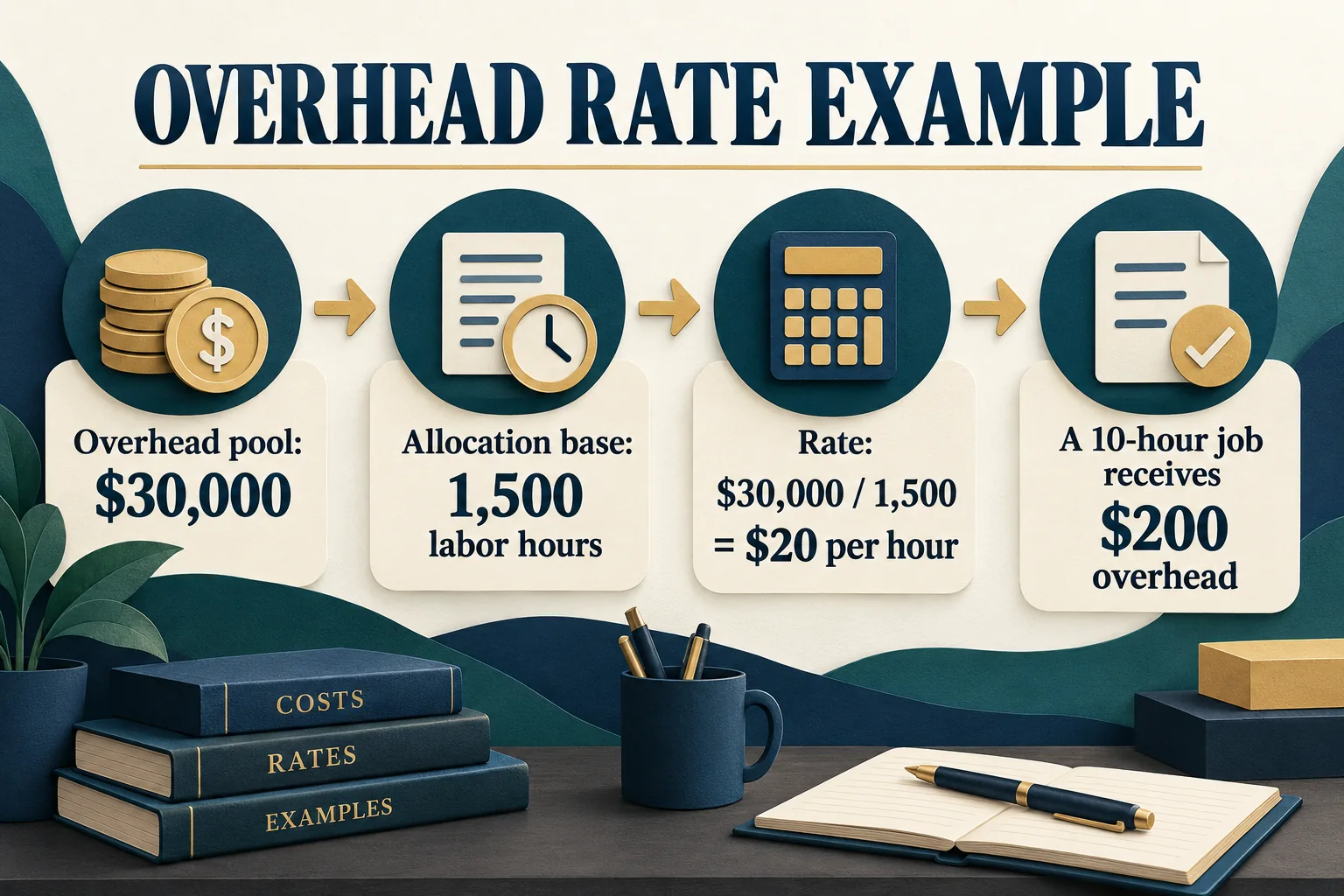
A manufacturer with $120,000 of monthly factory overhead and 10,000 expected machine hours has a predetermined rate of $12 per machine hour. A product requiring 2.5 machine hours receives $30 of applied overhead.
| Metric | Formula | Worked values | Result |
|---|---|---|---|
| Revenue overhead rate | Overhead / revenue | $240,000 / $800,000 | 30% |
| Labor-hour rate | Overhead / direct hours | $90,000 / 6,000 hours | $15 per hour |
| Machine-hour rate | Factory overhead / machine hours | $120,000 / 10,000 hours | $12 per hour |
| Unit overhead | Applied rate × hours | $12 × 2.5 hours | $30 per unit |
| Break-even units | Fixed costs / contribution per unit | $150,000 / $30 | 5,000 units |
Use expected practical capacity rather than an unusually depressed production month when setting a predetermined rate. Dividing fixed overhead by actual low volume can inflate unit cost and create a self-reinforcing pricing problem.
Which Allocation Base Should a Business Use?
The best allocation base is the activity that most plausibly causes the overhead cost. Labor hours suit a labor-intensive repair shop, machine hours suit an automated factory, square footage suits facilities costs, and support tickets may suit a technical service department.
| Business activity | Suitable allocation base | Why it fits | Warning |
|---|---|---|---|
| Custom fabrication | Machine hours | Machines consume power and capacity | Labor-heavy jobs may still be undercosted |
| Commercial cleaning | Labor hours | Staff time drives scheduling and supervision | Travel may need a separate mileage pool |
| SaaS support | Support tickets or resolution minutes | Service demand consumes staff capacity | Enterprise contracts can require account-level tracking |
| Retail property | Square footage | Space drives rent and facilities use | Sales volume does not explain all occupancy cost |
| Procurement department | Purchase orders or supplier count | Transactions consume staff effort | Large strategic purchases may distort averages |
| Consulting firm | Billable and non-billable hours | People capacity drives delivery | Partner compensation needs separate treatment |
Activity-based costing, or ABC, uses multiple pools and drivers instead of one broad rate. ABC is most valuable when products have different order sizes, support requirements, setup times, or channel complexity. It is less useful when measurement costs exceed the decision value or when the business has only one simple offering.
How Does Overhead Affect Pricing and Profit?
Overhead affects pricing by setting the revenue required to recover indirect costs after direct costs are paid. A price that covers materials and delivery labor but ignores rent, administration, software, and financing may produce positive gross margin while still generating an operating loss.
Suppose a service project sells for $5,000, includes $2,000 of direct labor and subcontracting, and receives $1,500 of allocated overhead. The project contributes $1,500 before any unallocated corporate costs and taxes. If the business prices only from direct cost plus a 20% markup, the quote may be commercially attractive but financially inadequate.
| Pricing view | Included costs | Example on $5,000 sale | Decision use |
|---|---|---|---|
| Gross margin view | Direct costs only | $2,000 direct cost | Product and sales analysis |
| Contribution view | Direct plus variable overhead | $2,000 + $300 | Short-term capacity decisions |
| Fully loaded view | Direct costs plus allocated overhead | $2,000 + $1,500 | Long-term pricing and portfolio review |
| Operating profit view | Fully loaded cost plus corporate expenses | $2,000 + $1,500 + $700 | Company-level profitability |
| Cash view | Timing of cash receipts and payments | Customer pays in 45 days | Liquidity and financing decisions |
A fully loaded price is not automatically the right quote. For a temporary capacity gap, a business may accept a price above incremental cost if the project uses idle resources and does not displace higher-margin work. Long-term pricing must recover sustainable overhead.
Is Low Overhead Better Than High Overhead?
Low overhead reduces the break-even burden and usually improves resilience during a sales decline, while high overhead can provide capacity, control, physical assets, and economies of scale. The better model depends on demand stability, utilization, service requirements, and the cost of outsourcing.
| Model | Typical fixed-cost profile | Break-even effect | Main advantage | Main risk |
|---|---|---|---|---|
| Remote consulting | $1,000-$8,000 monthly | Low | Flexible capacity | Limited delivery scale |
| E-commerce operator | $5,000-$40,000 monthly | Moderate | Outsourced fulfillment | Vendor and shipping dependence |
| Small manufacturer | $30,000-$250,000 monthly | High | Production control | Idle equipment and maintenance |
| Medical clinic | $60,000-$400,000 monthly | High | Licensed facilities and staff | Regulatory and lease commitments |
| Enterprise software platform | $100,000-$5 million monthly | High before scale | Infrastructure and product capacity | Large payroll and cloud commitments |
These figures are illustrative planning ranges, not universal industry benchmarks. The U.S. Small Business Administration advises businesses to separate one-time and monthly expenses when estimating startup requirements, a distinction that prevents equipment purchases from being confused with recurring overhead.
What Overhead Benchmarks Should a Business Use?
No single overhead percentage is healthy for every business. A 20% ratio may be high for a distributor with thin administrative needs but low for a regulated healthcare provider, while a software company can carry substantial engineering and hosting costs before revenue scales.
Instead of adopting a universal 25-35% target, compare four measures:
- Overhead as a percentage of revenue.
- Overhead as a percentage of gross profit.
- Fixed overhead as a percentage of contribution margin.
- Monthly fixed overhead relative to cash reserves.
Use at least twelve months of actual data where seasonality exists. Compare the same classification rules across periods and peers; otherwise, outsourcing, owner compensation, capitalization policies, or pass-through revenue can make ratios appear artificially better or worse.
What Are Common Overhead Mistakes?
The most expensive overhead errors usually involve classification, capacity assumptions, and unreviewed commitments. Correcting the accounting label alone does not reduce cost, but it can reveal which products, customers, or locations are actually consuming resources.
| Mistake | Business consequence | Diagnostic signal | Corrective action |
|---|---|---|---|
| Allocating fixed costs over low actual volume | Inflated unit cost and defensive pricing | Unit cost rises as sales fall | Use practical capacity and sensitivity analysis |
| Treating every SaaS subscription as immaterial | Accumulating unused recurring spend | Multiple owners and duplicate tools | Review seats and contracts quarterly |
| Using revenue for every allocation | Distorted product profitability | High-volume products subsidize complex orders | Add activity-based pools |
| Mixing direct and indirect labor | Unreliable gross margin | Margin changes without operational explanation | Map roles in the chart of accounts |
| Ignoring step costs | Unexpected capacity shock | Overtime or support backlog near a threshold | Model the next staffing or facility block |
| Confusing profit with cash | Missed payroll or debt payments | Positive income but weak bank balance | Add collection and payment timing to forecasts |
An overhead report should identify the owner, contract end date, renewal terms, monthly cost, activity driver, and cancellation consequence for every material line item. A quarterly review is practical for software and vendors, while leases, insurance, and compensation require annual or event-driven review.
How Can a Business Reduce Overhead Without Damaging Operations?
Reduce overhead by removing unused capacity, renegotiating recurring contracts, standardizing tools, and redesigning work before cutting resources that protect revenue or compliance. The strongest savings usually come from structural changes rather than across-the-board percentage cuts.
For Startups and Freelancers
Prefer reversible commitments during uncertain demand. Use monthly or annual software plans according to cash-flow value, avoid hiring permanent capacity before utilization is visible, and separate personal expenses from business accounts.
Do not reduce bookkeeping, tax compliance, insurance, or security controls simply because they do not produce billable output. Those costs are overhead, but eliminating them can create larger legal, financial, or operational losses.
For Growing Businesses
Measure utilization before adding space or headcount. A company with a 55% billable utilization rate may need scheduling and pricing improvements before hiring, while a company at 95% may need capacity even if payroll overhead rises.
Consolidate duplicate software, negotiate volume tiers, and use service-level agreements for outsourced providers. Convert variable vendor charges to fixed contracts only when historical usage is stable enough to avoid paying for unused capacity.
For Larger Enterprises
Shared-service centers can consolidate finance, human resources, procurement, and legal administration, but service quality and transfer-pricing effects require monitoring. Zero-based budgeting can challenge inherited spending, yet repeating a full zero-based exercise every year may consume more management time than it saves.
A practical rule is to rank overhead by controllability, financial materiality, and customer impact. Cut low-value recurring commitments first, then redesign processes before reducing customer-facing capacity.
When Is Overhead Not the Right Cost Concept?
Overhead is not the right sole metric for every decision. A short-term special-order decision should usually focus on avoidable and incremental costs, because allocated corporate rent will not change when an idle machine accepts one additional order.
Overhead also cannot measure strategic value by itself. A research team may look unprofitable under a current allocation while creating future products; a compliance function may add no direct revenue but prevent fines and lost licenses. Use contribution margin, relevant cost, cash flow, capacity, and risk alongside fully allocated profitability.
This limitation matters in pricing. Allocating every corporate cost to every product can produce a precise-looking number that hides uncertainty. Treat the allocation as a model, test the driver, and show decision-makers which assumptions change the result.
Frequently Asked Questions
Is overhead the same as operating expenses?
No. Operating expenses are a broad financial-statement category covering selling, general, and administrative costs, while overhead usually means indirect costs that support operations. Businesses often use the words interchangeably in management reports, but manufacturing overhead, corporate overhead, and selling expenses can require different accounting treatment.
Is payroll overhead or a direct cost?
Payroll can be either. A technician working directly on one customer project is usually direct labor, while a human-resources manager, finance employee, or general operations manager is overhead. Supervisors and shared service employees require a policy based on traceability, materiality, and the accounting purpose of the report.
Does overhead include cost of goods sold?
Manufacturing overhead can form part of inventory cost and later become manufacturing cost of goods sold. Administrative overhead and selling expenses generally do not become product inventory under standard financial reporting. The answer therefore depends on whether the business means factory overhead or broader operating overhead.
How often should a business review overhead?
Review recurring software, vendors, utilities, and usage-based services monthly or quarterly. Review leases, insurance, compensation structures, and facility capacity at least annually and whenever demand, staffing, or location changes. A monthly variance report should explain material differences rather than merely list them.
How can a service business calculate overhead per billable hour?
Divide the relevant annual overhead pool by realistic annual billable hours, not total employee hours. For example, $180,000 of overhead divided by 6,000 billable hours produces $30 of overhead per billable hour. Add direct labor, benefits, delivery costs, and profit requirements before setting the final billing rate.
Can a business have too little overhead?
Yes. Underinvestment in accounting, security, maintenance, training, quality control, or management can create delayed failures and capacity constraints. Low overhead is valuable when it reflects efficient design, not when it merely postpones necessary spending or transfers hidden work to owners and employees.
Conclusion: What Overhead Means in Business
The meaning of overhead in business is the indirect operating cost required to keep an organization functioning, such as facilities, administration, insurance, systems, and shared support. Classify it consistently, select allocation drivers that reflect resource use, and evaluate the result against capacity, contribution margin, cash flow, and strategic risk rather than a universal percentage target.