

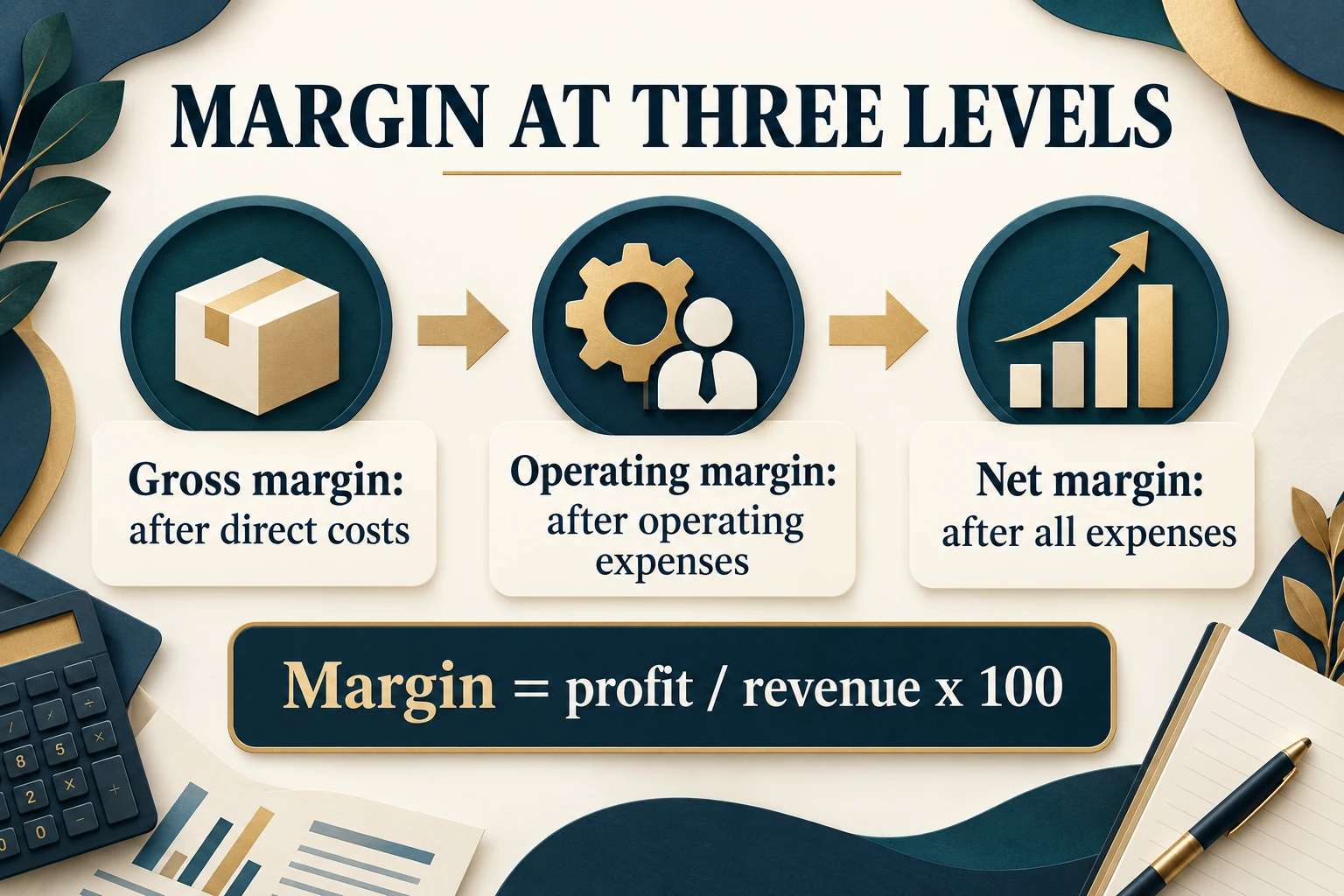
Margin in business is the amount of revenue a company retains after subtracting a defined category of costs, expressed in dollars or as a percentage of revenue. Business margin shows how efficiently sales become profit, but the meaning changes with the cost layer used: gross margin measures production economics, operating margin measures core operations, and net margin measures final profitability.
Key Facts at a Glance
- Margin percentage equals profit divided by revenue, multiplied by 100.
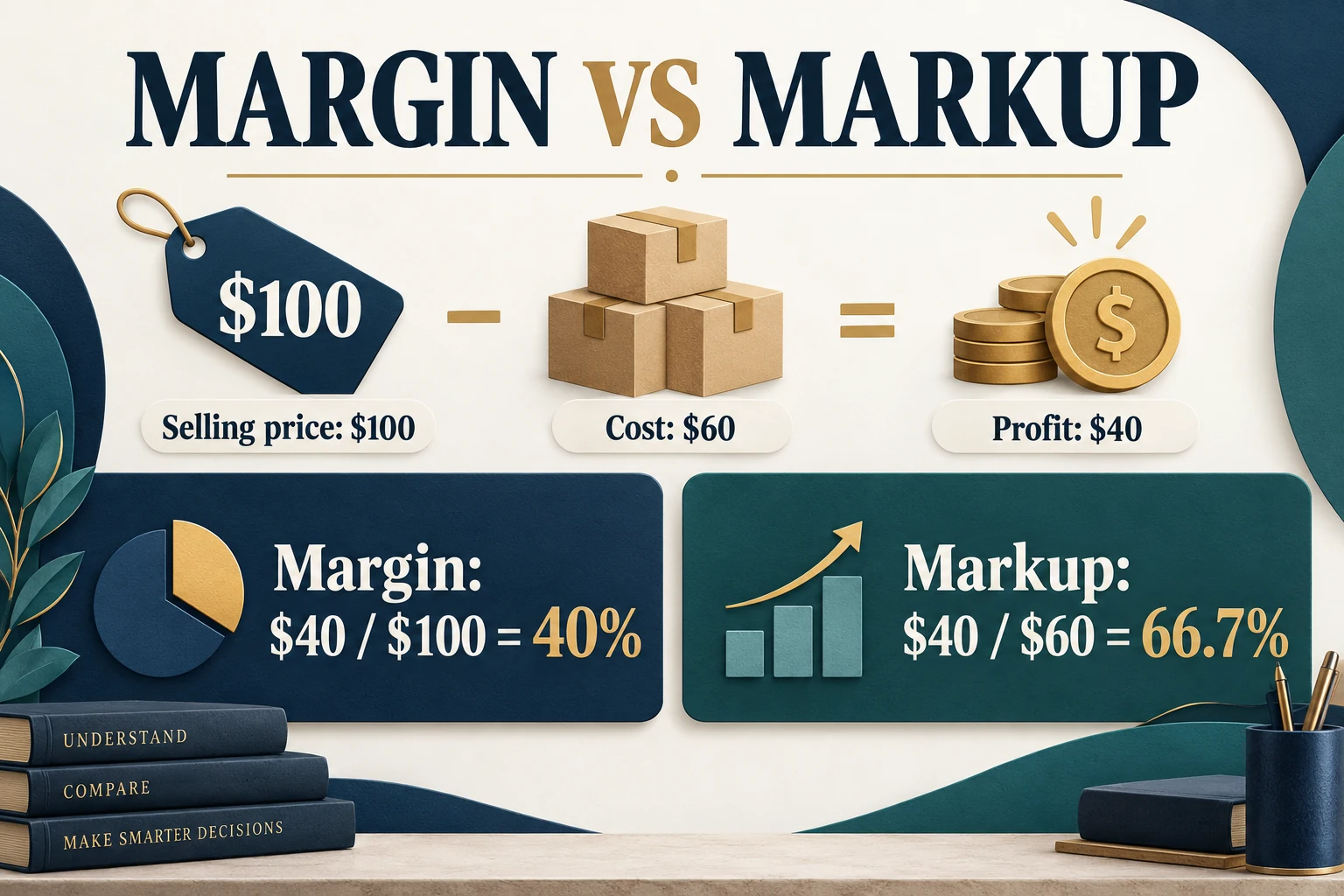
- Margin uses selling price as its denominator; markup uses cost as its denominator.
- Gross margin subtracts cost of goods sold, operating margin subtracts operating expenses, and net margin subtracts all expenses.
- Contribution margin subtracts variable costs and helps determine break-even volume.
- A high revenue growth rate cannot compensate for a negative unit margin.
- Industry benchmarks are typical ranges, not universal targets, because accounting policies and business models differ.
What Does Margin Mean in Business?
Business margin measures the share of sales revenue remaining after a specified cost category is deducted. A company with $40,000 in revenue and $28,000 in relevant costs has $12,000 of margin dollars and a 30% margin for that cost layer.
The phrase “margin” is incomplete without naming the layer. A retailer may report a 35% gross margin but a 4% net margin after payroll, rent, delivery, card fees, taxes, and interest. Both figures can be accurate because they answer different questions.
Margin dollars versus margin percentage
Margin dollars show the absolute amount retained. Margin percentage makes businesses of different sizes easier to compare.
| Measure | Revenue | Relevant cost | Result |
|---|---|---|---|
| Gross margin dollars | $100,000 | $62,000 COGS | $38,000 |
| Gross margin percentage | $100,000 | $62,000 COGS | 38% |
| Operating margin dollars | $100,000 | $86,000 total operating cost | $14,000 |
| Net margin dollars | $100,000 | $94,000 total expenses | $6,000 |
A growing company can increase margin dollars while its percentage margin falls. For example, revenue may rise from $100,000 to $150,000 while gross margin declines from 40% to 34%. The business retains more dollars, but each sales dollar produces less gross profit.
How Is Business Margin Calculated?
Calculate business margin by subtracting the relevant cost from revenue, dividing the result by revenue, and multiplying by 100. The formula is:
Margin percentage = (Revenue – Relevant cost) / Revenue × 100
For a product sold for $80 with a fully allocated cost of $50:
- Margin dollars: $80 – $50 = $30
- Margin percentage: $30 / $80 × 100 = 37.5%
The calculation depends on consistent definitions. Revenue should normally exclude sales tax collected for a government authority, while costs should match the accounting period and the margin layer being analyzed.
A reliable calculation process
- Define the period. Use a week, month, quarter, or year, and compare equivalent periods.
- Identify revenue. Start with recognized sales, then account for refunds, returns, discounts, and allowances.
- Select the cost layer. Use COGS for gross margin, operating expenses for operating margin, or all expenses for net margin.
- Check cost classification. Confirm that freight, packaging, payment fees, and labor are assigned consistently.
- Calculate dollars and percentage. Report both because percentage shows efficiency and dollars show economic capacity.
- Compare trends. Review the current result against budget, prior periods, product categories, and customer segments.
How do discounts and returns change margin?
Discounts and returns reduce effective revenue, so margin should usually be calculated using net sales rather than the advertised list price. A $100 product sold at a 15% discount generates $85 before refunds, not $100.
If the product costs $50, the list-price margin appears to be 50%, but the discounted margin is:
($85 – $50) / $85 × 100 = 41.2%
That difference becomes larger when payment fees, return shipping, marketplace commissions, or promotional credits are deducted.
What Are the Main Types of Business Margin?
The three standard profit-margin layers are gross, operating, and net margin. Contribution margin is an additional management metric that isolates variable economics and is especially useful for pricing, advertising, capacity, and break-even decisions.
| Margin type | Formula | Costs deducted | Main question answered |
|---|---|---|---|
| Gross margin | (Revenue – COGS) / Revenue | Materials, inventory, direct production | Does the product or service make money before overhead? |
| Contribution margin | (Revenue – variable costs) / Revenue | Per-unit labor, shipping, fees, usage costs | Does each sale help pay fixed costs? |
| Operating margin | Operating income / Revenue | COGS plus operating expenses | Does the core business run efficiently? |
| Net margin | Net income / Revenue | Operating costs, interest, taxes, one-off items | What percentage becomes final profit? |
What is gross profit margin?
Gross profit margin is revenue remaining after subtracting the cost of goods sold. The formula is:
Gross margin = (Revenue – COGS) / Revenue × 100
COGS can include purchased inventory, raw materials, direct manufacturing labor, and production-related freight, depending on the company’s accounting policy. It normally excludes corporate rent, general marketing, executive salaries, interest, and income tax.
Gross margin helps reveal pricing power, supplier economics, waste, purchasing performance, and product mix. A falling gross margin often appears before a falling operating margin because product costs or discounts change first.
What is contribution margin?
Contribution margin is revenue minus variable costs, divided by revenue. Variable costs rise with each sale, such as card processing, fulfillment, sales commissions, usage-based hosting, and per-unit packaging.
A software subscription priced at $100 per month with $18 of hosting and support costs has an $82 contribution margin, or 82%. If fixed monthly costs are $41,000, the business needs 500 subscriptions to cover them:
$41,000 / $82 = 500 subscriptions
Contribution margin is not a statutory financial statement line and should not replace gross margin in external reporting. It is a decision tool for evaluating incremental sales.
What is operating profit margin?
Operating margin measures profit from normal business operations after COGS and operating expenses, but before interest and income taxes. The formula is:
Operating margin = Operating income / Revenue × 100
Operating expenses can include sales and marketing, research and development, general administration, rent, software, and non-production payroll. Operating margin reveals whether the company’s infrastructure is growing faster than its revenue base.
A business may have a strong gross margin and weak operating margin when headcount, advertising, facilities, or technology spending expands without corresponding sales productivity.
What is net profit margin?
Net profit margin is the percentage of revenue left after all recognized expenses, including interest, taxes, and qualifying one-off items. The formula is:
Net margin = Net income / Revenue × 100
Net margin is the broadest profitability measure, but it is not always the best operating diagnostic. A refinancing event, unusual tax charge, asset sale, or foreign-exchange loss can distort one period. Review operating margin alongside net margin before concluding that the core business improved or deteriorated.
What Is the Difference Between Margin and Markup?
Margin calculates profit as a percentage of selling price, while markup calculates profit as a percentage of cost. The same transaction therefore produces different percentages.
| Example | Cost | Selling price | Profit | Margin | Markup |
|---|---|---|---|---|---|
| Basic sale | $50 | $75 | $25 | 33.3% | 50% |
| Target-margin sale | $50 | $100 | $50 | 50% | 100% |
| Premium sale | $50 | $125 | $75 | 60% | 150% |
| Low-price sale | $50 | $60 | $10 | 16.7% | 20% |
To price for a target margin, use:
Selling price = Cost / (1 – Target margin)
For a $50 cost and a 40% target margin:
$50 / (1 – 0.40) = $83.33
A 40% markup would produce a $70 price, but the resulting margin would be only 28.6%. This error is common in retail pricing because staff often add a percentage to cost without checking the selling-price denominator.
What Is a Good Business Margin?
A good margin is one that covers fixed costs, supports required investment, compensates for risk, and remains stable after realistic discounts and losses. No single percentage applies across industries, because inventory intensity, labor requirements, customer acquisition, and pricing power vary substantially.
| Business model | Typical gross margin | Typical net margin | Main margin pressure |
|---|---|---|---|
| SaaS software | 70%-85% | 10%-25% | Customer acquisition and product payroll |
| Retail and e-commerce | 20%-45% | 2%-10% | Inventory, shipping, returns, promotions |
| Restaurants | 55%-70% food gross margin | 3%-10% | Labor, rent, spoilage, delivery commissions |
| Professional services | 40%-70% gross margin | 10%-25% | Billable utilization and senior salaries |
| Wholesale distribution | 10%-30% | 1%-5% | Freight, inventory financing, price competition |
These are typical planning ranges, not universal standards. A restaurant with unusually low rent may outperform the range, while a software company with heavy implementation labor may have a lower gross margin than a conventional subscription model.
Industry data should also be compared on a like-for-like basis. A gross margin including fulfillment labor cannot be directly compared with a company that classifies that labor as operating expense.
How should a small business set a margin target?
A small business should set its target from required fixed costs, expected sales volume, taxes, reinvestment, and owner compensation. For example, if monthly fixed costs and desired operating profit total $30,000, and expected monthly revenue is $100,000, the required contribution margin is 30% before accounting for variable costs.
Founders selling physical goods generally need more margin buffer than mature high-volume operators. A new retailer may face higher shipping rates, more returns, smaller purchasing discounts, and less efficient labor than a national chain.
Is High Margin Better Than High Volume?
High margin is better when sales are uncertain, capacity is limited, or the business needs pricing flexibility. High volume with a low margin can work when demand is predictable, inventory turns quickly, purchasing costs fall with scale, and operating expenses remain tightly controlled.
| Strategy | Typical example | Primary advantage | Primary risk |
|---|---|---|---|
| High volume, low margin | Grocery retail | Repeat demand and purchasing scale | Small cost increases can erase profit |
| Moderate volume, moderate margin | Specialty e-commerce | Balanced pricing and demand | Inventory can become fragmented |
| Low volume, high margin | Luxury goods | Greater profit per transaction | Slow demand and high acquisition cost |
| Recurring high margin | Enterprise SaaS | Revenue compounding after acquisition | Large upfront sales and support expense |
The volume fallacy occurs when a company assumes more sales will repair a negative unit margin. Selling 10,000 units at a $2 loss creates a $20,000 loss before additional overhead. Volume magnifies unit economics; it does not reverse them.
How Does Margin Affect Pricing and Break-Even?
Margin affects the price required to cover variable costs and fixed expenses. Break-even units equal fixed costs divided by contribution margin dollars per unit.
| Scenario | Selling price | Variable cost | Contribution per unit | Fixed costs | Break-even units |
|---|---|---|---|---|---|
| Base price | $100 | $60 | $40 | $20,000 | 500 |
| 10% discount | $90 | $60 | $30 | $20,000 | 667 |
| Supplier increase | $100 | $66 | $34 | $20,000 | 589 |
| Premium price | $115 | $66 | $49 | $20,000 | 409 |
A discount can require a disproportionate sales increase. Moving from $100 to $90 reduces contribution from $40 to $30, so the business must sell 33.4% more units to earn the same contribution dollars.
Which costs are often missing from margin calculations?
Commonly omitted costs include payment processing, marketplace fees, return postage, refunds, damaged inventory, shrinkage, customer support, warranty claims, sales commissions, and customer acquisition cost. Each omission makes the reported margin look stronger than the money generated by the transaction.
For an e-commerce order priced at $120, a realistic contribution calculation might include $48 product cost, $8 fulfillment, $4 payment fee, $6 expected returns, and $20 advertising cost. The adjusted contribution is $34, or 28.3%, rather than the apparent 60% product margin.
Why Is Business Margin Shrinking?
Margin compression occurs when revenue grows more slowly than relevant costs, or when the sales mix shifts toward lower-margin products. The most common causes are supplier inflation, discounting, freight increases, wage growth, channel fees, returns, and customers selecting cheaper plans.
Use this audit sequence:
- Reconcile revenue. Compare list price, realized price, discounts, refunds, and credit notes.
- Deconstruct COGS. Separate material, labor, freight, packaging, and supplier changes.
- Review product mix. Measure margin by SKU, plan, customer, region, and channel.
- Inspect variable overhead. Check card fees, commissions, delivery, support, and usage-based software.
- Test operating leverage. Compare revenue growth with payroll, rent, marketing, and technology growth.
A product-mix shift can reduce total margin even when every individual product remains profitable. If a company moves from 60% premium products at 50% margin to 60% basic products at 25% margin, the blended result falls sharply without a pricing-system error.
What is margin analysis not good for?
Margin analysis is not a substitute for cash-flow forecasting, working-capital management, or customer-retention analysis. A business can show a 40% margin and still fail when customers pay in 60 days, inventory must be purchased in advance, or debt repayments consume available cash.
Accounting margin also cannot identify strategic value by itself. A low-margin customer may generate referrals or recurring orders, while a high-margin customer may require expensive support and pay late. Pair margin with payment timing, retention, capacity use, and customer acquisition data.
Which Margin Should Each Business Track?
The right metric depends on the decision. Product and purchasing teams need gross margin, growth teams need contribution margin after acquisition cost, operators need operating margin, and owners or investors need net margin plus cash flow.
| User | Primary metric | Review frequency | Useful action |
|---|---|---|---|
| Product manager | Gross margin by SKU | Monthly | Change specifications or supplier |
| E-commerce manager | Contribution margin by channel | Weekly | Adjust bids, promotions, or shipping |
| Small-business owner | Operating margin | Monthly | Control overhead and staffing |
| CFO or investor | Net margin and operating margin | Monthly or quarterly | Assess profitability and capital needs |
| SaaS founder | Gross margin, CAC payback, net margin | Monthly | Balance growth spending and retention |
A practical reporting pack should show revenue, discounts, returns, COGS, gross margin, variable selling costs, contribution margin, operating expenses, operating income, net income, and cash balance. Report both current period and trailing 12-month trends.
Frequently Asked Questions
Is a 20% margin the same as a 20% profit?
A 20% margin means the relevant profit measure equals 20% of revenue, but the relevant cost layer must be named. A 20% gross margin does not mean a 20% net profit because operating expenses, interest, and taxes may reduce final profit substantially.
Can margin be negative?
Yes. A negative margin means the defined costs exceed revenue. Negative gross margin indicates the product cannot cover direct costs, while negative net margin may occur because overhead, interest, or taxes exceed gross profit. Increasing volume usually increases the loss unless unit economics change.
Should margin include tax?
Sales tax collected on behalf of a government authority normally should not be treated as business revenue. Income tax is included when calculating net margin, but it is excluded from gross and operating margin. Tax treatment varies by jurisdiction and accounting method, so internal reports must use consistent rules.
Why can two companies have different margins in the same industry?
Two companies can report different margins because they classify costs differently, serve different customer segments, use different channels, or operate at different scales. One retailer may classify warehouse labor in COGS, while another records it as operating expense, making gross margins appear different even when economics are similar.
How often should a business calculate margin?
Most businesses should calculate gross and contribution margin monthly, with weekly monitoring for fast-moving products, paid advertising, or volatile input costs. Quarterly reporting may be sufficient for stable companies, but monthly trend analysis catches discounting, supplier increases, and product-mix changes sooner.
What is the simplest way to remember margin?
Remember that margin asks, “What percentage of the selling price do we keep?” Markup asks, “What percentage did we add to cost?” If an item costs $50 and sells for $100, the profit is $50, the margin is 50%, and the markup is 100%.
The Bottom Line
Margin meaning in business depends on the cost layer being measured. Gross margin evaluates product economics, contribution margin evaluates each sale’s ability to fund fixed costs, operating margin evaluates core management, and net margin evaluates final profitability. Calculate the relevant margin from net revenue, include realistic variable costs, compare trends rather than isolated percentages, and use cash flow alongside margin before making pricing or growth decisions.