

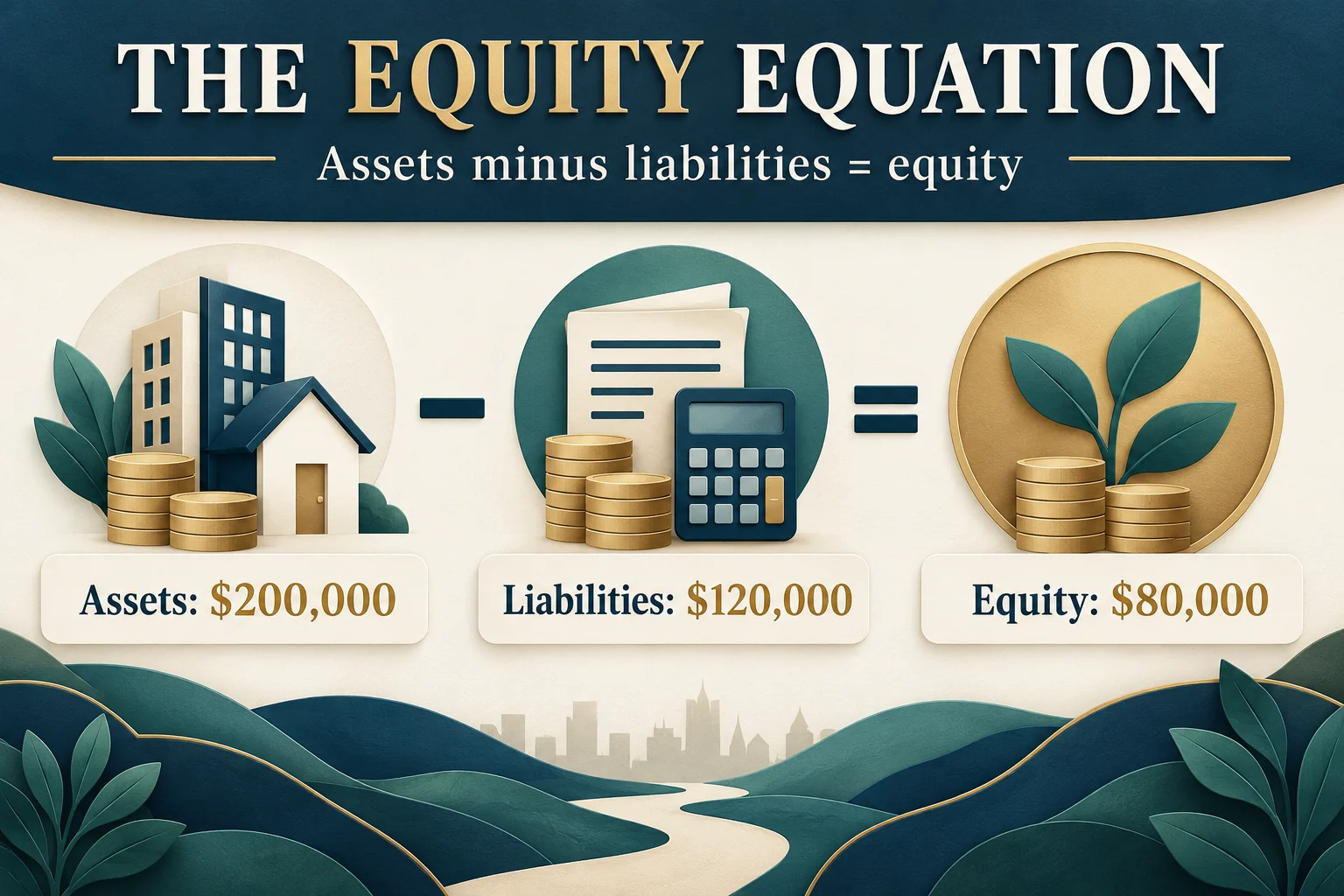
Equity in business means the ownership value remaining after a company subtracts its debts and other liabilities from its assets. For an owner or investor, equity can represent a residual claim on company assets, a percentage of profits, voting rights, or an economic interest that becomes liquid through a sale, dividend, or public offering.
Key Facts
Business equity equals assets minus liabilities on the balance sheet.
A shareholder’s ownership percentage is separate from the company’s total equity value.
Issuing new shares usually dilutes existing owners’ percentage ownership.
Retained earnings increase equity when profitable operations are kept in the business.
Equity investors generally accept more risk than lenders because repayment is not guaranteed.
Private-company equity may have substantial value but no immediate market for selling it.
What Does Equity Mean in Business?
Business equity has two connected meanings: the accounting value of a company after liabilities, and an ownership interest held by founders, partners, employees, or investors. The accounting meaning appears on the balance sheet, while the ownership meaning describes who receives economic benefits and controls specific decisions.
For a company with $500,000 in assets and $320,000 in liabilities, total book equity is $180,000. If the business sells for $900,000, however, the owners may receive approximately $580,000 before transaction costs and taxes, because market value and book value measure different things.
The legal rights attached to equity depend on the entity and security. A corporation may issue common or preferred shares, a limited liability company may issue membership interests, and a partnership may allocate capital and profit interests under its partnership agreement.
Is Equity the Same as Business Value?
Equity is not automatically the same as enterprise value or a company’s sale price. Enterprise value generally represents the value of operating assets available to all capital providers, while equity value is the amount attributable to owners after accounting for debt and cash adjustments.
| Measure | Simplified calculation | Typical use | Example |
|---|---|---|---|
| Book equity | Assets minus liabilities | Financial reporting | $500,000 – $320,000 = $180,000 |
| Equity value | Enterprise value minus net debt | Acquisition analysis | $900,000 – $320,000 debt + $40,000 cash = $620,000 |
| Enterprise value | Equity value plus net debt | Comparing businesses | $620,000 + $280,000 = $900,000 |
| Ownership percentage | Holder’s units divided by total units | Control and economics | 250,000 / 1,000,000 = 25% |
Book equity can understate a software company with valuable intellectual property or overstate a company holding obsolete inventory. Valuation depends on expected cash flow, market comparables, assets, liabilities, and transaction terms.
How Is Equity Calculated?
A business calculates accounting equity with the formula assets minus liabilities equals owners’ equity. The calculation includes contributed capital, retained earnings, accumulated losses, treasury stock, and certain accounting adjustments, depending on the entity and reporting framework.
A simple balance sheet may contain $200,000 of cash, $150,000 of equipment, and $50,000 of inventory. Against $250,000 of loans and unpaid bills, the company reports $150,000 of equity.
| Balance-sheet item | Amount | Effect on equity |
|---|---|---|
| Cash | $200,000 | Included in assets |
| Equipment | $150,000 | Included in assets |
| Inventory | $50,000 | Included in assets |
| Loans and payables | $250,000 | Subtracted as liabilities |
| Owners’ equity | $150,000 | $400,000 assets minus $250,000 liabilities |
A profitable period increases equity through net income when the company retains earnings. Dividends reduce retained earnings, while a new cash investment increases contributed capital. Borrowing money increases assets and liabilities together, so borrowing alone does not create equity.
How Do Ownership Percentage and Equity Value Relate?
Ownership percentage determines a holder’s share of the company’s economic interest, but it does not guarantee a fixed cash amount. A 20% stake in a company valued at $2 million has an implied value of $400,000 before discounts, preferences, taxes, and transaction costs.
A holder’s percentage can fall after new shares are issued. The stake may still become more valuable if the funding increases the company’s total value.
What Are the Main Types of Business Equity?
The main types include common stock, preferred stock, retained earnings, treasury stock, partnership or membership interests, and employee options. These categories differ in voting power, liquidation priority, distributions, transfer restrictions, and whether they represent shares immediately or a future purchase right.
| Equity type | Holder | Economic or control feature | Main risk |
|---|---|---|---|
| Common stock | Founders and public investors | Usually voting rights and residual upside | Last priority in liquidation |
| Preferred stock | Venture capital and institutional investors | Liquidation preference and negotiated rights | Preference can reduce common proceeds |
| Membership interest | LLC owners | Rights defined by operating agreement | Transfer and tax treatment vary |
| Retained earnings | Existing owners collectively | Past profit kept in the company | Does not equal cash available |
| Treasury stock | Issuing corporation | Repurchased shares usually lose voting status | Buybacks can reduce liquidity |
| Stock options | Employees and advisers | Right to buy shares at a strike price | Options can expire worthless |
Preferred stock does not always lack voting rights. A preferred security may receive votes on major corporate actions, elect a director, or gain voting rights if dividends remain unpaid. The certificate of incorporation and investment documents control the result.
What Is Retained Earnings?
Retained earnings are cumulative profits kept by a business after distributions to owners. Retained earnings are an equity account, not a separate bank account, so a company can report substantial retained earnings while holding little cash after buying equipment or repaying debt.
What Is Sweat Equity?
Sweat equity is ownership granted for work, expertise, intellectual property, or business development rather than a direct cash contribution. Founders commonly subject sweat equity to vesting, because immediate ownership can leave the company exposed if a founder departs early.
How Does Startup Dilution Work?
Startup dilution occurs when a company issues new shares and existing owners hold a smaller percentage of the enlarged share count. Dilution reduces percentage ownership, but it can increase the dollar value of an existing stake when the new capital produces enough company growth.
Suppose a founder owns 1,000,000 of 1,000,000 shares, or 100%. The company issues 250,000 new investor shares. The founder now owns 80%, while the investor owns 20%. The founder has been diluted by 20 percentage points, not necessarily by 20% of the founder’s dollar wealth.
| Funding stage | Shares before issue | New shares | Shares after issue | Founder percentage |
|---|---|---|---|---|
| Formation | 1,000,000 | 0 | 1,000,000 | 100% |
| Seed investment | 1,000,000 | 250,000 | 1,250,000 | 80% |
| Option-pool expansion | 1,250,000 | 150,000 | 1,400,000 | 71.4% |
| Series A investment | 1,400,000 | 466,667 | 1,866,667 | 53.6% |
The option pool is often included in the pre-money capitalization calculation, which means founders may bear its dilution before the new investor’s shares are added. This point regularly creates a larger founder dilution than headline investment percentages suggest.
What Are Pre-Money and Post-Money Valuation?
Pre-money valuation is the agreed company value immediately before an investment. Post-money valuation equals pre-money valuation plus the new investment.
For example, a $3 million pre-money valuation plus a $1 million investment creates a $4 million post-money valuation. The investor receives 25% on a simplified post-money basis, subject to the term sheet’s treatment of options, convertible instruments, and other securities.

How Much Equity Should a Startup Reserve?
A startup often reserves approximately 10%-15% of its fully diluted capitalization for employee options, but the appropriate percentage depends on hiring plans, stage, geography, and investor expectations. A company planning to hire ten senior employees may need more than a company with a small contractor-led team.
A four-year vesting schedule with a one-year cliff is a common planning standard. Under that structure, 25% vests after twelve months and the remaining 75% typically vests monthly over the next thirty-six months. The documents should specify treatment after termination, acquisition, disability, or death.
Employees should ask four questions before accepting options:
- What is the number of granted options and the fully diluted ownership percentage?
- What is the exercise price, and when can the employee exercise?
- What happens to vested options after departure?
- What tax may arise at exercise or sale?
An option is not stock. It becomes an ownership interest only after exercise, and its value depends on the company’s future share price, exercise cost, tax, expiration date, and liquidity.
Which Equity Metrics Matter?
The most useful equity metrics are return on equity, debt-to-equity ratio, book value per share, and ownership dilution. Each metric answers a different question, so no single ratio proves that a company has healthy equity.
| Metric | Formula | Example | Interpretation |
|---|---|---|---|
| Return on equity | Net income / average equity | $60,000 / $300,000 = 20% | Profit generated per equity dollar |
| Debt-to-equity | Total debt / equity | $450,000 / $300,000 = 1.5 | Debt leverage relative to equity |
| Book value per share | Equity / outstanding shares | $2,000,000 / 500,000 = $4 | Accounting value per share |
| Ownership dilution | New shares / post-issue shares | 250,000 / 1,250,000 = 20% | Percentage transferred to new shares |
Return on equity can look high because a company has very little equity or substantial debt. Analysts should compare it with operating margins, interest costs, industry norms, and the period’s average equity rather than relying on the year-end balance alone.
Book value per share is not a guaranteed liquidation payment. Asset values may fall, preferred claims may rank ahead of common shares, and liquidation costs may consume proceeds.
Equity Financing Versus Debt Financing
Equity financing is usually preferable when cash flows are uncertain and the business needs patient capital, while debt is usually preferable when revenue is predictable and owners can safely meet scheduled payments. The right choice depends on repayment capacity, control objectives, collateral, cost, and growth risk.
| Decision factor | Equity financing | Debt financing | Practical consequence |
|---|---|---|---|
| Repayment | No fixed principal schedule | Principal and interest required | Debt pressures cash flow |
| Ownership | Percentage ownership usually falls | Ownership normally remains unchanged | Equity affects control |
| Investor rights | Votes, information, or board rights possible | Covenants and lender protections | Both can restrict decisions |
| Collateral | Usually unsecured ownership claim | Often secured by assets | Default can trigger enforcement |
| Upside cost | Investor shares future upside | Lender receives contracted return | Equity can become expensive |
| Failure priority | Usually behind creditors | Ahead of equity holders | Equity carries greater downside |
Debt is not automatically cheaper. Interest may be contractually limited, but excessive leverage can cause default, refinancing risk, or loss of assets. Equity avoids mandatory payments, but investors may require preferred returns, governance rights, protective provisions, or a large share of future value.
What Are Alternatives to Selling Equity?
Businesses can use retained earnings, bank loans, asset-based lending, revenue-based finance, grants, customer prepayments, convertible notes, or strategic partnerships. Each alternative changes the business’s cash obligations, ownership dilution, control rights, or eligibility requirements.
Convertible notes and simple agreements for future equity postpone the exact share price, but they do not eliminate dilution. Interest, valuation caps, discounts, and conversion events determine the eventual ownership transfer.
What Happens to Equity in Liquidation?
In liquidation, creditors generally receive payment before equity holders, and preferred stock may receive proceeds before common stock. Common shareholders receive value only if assets remain after secured debt, employee claims, taxes, trade creditors, unsecured debt, and preferred preferences are satisfied.
A simplified $1 million liquidation might distribute $600,000 to secured lenders, $200,000 to other creditors, and $200,000 to preferred investors with a liquidation preference. Common shareholders would receive nothing. The actual waterfall depends on law, insolvency rules, security documents, and the company’s governing agreements.
This priority explains why common equity can be valuable during growth yet worthless in a failure. Equity is a residual claim, not a guaranteed claim.
Can Equity Be Negative?
A business can have negative equity when total liabilities exceed total assets. Negative equity often follows accumulated losses, asset write-downs, excessive distributions, or debt-funded acquisitions whose assets later lose value.
| Situation | Assets | Liabilities | Equity |
|---|---|---|---|
| Healthy positive equity | $800,000 | $500,000 | $300,000 |
| Break-even balance | $600,000 | $600,000 | $0 |
| Negative equity after losses | $450,000 | $600,000 | -$150,000 |
| Negative equity after write-down | $700,000 | $850,000 | -$150,000 |
Negative book equity does not automatically mean immediate insolvency. A company may possess valuable unrecorded brands or generate future cash flow, but negative equity increases financing difficulty and may breach loan covenants.
How Should Owners Manage Equity Risk?
Owners should maintain an accurate capitalization table, document every issuance, use vesting for unearned founder interests, and model dilution before accepting investment. A cap table should reconcile authorized shares, issued shares, options, warrants, convertible instruments, and ownership on a fully diluted basis.
Common failures include granting a large advisory stake without milestones, ignoring an option pool during negotiations, promising ownership verbally, and setting an unrealistic valuation that makes later fundraising difficult. A high valuation can reduce immediate dilution but create a down round if operational growth does not support it.
Professional valuation work may also matter. In the United States, private corporations commonly obtain a 409A valuation for determining the fair market value used in employee option pricing, although the valuation does not determine the company’s fundraising price.
What Is Equity Not Good For?
Equity is not a substitute for salary, guaranteed liquidity, or a reliable short-term return. Private shares may be restricted, difficult to sell, and subject to investor preferences that alter the employee’s or founder’s eventual proceeds.
Owners should also avoid treating retained earnings as available cash. A company may need those funds for payroll, inventory, taxes, debt service, or planned capital expenditure.
Frequently Asked Questions
Is equity an asset or a liability?
Equity is neither an asset nor a liability on the company’s balance sheet. Equity is the residual interest after liabilities are subtracted from assets. For an individual investor, however, shares or membership interests are personal assets because they may have economic value.
Do equity investors get paid monthly?
Equity investors do not normally receive mandatory monthly payments. They may receive dividends when the company declares them, distributions under an operating agreement, or proceeds from a sale, merger, buyback, or public-market transaction.
What is the difference between equity and ownership?
Ownership is the legal or economic relationship with a business, while equity describes the value and rights attached to that relationship. A person may own 10% of a company, but the value of that ownership depends on company valuation, liabilities, share class, preferences, and transfer restrictions.
Is employee equity better than a cash bonus?
Employee equity can exceed a cash bonus if the company grows substantially and creates liquidity, but it can also expire or become worthless. A cash bonus has immediate value, whereas options and restricted shares require analysis of vesting, exercise cost, taxes, dilution, and exit probability.
How can a small business increase equity?
A small business can increase equity by earning and retaining profits, receiving owner contributions, issuing ownership interests, reducing liabilities through repayment, or increasing the value of assets. Paying down debt with cash does not always change equity immediately because both assets and liabilities decline by the same amount.
What is the simplest equity example?
If a business owns $100,000 of assets and owes $40,000, its accounting equity is $60,000. If two owners hold equal economic interests, each has a 50% claim on the equity, subject to the governing agreement and any preferred or creditor claims.
Conclusion
Equity meaning in business centers on ownership and residual value. Accounting equity equals assets minus liabilities, while investor equity also includes voting rights, distribution rights, liquidation priority, dilution exposure, and potential future liquidity. Owners should calculate book equity, understand the capitalization table, compare equity with debt, and review every security’s legal terms before issuing or accepting ownership.