
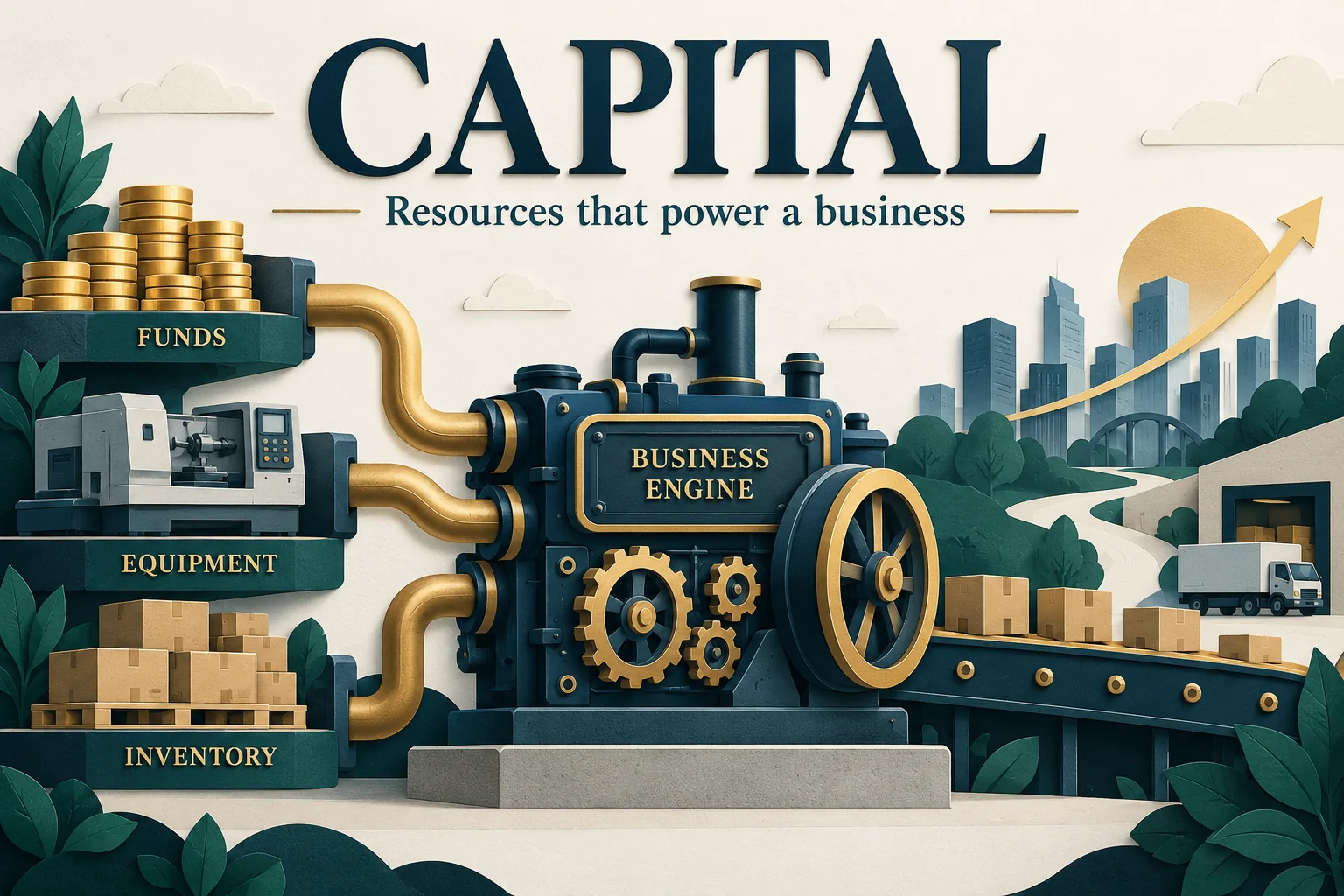
Capital in business means the financial resources a company uses to operate, buy productive assets, fund growth, and generate future revenue. Capital can include owner contributions, investor funds, borrowings, retained profits, equipment, inventory, and other resources, while cash is only the immediately spendable portion of that capital.
Key Facts at a Glance
Business capital finances operations, assets, expansion, and revenue-producing activity.
Equity capital provides funds without scheduled repayment but reduces ownership.
Debt capital preserves ownership but creates principal, interest, and repayment obligations.
Working capital equals current assets minus current liabilities.
Retained earnings are internally generated capital kept in the company instead of distributed.
A business can report accounting capital and still face a cash shortage.
What Does Capital Mean in Business?
Business capital is the money and financial resources committed to producing goods, delivering services, or increasing enterprise value. A manufacturer’s capital may include cash, factory equipment, raw materials, and retained profit; a consulting firm may rely more heavily on cash reserves, computers, software, and owner investment.
Capital has two related meanings. In finance, capital often means funding available for investment or operations. In accounting, capital can describe the owners’ residual interest after liabilities are subtracted from assets, although financial statements may use more precise labels such as shareholders’ equity, contributed capital, or retained earnings.
Capital is therefore a resource with a purpose. Cash held for payroll is capital available for operations, while a delivery van is capital invested in productive capacity. Neither item automatically creates profit; the business must deploy resources efficiently enough to earn a return above their economic cost.
How Does Business Capital Work?
Business capital follows a four-stage cycle: sourcing, deployment, revenue generation, and reinvestment. A company obtains resources, uses them to create products or services, converts those outputs into sales, and retains some resulting cash or profit for another operating cycle.
The Four Stages of the Capital Cycle
| Stage | Business action | Example value | Main risk |
|---|---|---|---|
| Sourcing | Obtain owner, lender, or investor funds | $100,000 loan | Expensive or restrictive financing |
| Deployment | Buy inventory, equipment, or software | $60,000 equipment | Misallocated resources |
| Generation | Sell products or services | $180,000 annual sales | Weak demand or pricing |
| Recycling | Retain cash for future use | $35,000 reinvested profit | Distributions reduce capacity |
Consider a bakery that raises $120,000. The owner spends $45,000 on ovens, $25,000 on inventory and packaging, and $30,000 on launch payroll and rent. If the bakery generates enough gross margin, it can repay debt, maintain reserves, and reinvest future operating cash into a second location.
Capital does not move in a perfectly closed loop. Taxes, interest, dividends, losses, asset depreciation, and working-capital delays remove or temporarily trap cash. The practical question is not only how much capital a company raises, but how quickly deployed capital becomes cash-producing activity.
What Are the Main Types of Business Capital?
The main categories are equity capital, debt capital, working capital, fixed capital, retained earnings, and trading capital. These categories overlap because one funding source can finance several uses: a bank loan may buy equipment, while retained earnings may support inventory.
| Capital type | Definition | Typical source | Primary use |
|---|---|---|---|
| Equity capital | Funding exchanged for ownership | Founders, angels, VC funds, public investors | Growth, product development |
| Debt capital | Borrowed funds requiring repayment | Banks, lenders, bondholders | Equipment, expansion, working capital |
| Working capital | Current assets minus current liabilities | Operations and short-term finance | Payroll, inventory, bills |
| Fixed capital | Long-lived productive assets | Equity, loans, retained earnings | Buildings, machinery, vehicles |
| Retained earnings | Accumulated profit kept in the company | Internal operations | Reinvestment and reserves |
| Trading capital | Funds allocated to market transactions | Brokerages, trading firms | Securities or commodities trading |
Equity Capital
Equity capital is funding received in exchange for an ownership interest or a claim linked to ownership. Private equity investors may receive shares, voting rights, information rights, liquidation preferences, or board representation.
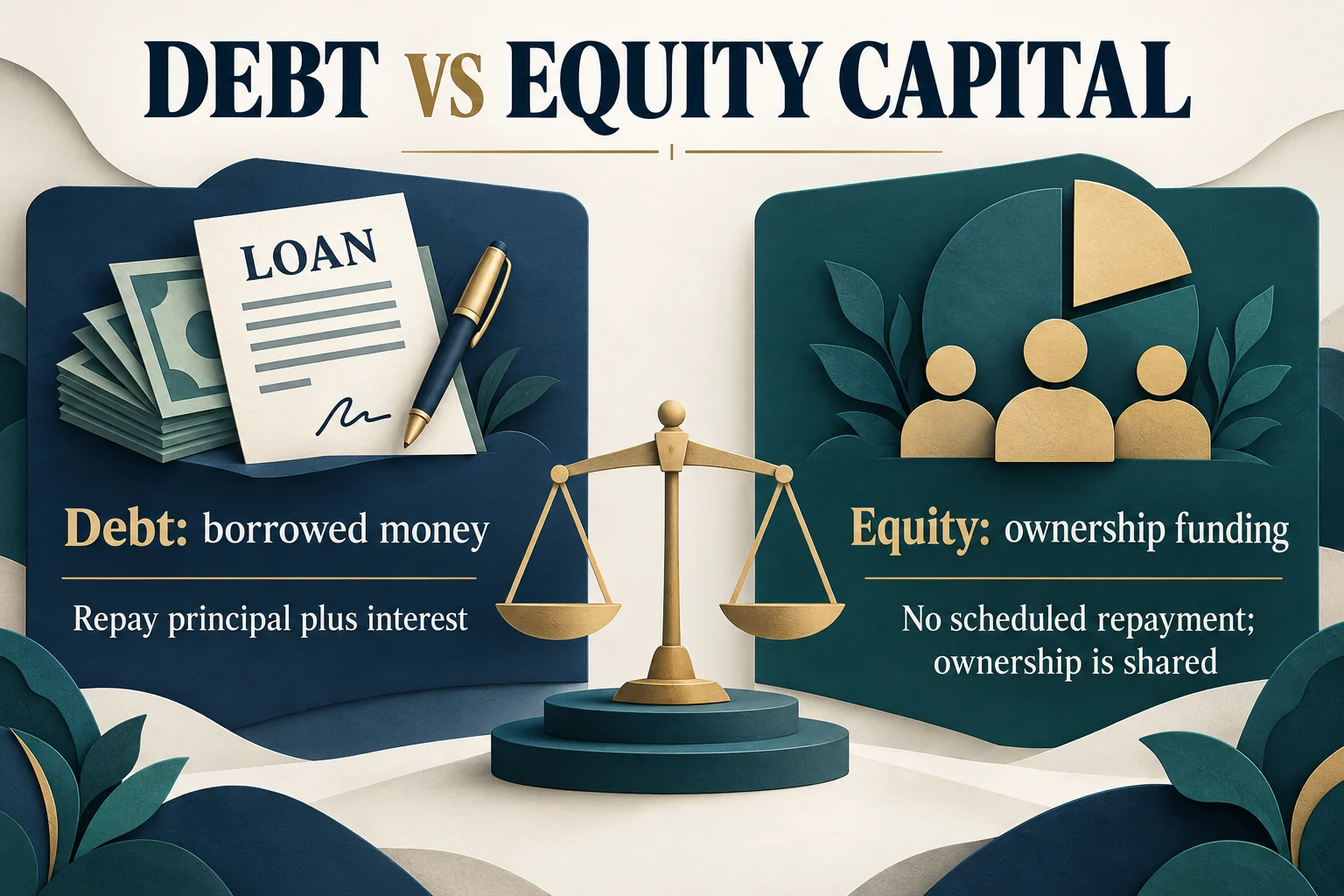
Equity has no mandatory interest payment and normally does not require repayment on a fixed schedule. Its economic cost is dilution: founders surrender part of future profits, voting power, and sale proceeds. A founder who sells 20% for $500,000 retains 80% of the company, but the investor may also influence strategic decisions.
Equity is usually better suited to uncertain, high-growth ventures whose cash flows cannot reliably support debt service. It can be a poor choice for a profitable company that could fund expansion through retained earnings or a reasonably priced loan.
Debt Capital
Debt capital is borrowed money that must be repaid according to a contract. The agreement normally specifies principal, interest rate, maturity, payment dates, collateral, financial covenants, and consequences of default.
Debt preserves ownership, but it transfers risk to the company’s cash flow. A $250,000 loan at 9% annual interest requires approximately $22,500 in annual interest before principal repayment, assuming a simple annual calculation. Actual payment amounts depend on amortization, fees, compounding, and loan structure.
Debt is most appropriate when revenue is reasonably predictable and the project can produce cash above scheduled payments. A lender may also require a personal guarantee, minimum liquidity, or a debt-service coverage ratio, commonly calculated as operating cash flow divided by required debt payments.
Working Capital
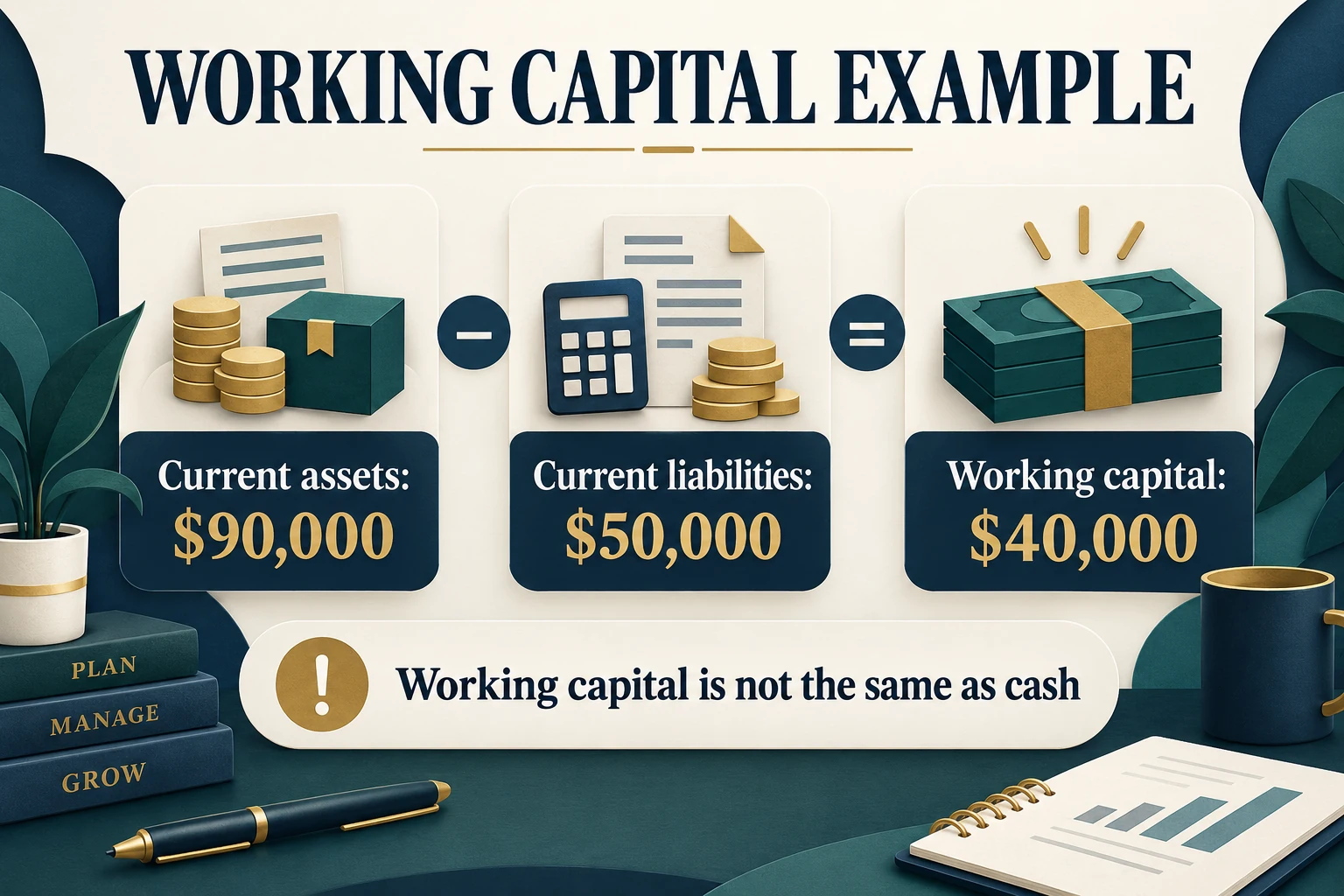
Working capital equals current assets minus current liabilities:
Working capital = current assets – current liabilities
Current assets include cash, accounts receivable, inventory, and short-term investments. Current liabilities include accounts payable, accrued expenses, taxes due, and short-term debt. Positive working capital generally provides a payment cushion, but the quality and timing of those assets matter.
| Example company | Current assets | Current liabilities | Working capital |
|---|---|---|---|
| Retailer A | $420,000 | $300,000 | $120,000 |
| Manufacturer B | $1,100,000 | $1,250,000 | -$150,000 |
| Agency C | $210,000 | $90,000 | $120,000 |
| Contractor D | $680,000 | $500,000 | $180,000 |
Negative working capital is not automatically a failure. Supermarkets often collect customer cash before paying suppliers, creating a structurally negative operating cycle. A contractor with negative working capital may be in danger if receivables are slow and payroll is due weekly.
Fixed Capital and Retained Earnings
Fixed capital consists of resources committed to long-lived assets such as buildings, machinery, vehicles, laboratory equipment, and enterprise software. Fixed capital supports capacity but is less liquid than cash or receivables, so excessive investment can create a funding mismatch.
Retained earnings are cumulative profits kept in the business after dividends or distributions. Retained earnings are not the same as cash because profits can be tied up in inventory, unpaid invoices, or equipment. A company can show $200,000 of retained earnings and have only $20,000 in its bank account.
Trading Capital
Trading capital is money reserved for buying and selling financial instruments or commodities. A brokerage firm, proprietary trading operation, or commodity merchant may separate trading capital from operating capital to control market exposure.
Trading capital differs from ordinary operating capital because its value can change rapidly with market prices. Margin, leverage, concentration, liquidity, and position limits can cause losses that exceed a normal business budget. A company should not use payroll reserves as speculative trading capital.
Is Capital the Same as Cash, Revenue, or Profit?
Capital, cash, revenue, and profit describe different financial concepts. Cash measures liquidity, revenue measures sales, profit measures the surplus after expenses, and capital describes resources committed to operating or expanding the business.
| Term | Meaning | Example | Why it matters |
|---|---|---|---|
| Cash | Money immediately available | $80,000 bank balance | Pays near-term obligations |
| Revenue | Sales earned before expenses | $500,000 annual sales | Measures commercial activity |
| Profit | Revenue minus recognized costs | $60,000 net income | Indicates accounting surplus |
| Capital | Resources funding activity | $300,000 equipment and cash | Supports future production |
| Equity | Assets minus liabilities | $400,000 net ownership value | Measures residual ownership |
A business can have high revenue but insufficient cash when customers pay in 90 days and suppliers require payment in 15 days. A business can report profit while lacking capital for expansion because profits were distributed or absorbed by inventory.
Capital expenditure, often called CapEx, purchases or improves long-lived assets. Operating expenses, or OpEx, cover recurring costs such as wages, rent, utilities, and subscriptions. The distinction affects budgeting, depreciation, tax treatment, and cash planning.
How Do Businesses Obtain Capital?
Businesses obtain capital through owner contributions, retained earnings, loans, credit lines, leases, private investment, crowdfunding, grants, and public markets. The right source depends on business stage, predictable cash flow, collateral, desired control, speed, and regulatory eligibility.
| Funding method | Typical cost or trade-off | Typical access time | Best-fit situation |
|---|---|---|---|
| Owner savings | Opportunity cost, usually no interest | Immediate | Early validation |
| Retained earnings | No lender interest, limited by profit | Immediate | Profitable reinvestment |
| Bank term loan | Often fixed or variable interest plus fees | 2-8 weeks | Predictable expansion |
| Online business loan | Often higher APR and origination fees | 1-5 days | Urgent short-term need |
| Angel investment | Ownership dilution and investor rights | 1-4 months | Early-stage uncertainty |
| Venture capital | Significant dilution and governance terms | 3-9 months | Exceptional growth potential |
| Equipment lease | Lease payments and contract restrictions | 1-4 weeks | Asset acquisition without purchase |
U.S. businesses may investigate Small Business Administration-backed lending, commercial bank products, Community Development Financial Institution programs, or state-level incentives. Eligibility, rates, guarantees, and application requirements change, so a funding offer should be evaluated using its annual percentage rate, total repayment, covenants, and personal-liability provisions.
How Much Does Business Capital Cost?
Business capital costs either an explicit price or an economic sacrifice. Interest and fees are explicit debt costs; dilution is the equity cost; retained earnings carry the opportunity cost of not distributing or investing funds elsewhere.
| Source | Typical stated cost | Repayment or dilution | Common timeline |
|---|---|---|---|
| Retained earnings | 0% interest | No contractual repayment | Immediate |
| Bank loan | 6%-12% annual rate in many ordinary market settings | Principal plus interest | 2-8 weeks |
| Alternative loan | 8%-25% or more APR is possible | Principal, interest, fees | 1-5 days |
| Angel funding | Negotiated ownership percentage | Equity or convertible claim | 1-4 months |
| Venture capital | Negotiated ownership and preferences | Equity, governance rights | 3-9 months |
| Trade credit | Supplier terms, late fees if missed | Invoice payment, often 15-60 days | Immediate to 60 days |
These ranges are typical planning figures, not universal quotes. Credit quality, collateral, benchmark rates, industry volatility, loan duration, investor demand, and geography can materially change the final terms.
A counterintuitive financing rule is that the cheapest nominal capital can be the most expensive operationally. A low-rate loan that forces monthly payments before sales stabilize may destroy more value than a higher-cost equity round with no fixed payment obligation.
Debt Capital Versus Equity Capital: Which Is Better?
Debt is usually preferable when cash flow is predictable, the borrowing cost is manageable, and owners strongly value control. Equity is usually preferable when the company has uncertain cash flow, substantial growth needs, limited collateral, or a project whose payoff may arrive several years later.
| Decision factor | Debt capital | Equity capital |
|---|---|---|
| Ownership | Founders usually retain shares | Investors receive an ownership stake |
| Cash payments | Principal and interest required | No scheduled repayment |
| Control | Lender covenants may restrict actions | Investors may receive votes or board rights |
| Collateral | Often required for bank lending | Usually not collateralized like a loan |
| Tax treatment | Interest may be deductible under applicable rules | Dividends generally are not interest deductions |
| Downside risk | Default can trigger enforcement or insolvency | Loss is shared through reduced ownership value |
| Suitable cash flow | Stable and forecastable | Uncertain or delayed |
| Funding speed | Often weeks | Often months for institutional investors |
Debt is not automatically cheaper than equity. Interest may be tax-deductible, but debt also creates financial distress risk, fees, guarantees, and lost flexibility. Equity avoids scheduled payments, yet a low valuation can transfer a large share of future upside to investors.
A Simple Dilution Example
Suppose a company is valued at $2 million before investment. An investor contributes $500,000 at a $2 million pre-money valuation. The post-money valuation is $2.5 million, and the investor owns 20% because $500,000 divided by $2.5 million equals 20%.
A SAFE or convertible note can postpone the valuation decision, but it does not eliminate dilution. Valuation caps, discounts, accrued interest, and later financing terms determine the eventual ownership transferred.
How Much Capital Does a Business Need?
A business needs enough capital to cover its operating cycle, planned investment, debt obligations, and a defined contingency reserve. A practical starting formula is:
Required capital = startup or expansion costs + peak working-capital gap + contingency reserve – available internal funds
For example, a new service firm may estimate $180,000 in setup and payroll costs, a $70,000 receivables gap, and a $50,000 reserve. If the owner contributes $100,000, the initial external requirement is $200,000.
Runway is calculated as:
Runway in months = available cash divided by average monthly net cash burn
A company with $360,000 available and $60,000 monthly net burn has six months of runway. The calculation becomes misleading when growth changes hiring, inventory, marketing, or payment timing, so management should also model a downside case.
| Business profile | Main capital need | Useful planning measure | Common warning |
|---|---|---|---|
| Pre-revenue startup | Product, hiring, validation | Monthly burn and runway | Hiring ahead of evidence |
| Retail business | Inventory and seasonal cash | Inventory days and gross margin | Stock purchased before demand |
| Manufacturer | Equipment and receivables | Capacity utilization and cash cycle | Fixed costs exceed orders |
| Professional agency | Payroll before collection | Receivable days and backlog | Client invoices paid late |
| Established SMB | Expansion or acquisition | Debt-service coverage | Loan payments reduce flexibility |
Three to six months of operating expenses is a common reserve heuristic, not a universal rule. A seasonal construction company, regulated manufacturer, or heavily inventory-dependent retailer may need more because revenue volatility and replacement lead times exceed those of a subscription software firm.
Which Metrics Reveal a Capital Problem?
Capital problems appear when a company cannot fund obligations, convert investment into sales, or earn an adequate return. Managers should monitor liquidity, leverage, operating efficiency, and return metrics together rather than relying on a single balance-sheet number.
| Metric | Formula | Illustrative result | Interpretation |
|---|---|---|---|
| Current ratio | Current assets / current liabilities | 1.40 | $1.40 of current assets per $1 owed |
| Quick ratio | Cash plus receivables / current liabilities | 0.85 | Liquid assets cover 85% of current liabilities |
| Debt-to-equity | Total debt / owners’ equity | 1.20 | $1.20 debt per $1 equity |
| Cash conversion cycle | Inventory days + receivable days – payable days | 48 days | Cash tied up for 48 operating days |
| Return on invested capital | Operating profit after tax / invested capital | 12% | Operating return on committed funds |
| Debt-service coverage | Operating cash flow / debt payments | 1.50 | $1.50 cash flow per $1 payment |
Ratios require industry context. A 1.4 current ratio may be adequate for one company and weak for another with volatile inventory. More important than a single ratio is the direction: falling liquidity, rising receivable days, and increasing short-term borrowing create a recognizable deterioration pattern.
What Capital Mistakes Damage Businesses?
The most damaging mistakes are mismatching funding duration with asset life, ignoring cash conversion, over-borrowing, and accepting equity terms without modeling future dilution. These errors can affect a solvent company before its income statement reports a loss.
- Funding long-lived assets with short-term debt: A five-year machine financed by a 90-day facility creates refinancing risk.
- Treating profit as available cash: Uncollected invoices and inventory can absorb reported earnings.
- Borrowing against optimistic forecasts: Debt should be stress-tested against lower sales, delayed collections, and higher costs.
- Giving away too much ownership early: A poorly priced seed round can make later fundraising and founder incentives difficult.
- Ignoring covenants: A company can have cash but breach a leverage or minimum-liquidity requirement.
- Using emergency finance repeatedly: Fast online borrowing can become a permanent high-cost funding cycle.
What Should a Company Do During a Working-Capital Crisis?
A company facing a working-capital crisis should first produce a weekly 13-week cash forecast, then prioritize payroll, taxes, essential suppliers, and legally binding obligations. Management should accelerate invoicing, negotiate supplier terms, pause nonessential spending, and seek financing before cash reaches zero.
A forecast should list opening cash, expected customer receipts, payroll, taxes, rent, debt payments, inventory purchases, and one-time expenses by week. Scenario testing at 10%, 20%, and 30% below expected collections reveals whether the business needs a credit line, equity injection, asset sale, or restructuring.
Do not solve a structural loss with repeated short-term borrowing. Emergency capital can buy time, but it cannot repair negative gross margins, unprofitable pricing, or permanently excessive fixed costs.
Which Capital Strategy Fits Each Business Stage?
Early-stage companies generally need risk-tolerant capital, established small businesses often benefit from debt or retained earnings, and high-growth companies may pursue equity to fund rapid expansion. The recommendation changes when revenue predictability, collateral, control preferences, and growth speed change.
| Business stage | Preferred starting sources | Usually avoid first | Main decision test |
|---|---|---|---|
| Idea stage | Founder funds, grants, angel capital | Large amortizing debt | Can the concept validate cheaply? |
| Early revenue | Retained earnings, angels, small credit line | Debt sized to unproven forecasts | Are repeat sales emerging? |
| Established SMB | Retained earnings, bank loan, SBA-backed loan | Unpriced equity dilution | Can cash flow cover payments? |
| High-growth technology | VC, strategic equity, venture debt later | Slow financing that limits growth | Does speed create defensible scale? |
| Asset-heavy company | Equipment loan, lease, equity | Short-term debt for fixed assets | Does asset output exceed financing cost? |
Capital selection is a portfolio decision, not a contest to find one perfect source. A company may combine owner equity for risk absorption, a revolving credit line for seasonal needs, and a term loan for equipment.
Frequently Asked Questions About Business Capital
Can a profitable business run out of capital?
Yes. A profitable business can run out of cash when customers pay slowly, inventory expands, loan payments accelerate, or profits are invested in equipment. Profit is an accounting measure, while capital and liquidity determine whether the company can meet obligations when they fall due.
Is owner investment considered capital?
Yes. Money, equipment, or other assets contributed by an owner are generally treated as contributed or owner’s capital. The accounting entry depends on the legal structure, but the economic effect is funding supplied in exchange for an ownership claim rather than a normal sale.
Is working capital an asset?
Working capital is a calculated difference, not a standalone asset account. It equals current assets minus current liabilities. Cash, receivables, and inventory are assets; accounts payable and accrued expenses are liabilities. Positive working capital indicates a net short-term resource position.
What is circulating capital?
Circulating capital is capital that moves through the operating cycle, including cash, inventory, and receivables. Unlike fixed capital such as machinery or buildings, circulating capital is expected to be converted, consumed, or replenished during normal business activity.
Should a small business use debt or equity?
A small business should generally consider debt when cash flow is stable, repayment capacity is documented, and owners want to preserve control. Equity may be more suitable when revenue is uncertain, collateral is limited, or the company needs substantial funding before it can generate predictable operating cash.
What is the difference between capital and working capital?
Capital is the broader pool of financial resources committed to a business. Working capital is the short-term portion calculated as current assets minus current liabilities. A company can have substantial total capital invested in buildings and equipment while having insufficient working capital for payroll and supplier invoices.
The Bottom Line
Capital meaning in business is the financial and productive resources used to operate, invest, and create future revenue. Equity avoids scheduled repayment but dilutes ownership, debt preserves ownership but increases cash-flow risk, and working capital determines whether daily obligations can be paid. The strongest funding decision matches capital duration, cost, risk, and control with the company’s actual cash-generation ability.