
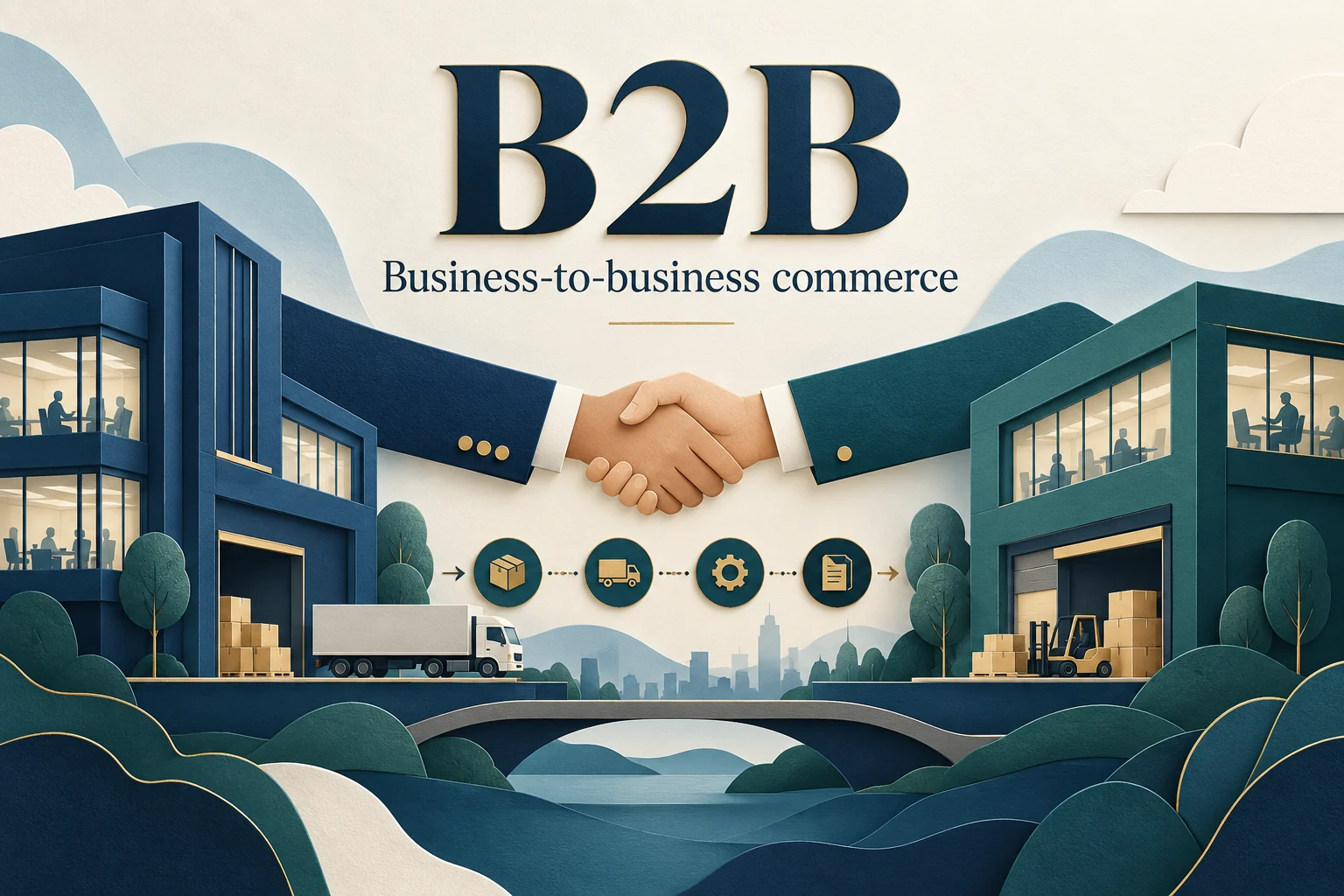
B2B meaning in business is business-to-business commerce, where one organization sells products, services, software, or components to another organization. B2B transactions support operations, production, compliance, or revenue generation, and usually involve multiple stakeholders, formal purchasing controls, negotiated terms, and ongoing account management.
Key Facts at a Glance
- B2B means one business sells to another business rather than directly to an individual consumer.
- B2B buyers typically evaluate measurable value, operational fit, risk, security, and total cost.
- A B2B purchase may involve a user, technical evaluator, procurement officer, finance reviewer, legal team, and economic buyer.
- Typical B2B payment terms include immediate payment, Net 30, Net 60, and Net 90.
- B2B sales cycles range from days for low-risk supplies to more than 12 months for enterprise technology.
- B2B includes manufacturing, wholesale, distribution, professional services, SaaS, logistics, and business marketplaces.
What Is the B2B Meaning in Business?
B2B means business-to-business, a commercial relationship in which the buyer and seller are organizations. The purchased item can be physical, digital, or knowledge-based, provided the transaction helps the buyer operate, manufacture, distribute, comply, or serve its own customers.
A manufacturer buying aluminum from a supplier is B2B. A hospital subscribing to electronic health-record software is B2B. A retailer purchasing inventory from a wholesaler is also B2B, even when the retailer later sells those products to consumers.
B2B describes the relationship between the parties, not a specific sales channel. A transaction can occur through a salesperson, procurement portal, distributor, electronic data interchange (EDI), online marketplace, or self-service ecommerce website.
What Does B2B Include?
| B2B category | Seller example | Buyer example | Commercial output |
|---|---|---|---|
| Raw materials | Steel mill | Automobile manufacturer | Sheet steel and coils |
| Components | Intel | Dell or Lenovo | Processors and chips |
| Wholesale goods | Food distributor | Restaurant chain | Packaged food inventory |
| Professional services | Accenture | Commercial bank | Consulting and implementation |
| SaaS software | Salesforce | Regional insurer | CRM licenses and support |
| Logistics | DHL Supply Chain | Medical-device producer | Warehousing and transport |
The buyer usually has a business purpose for the purchase. That purpose may be reducing labor, increasing production capacity, meeting a regulation, lowering defects, or generating additional revenue.
How Does a B2B Transaction Work?
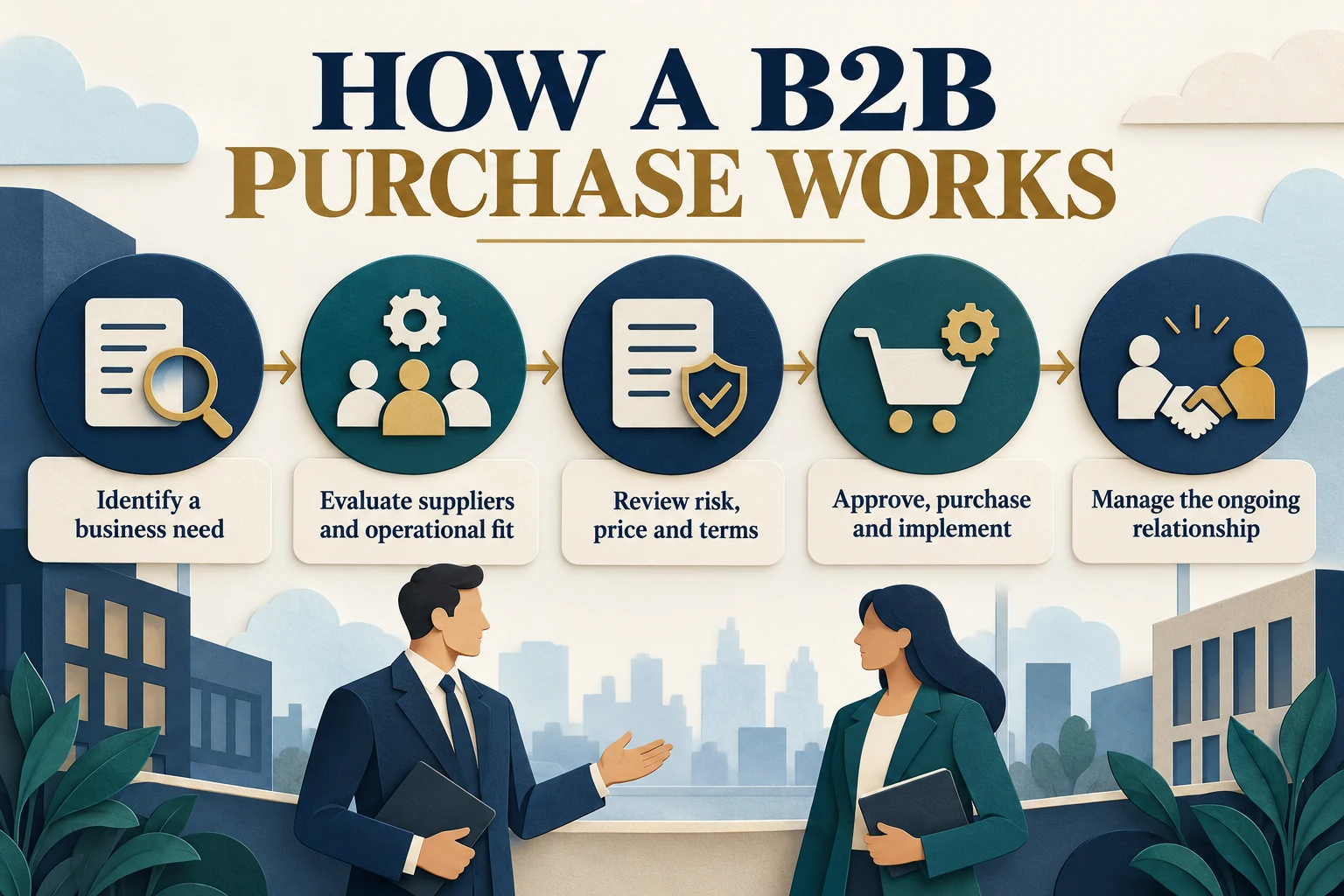
A B2B transaction normally moves through six stages: need definition, supplier research, proposal or quotation, evaluation, contracting, and fulfillment with ongoing account management. The sequence becomes more formal as the purchase becomes more expensive, strategic, regulated, or difficult to reverse.
| Stage | Main question | Common document | Typical duration |
|---|---|---|---|
| Need identification | What operational problem exists? | Business case or specification | 1-20 business days |
| Supplier sourcing | Which vendors can meet requirements? | Vendor shortlist | 3-30 business days |
| Proposal or quote | What will the solution cost and include? | RFP, RFQ, or proposal | 1-8 weeks |
| Evaluation | Which offer has acceptable value and risk? | Scoring matrix | 1-12 weeks |
| Contracting | What are the legal and commercial terms? | MSA, SOW, or purchase order | 1-12 weeks |
| Fulfillment and renewal | Was the promised result delivered? | Invoice, SLA, QBR, renewal | 1 month to multi-year |
The process is not always linear. A procurement team may request security documents before a demonstration, or finance may reject a technically preferred supplier because its payment terms create unacceptable working-capital exposure.
Who Makes a B2B Buying Decision?
A B2B buying committee commonly includes five roles, although one person may hold several roles in a small company.
- User: Works with the product or service daily.
- Technical evaluator: Tests integration, performance, security, or reliability.
- Champion: Builds internal support for the purchase.
- Economic buyer: Controls the budget and approves financial value.
- Procurement or legal reviewer: Negotiates commercial, contractual, and compliance terms.
A common sales failure occurs when a vendor wins the user but never reaches the economic buyer. User enthusiasm does not equal budget authority.
What Are the Main Types of B2B Business?
The main B2B types are product supply, wholesale and distribution, professional services, software platforms, manufacturing partnerships, and managed operational services. Each type has different pricing logic, buying evidence, delivery obligations, and retention mechanisms.
| B2B type | Typical pricing | Primary proof | Main retention factor |
|---|---|---|---|
| Manufacturing supply | Unit price, volume tier | Samples, certifications, defect rate | Quality and delivery reliability |
| Wholesale distribution | Margin, case quantity | Inventory availability, fill rate | Assortment and replenishment |
| Professional services | Fixed fee, hourly, retainer | Credentials, case evidence | Expertise and relationship |
| SaaS platform | Per seat, usage, tier, annual contract | Trial, security review, ROI case | Workflow integration and data |
| Managed service | Monthly fee, service level | SLA, response time, outcomes | Operational dependence |
| Contract manufacturing | Setup fee plus unit cost | Production audit and capacity | Qualified processes and scale |
Supply-Centric B2B
Supply-centric B2B connects producers, distributors, and manufacturers. A component supplier may sell thousands of units to an original equipment manufacturer, while a distributor aggregates products from many producers and resells them to smaller buyers.
The operational metrics are measurable. Buyers inspect lead time, minimum order quantity, defect rate, certifications, forecast accuracy, inventory availability, and freight cost. A low unit price can lose the deal when late delivery stops a production line.
Service-Centric B2B
Service-centric B2B sells specialized labor, judgment, execution, or accountability. Examples include accounting, cybersecurity, engineering, recruitment, legal work, advertising, consulting, and facilities management.
Service contracts may use hourly billing, fixed project fees, retainers, milestone payments, or outcome-based pricing. Buyers compare relevant experience, delivery capacity, security controls, staff continuity, and the provider’s ability to produce a defined business result.
Software and Platform B2B
B2B software includes SaaS applications, infrastructure, analytics, cybersecurity, enterprise resource planning, customer relationship management, and workflow automation. The buyer evaluates more than features because implementation, data migration, access controls, uptime, support, and renewal economics affect the real cost.
A $50-per-user monthly plan can become a major commitment after implementation, integrations, training, premium support, and minimum seat requirements are included.
How Is B2B Different From B2C?
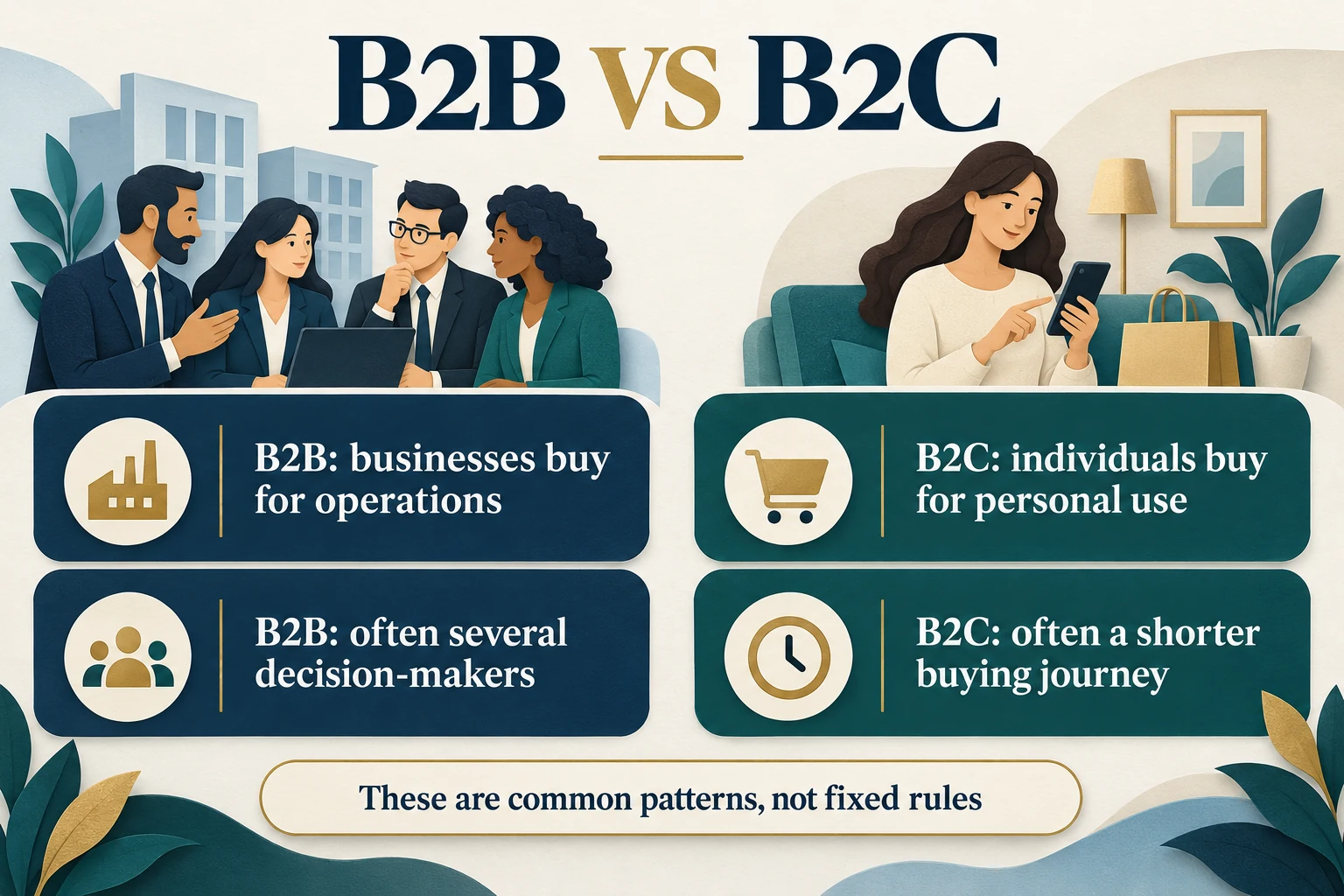
B2B differs from B2C because organizational purchases involve business outcomes, formal approval, multiple stakeholders, and negotiated commercial terms, whereas B2C purchases usually involve one consumer making a personal decision at a posted price.
| Attribute | B2B | B2C |
|---|---|---|
| Buyer | Company, institution, or government contractor | Individual consumer or household |
| Purchase purpose | Operations, production, compliance, revenue | Personal use, convenience, status, enjoyment |
| Decision group | Often 2-10 stakeholders | Usually 1-2 people |
| Price structure | Quote, tier, contract, negotiated discount | Posted price, promotion, subscription |
| Payment | Invoice, card, purchase order, terms | Card, wallet, cash, financing |
| Sales cycle | 1 day to 18 months | Seconds to several weeks |
| Order value | Often $100 to $1 million or more | Often $5 to $5,000 |
| Retention driver | Integration, service, switching cost, results | Satisfaction, habit, price, brand preference |
The distinction is behavioral, not absolute. B2B marketing can use emotion, but the emotional message must support a business case. A buyer may want confidence, professional status, or reduced anxiety, yet procurement still needs evidence of cost, risk, and operational impact.
Is Wholesale the Same as B2B?
Wholesale is a type of B2B commerce, but B2B is broader than wholesale. Wholesale usually involves resale inventory, while B2B also includes software, consulting, machinery, maintenance, transportation, financial services, and outsourced operations.
A wholesale transaction typically emphasizes quantities, margins, inventory, and replenishment. A cybersecurity subscription may involve no physical inventory, but it remains B2B because one organization sells protection and software access to another.
What Does B2B Usually Cost and How Long Does It Take?
B2B costs and timelines vary by risk, contract value, integration complexity, and regulation. Typical small-business purchases can close in one to four weeks, while enterprise technology, industrial equipment, and regulated services often require three to twelve months.
| Purchase profile | Typical contract value | Typical decision time | Common payment |
|---|---|---|---|
| Office or operating supplies | $100-$10,000 | 1-10 business days | Card or Net 30 |
| Small SaaS deployment | $1,200-$25,000 annually | 1-8 weeks | Annual invoice |
| Professional services project | $10,000-$250,000 | 1-4 months | Milestones or Net 30 |
| Mid-market platform | $25,000-$250,000 annually | 2-9 months | Annual or quarterly |
| Industrial equipment | $50,000-$5 million | 3-18 months | Deposit and milestones |
| Enterprise transformation | $250,000-$10 million or more | 6-24 months | Contract schedule |
These are practitioner ranges, not universal benchmarks. A $5,000 purchase may require weeks of security review at a bank, while a $100,000 order can close quickly when an existing supplier has already passed qualification.
B2B sellers should separate four financial measures:
- Average order value: Revenue from one transaction.
- Annual contract value: Contracted recurring revenue for one year.
- Customer lifetime value: Expected gross profit over the relationship.
- Customer acquisition cost: Sales and marketing expense required to win the account.
A large contract is not automatically profitable. Implementation labor, support obligations, financing costs, returns, commissions, and renewal risk must be deducted.
What Are the Advantages and Disadvantages of B2B?
B2B offers larger contracts, repeat purchasing, specialization, and more predictable revenue, but it also creates longer sales cycles, higher acquisition costs, payment delays, and customer concentration risk. The model works best when the seller can prove a measurable operational or financial result.
| Advantage | Mechanism | Useful measure | Main limitation |
|---|---|---|---|
| Repeat revenue | Renewal, replenishment, or retainer | Renewal rate | Poor delivery causes contract loss |
| Larger contracts | Wider business impact | ACV or gross profit | More approval friction |
| Specialization | Narrow expertise commands value | Win rate in niche | Limited total market |
| Expansion revenue | More users, sites, products | Net revenue retention | Requires adoption |
| High switching cost | Integration or process dependence | Churn and migration effort | Can create customer resentment |
| Risk | How it appears | Early warning | Control |
|---|---|---|---|
| Concentration | One client dominates revenue | Account exceeds 15%-20% | Segment and diversify |
| Slow cash collection | Invoice remains unpaid | Receivables exceed terms | Credit checks and deposits |
| Scope creep | Service expands without payment | Extra requests increase | Change-order process |
| Procurement delay | Approval repeatedly moves | No economic-buyer access | Mutual action plan |
| Failed adoption | Customer buys but does not use | Low activation or usage | Implementation and training |
A practitioner rule is to track gross profit by account, not revenue alone. A $500,000 account requiring a dedicated team may produce less profit than ten $75,000 accounts with standardized delivery.
How Should a Company Build a B2B Offer?
A strong B2B offer starts with one expensive, recurring business problem and defines the measurable result, buyer, proof, delivery method, and commercial boundary. Broad claims such as “improve efficiency” are weak until converted into a target such as reducing invoice processing time from five days to two.
Use this sequence:
- Select a narrow customer segment. Specify industry, company size, operating system, and trigger event.
- Define the operational problem. Quantify wasted time, lost revenue, defects, risk, or delay.
- Identify the economic buyer. Confirm who owns the budget and who carries the consequence.
- Package the deliverable. State inclusions, exclusions, implementation time, support, and service levels.
- Create proof. Use a pilot, benchmark, reference customer, sample report, or controlled demonstration.
- Set commercial terms. Include price, minimum commitment, renewal, payment timing, liability, and termination.
- Design onboarding. Assign owners, milestones, training, data requirements, and adoption measures.
A startup does not need thousands of customers to validate B2B demand. It does need several buyers willing to pay for the same defined outcome without requiring a custom company every time.
What Is B2B Ecommerce?
B2B ecommerce is digital purchasing between organizations through a web store, procurement portal, marketplace, EDI connection, or account-specific ordering system. B2B ecommerce must support business rules such as customer-specific pricing, tax exemption, approval workflows, purchase orders, credit limits, and bulk quantities.
| Capability | Consumer ecommerce | B2B ecommerce requirement |
|---|---|---|
| Price | Public price | Account, tier, or contract price |
| Checkout | Immediate payment | PO, credit, approval, or invoice |
| Quantity | One-off basket | Case pack, pallet, MOQ, or quote |
| Users | One account holder | Roles, permissions, subsidiaries |
| Catalog | General products | Contract assortment and technical data |
| Integration | Payment and shipping | ERP, CRM, EDI, inventory, tax |
Digital ordering does not eliminate sales. It removes repetitive administrative work so salespeople can handle configuration, negotiation, expansion, and exceptions.
What Are Common B2B Mistakes?
The most damaging B2B mistakes are targeting a user without budget authority, selling features without financial evidence, accepting uncontrolled customization, and neglecting implementation after contract signature. These failures increase acquisition cost and create churn even when the product itself functions correctly.
- Treating every lead as equally valuable: Score fit, urgency, authority, budget, and implementation feasibility.
- Ignoring procurement requirements: Prepare security, insurance, tax, accessibility, privacy, and supplier documents early.
- Using consumer-style messaging alone: Pair aspiration with quantified savings, risk reduction, revenue, or productivity.
- Underpricing complex delivery: Model onboarding, support, integrations, travel, and account management before quoting.
- Failing to define success: Put baseline, target, owner, measurement method, and review date into the agreement.
- Relying on one major customer: Set an internal concentration limit, commonly 15%-20% of revenue, and build other segments before the limit becomes dangerous.
B2B is not ideal for every product. It is a poor fit when the buyer cannot measure the problem, switching costs are negligible, demand is highly impulsive, or the sales effort costs more than the achievable gross profit.
How Does B2B Compare With B2G and B2B2C?
B2B describes sales between businesses, B2G describes sales to government entities, and B2B2C describes a business selling through another business to reach consumers. The difference affects contracting, compliance, distribution control, and the location of the end-user relationship.
| Model | Seller sells to | End user | Distinct requirement |
|---|---|---|---|
| B2B | Another business | Buyer’s organization or customers | ROI and commercial fit |
| B2G | Government agency | Public institution or citizens | Tender, compliance, public rules |
| B2B2C | Intermediary business | Consumer | Partner economics and end-user demand |
| D2C | Individual consumer | Same consumer | Brand, conversion, fulfillment |
A software company selling through an accounting firm has a B2B2C structure if the accounting firm distributes the product to its consumer clients. The software provider must satisfy the partner and preserve a workable end-user experience.
Frequently Asked Questions About B2B
What Is an Example of a B2B Company?
Examples include Microsoft selling cloud services to enterprises, Siemens selling industrial equipment to manufacturers, DHL providing logistics to retailers, and Accenture delivering consulting to banks. A company can operate both B2B and B2C divisions, so classification depends on the buyer in the specific transaction.
Is B2B Better Than B2C?
B2B is better when a company can solve a costly operational problem and support longer sales cycles, implementation, and account management. B2C may be better when demand is frequent, the product is easy to understand, and the business can acquire consumers profitably at high volume.
What Is B2B Sales?
B2B sales is the process of identifying organizational prospects, diagnosing business needs, coordinating stakeholders, presenting a commercial case, negotiating terms, and securing an agreement. B2B sales may be direct, partner-led, product-led, channel-based, or supported by account-based marketing.
What Is a B2B Marketplace?
A B2B marketplace is a digital platform where organizations discover, compare, buy, or sell business goods and services. Alibaba, Thomasnet, and specialized procurement exchanges are examples, although marketplace quality depends on supplier verification, product data, payment protection, logistics, and dispute handling.
What Does B2B Mean in Accounting?
In accounting, B2B means a business transaction recorded between organizational entities. The transaction may create accounts receivable for the seller and accounts payable for the buyer, with tax treatment, purchase orders, invoices, and payment terms documented according to applicable rules.
What Is the Bottom Line on B2B Meaning in Business?
B2B meaning in business is the exchange of products, services, software, or operational capability between organizations. The model succeeds when the seller connects a clearly defined business problem to measurable value, reaches the complete buying committee, controls delivery economics, and retains the account through reliable results.