
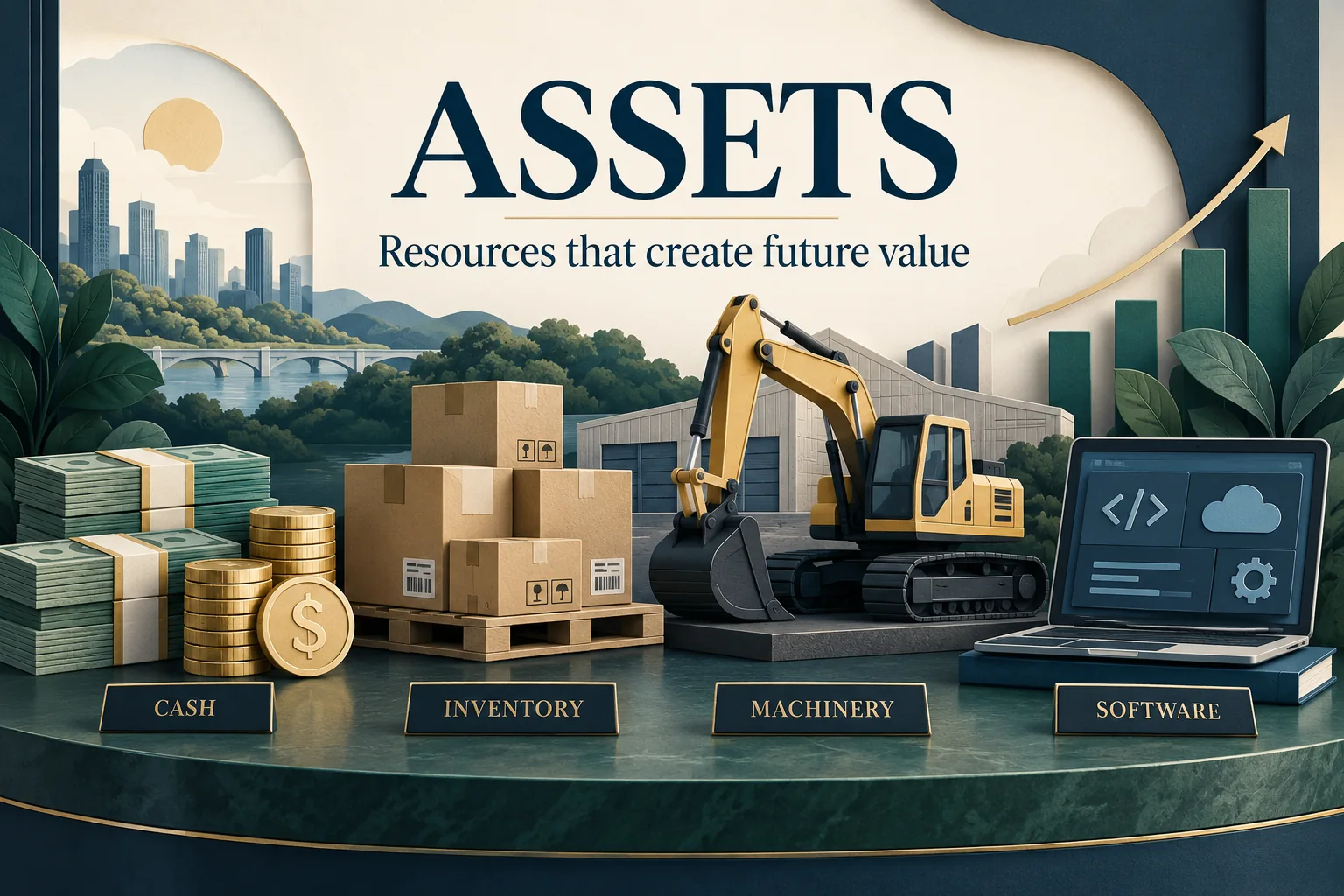
A business asset is an economic resource that a company owns or controls because of a past event and expects to produce future benefits. Assets include cash, inventory, equipment, buildings, receivables, software, patents, and certain contractual rights, but an item becomes an accounting asset only when recognition rules are satisfied.
Key Facts at a Glance
- A business asset can create revenue, reduce costs, provide operating capacity, or protect future cash flow.
- Current assets normally convert to cash, sell, or get consumed within 12 months or one operating cycle.
- Non-current assets support the business beyond the short term and include property, equipment, long-term investments, and qualifying intangible assets.
- Depreciation allocates the cost of a tangible asset, while amortization generally allocates the cost of a finite-lived intangible asset.
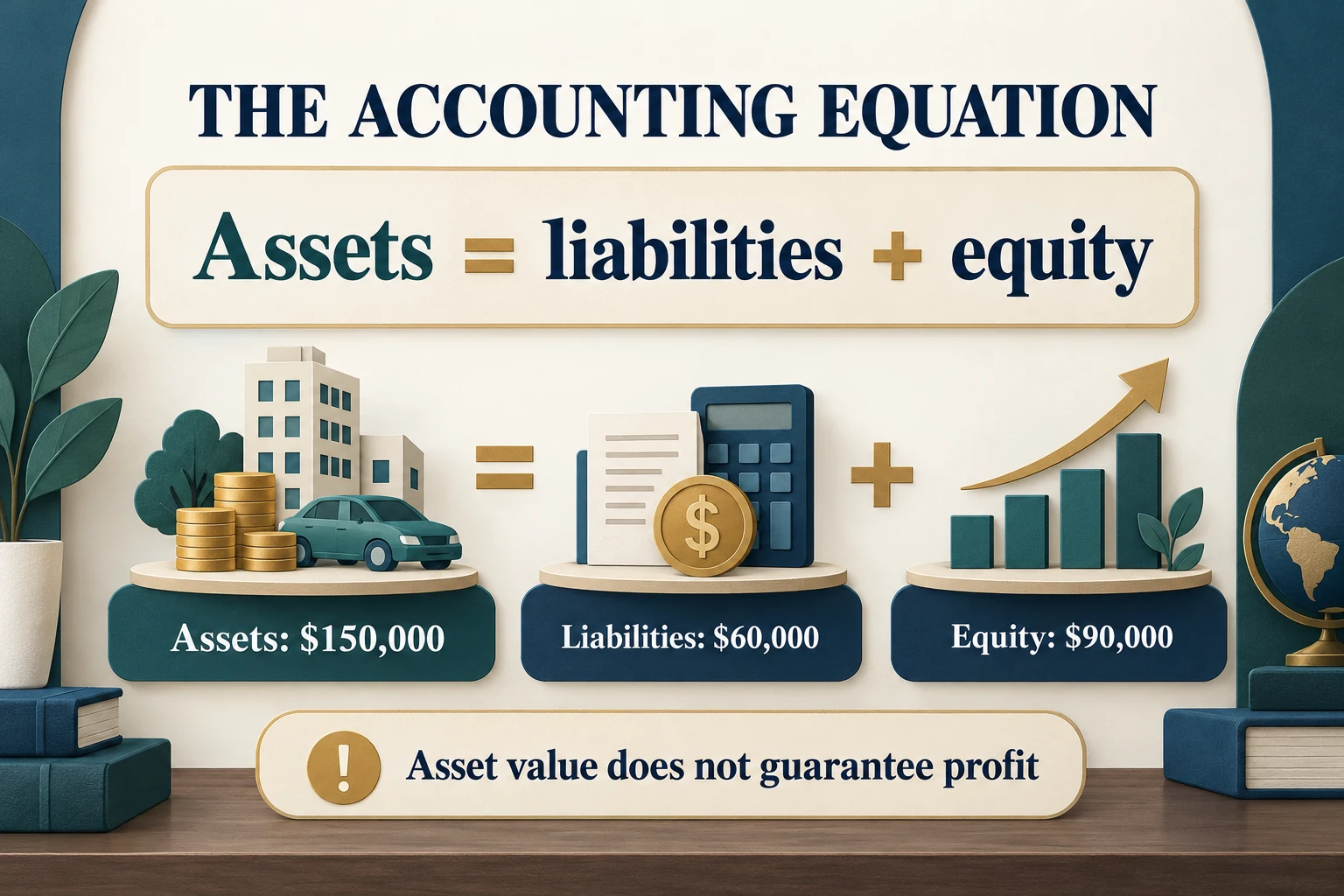
- The balance-sheet equation is Assets = Liabilities + Equity, but a high asset balance does not automatically mean high profitability.
- An asset can have substantial business value without appearing on the balance sheet, especially when the company created the brand, workforce, or customer relationships internally.
What Is the Meaning of an Asset in Business?
The meaning of an asset in business is an economic resource controlled by an organization that is expected to provide future economic benefits. Control matters more than simple legal ownership in some arrangements, while a future benefit may take the form of cash receipts, lower costs, production capacity, legal protection, or access to customers.
The Financial Accounting Standards Board describes an asset as a present right controlled by an entity to an economic benefit. International Financial Reporting Standards use a closely related concept: a present economic resource controlled by the entity because of past events. The frameworks differ in detailed recognition rules, but both focus on control, an existing resource, and probable economic benefit.
A desk purchased for $1,200 is usually a tangible fixed asset if the company expects to use it for several years. A $1,200 monthly advertising campaign is normally an expense because its benefit is consumed through promotion and does not create a separately controlled resource with a reliably measurable future benefit.
What Makes Something an Asset?
An item normally needs four characteristics before management records it as an asset:
- A past event created the resource. The company bought equipment, delivered goods, signed a contract, or completed another transaction.
- The company controls access to the benefit. Control may arise from ownership, enforceable rights, or contractual terms.
- Future economic benefit is expected. The resource should generate cash, reduce spending, or support productive activity.
- The amount can be measured reliably. Accounting records require a defensible monetary value.
The fourth test creates important boundaries. Employee skill, internally built reputation, and expected future sales may be valuable, but accounting standards often prohibit recognizing them as balance-sheet assets because the company cannot separately control or reliably measure them.
How Do Business Assets Work?
Business assets work by converting invested capital into operating capacity, revenue, cost savings, or financial claims. A company purchases a machine, uses it to manufacture products, sells those products, collects receivables, and eventually replaces or disposes of the machine.
The Asset Life Cycle
| Stage | Business action | Accounting result | Example |
|---|---|---|---|
| Acquisition | Buy, construct, receive, or lease a resource | Record cost or qualifying right | $80,000 production machine |
| Recognition | Apply control, benefit, and measurement tests | Capitalize or expense | Capitalize machine cost |
| Deployment | Use resource in operations | Generate sales or reduce costs | Machine produces 4,000 units |
| Consumption | Use economic benefit over time | Record depreciation, amortization, or impairment | $8,000 annual depreciation |
| Monitoring | Check condition, value, and existence | Update estimates or write down asset | Scrap obsolete equipment |
| Disposition | Sell, trade, abandon, or retire | Remove asset and record gain or loss | Sell machine for $25,000 |
Capitalization does not mean an asset never affects profit. Capitalized cost generally reaches the income statement later through depreciation, amortization, cost of sales, impairment, or a disposal loss.
What Is the Accounting Equation?
The accounting equation, Assets = Liabilities + Equity, means every recognized resource is financed by creditor claims, owner claims, or both. If a company borrows $100,000 to buy equipment, assets increase by $100,000 and liabilities increase by $100,000; equity does not increase from the purchase alone.
The equation is a control mechanism, not a performance score. A company can have substantial assets and weak returns if inventory is obsolete, equipment is idle, or receivables cannot be collected. Balance-sheet totals also depend on accounting rules, so internally created brand value may be absent while acquired goodwill appears after an acquisition.
What Are the Main Types of Business Assets?
Business assets are classified by liquidity, physical substance, operating role, and accounting treatment. The same asset can belong to several categories: a delivery van may be tangible, non-current, operating, and depreciable.
| Classification basis | Category | Typical examples | Main decision question |
|---|---|---|---|
| Liquidity | Current asset | Cash, receivables, inventory | Can it convert or be consumed within 12 months? |
| Liquidity | Non-current asset | Building, machinery, patent | Will it support activity beyond the short term? |
| Physical form | Tangible asset | Vehicle, furniture, factory | Can the resource be physically handled? |
| Physical form | Intangible asset | Software, patent, trademark | Does value arise from rights or nonphysical resources? |
| Operating role | Operating asset | Store, inventory, production line | Does core activity depend on it? |
| Operating role | Non-operating asset | Vacant land, excess securities | Does it sit outside ordinary operations? |
What Are Current Assets?
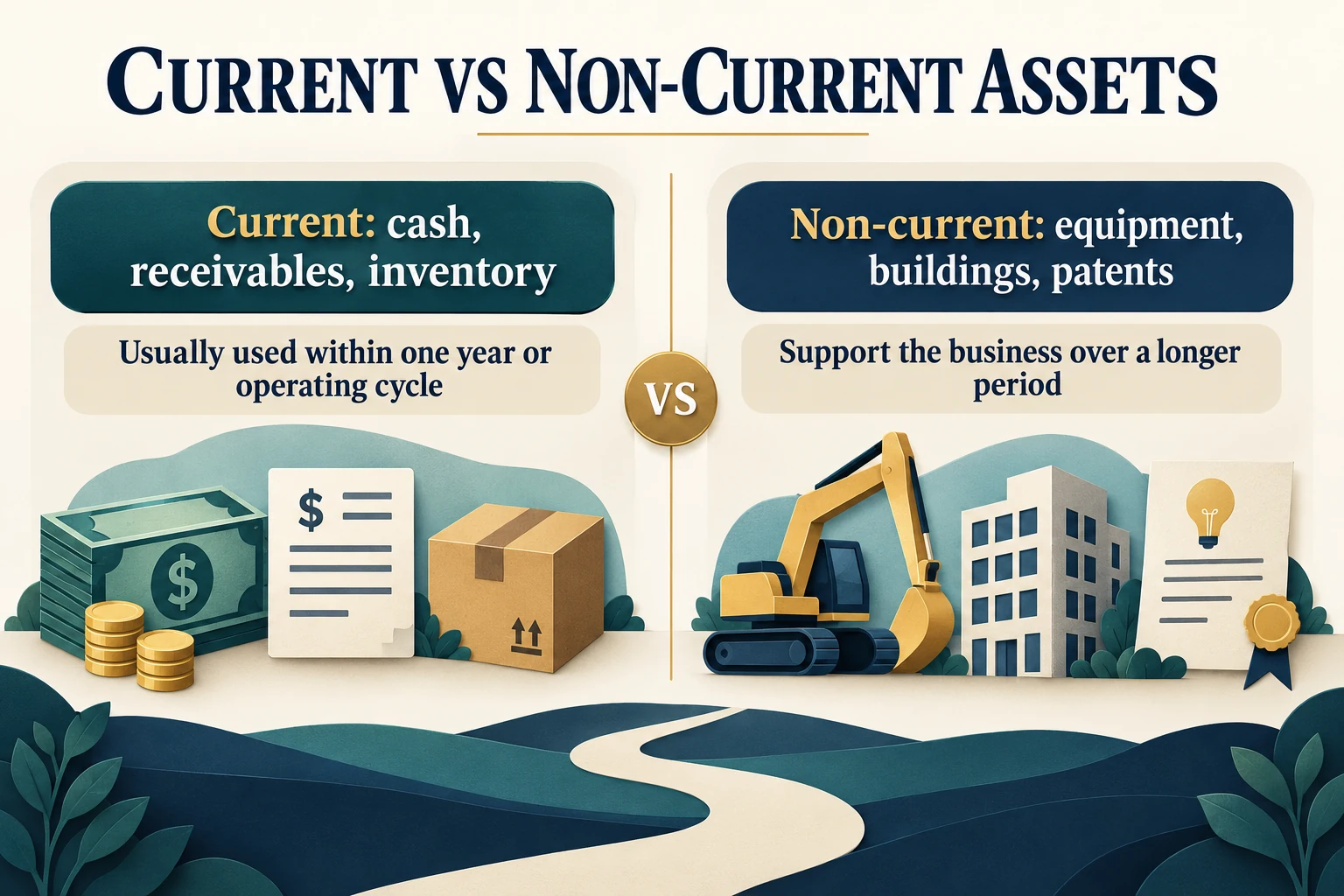
Current assets are resources expected to become cash, be sold, or be consumed within 12 months or the normal operating cycle, whichever is longer. Cash, trade receivables, marketable securities, prepaid expenses, and inventory are common examples.
Inventory can remain current even when a retailer’s operating cycle exceeds one year. Accounts receivable are current when collection is expected soon, but a doubtful balance may require an allowance that reduces its reported carrying amount.
| Current asset | Recognition example | Typical conversion period | Common risk |
|---|---|---|---|
| Cash | Bank balance of $45,000 | Immediate | Fraud or restricted access |
| Trade receivables | Customer invoice for $12,000 | 30-90 days | Nonpayment |
| Inventory | 600 units costing $18 each | 30-180 days | Obsolescence |
| Prepaid insurance | $6,000 covering 12 months | 1-12 months | Incorrect period allocation |
| Short-term investment | Treasury bill maturing in 90 days | Under 12 months | Market or liquidity risk |
What Are Non-Current Assets?
Non-current assets support the business for more than one year or one operating cycle. Property, plant and equipment, long-term investments, right-of-use assets, patents, and finite-lived software commonly appear in this category.
“Fixed asset” is often used for property, plant, and equipment, but the term can mislead. A fixed asset does not need to remain permanently fixed in place, and land is usually not depreciated because it normally has an indefinite useful life.
What Are Tangible and Intangible Assets?
Tangible assets have physical substance, while intangible assets derive value from contractual rights, legal protection, technology, or identifiable relationships. Equipment is tangible; a patent is intangible. Both can support revenue and both require impairment review when their recoverable value falls.
| Asset | Type | Typical useful-life range | Usual cost allocation |
|---|---|---|---|
| Laptop computer | Tangible | 3-5 years | Depreciation |
| Delivery vehicle | Tangible | 5-8 years | Depreciation |
| Factory machinery | Tangible | 10-15 years | Depreciation |
| Purchased software | Intangible | 3-7 years | Amortization |
| Patent | Intangible | Legal or economic life | Amortization if finite-lived |
| Goodwill | Intangible | Indefinite for accounting | Impairment testing, not routine amortization under US GAAP |
Useful lives are estimates, not universal facts. Tax authorities, industry conditions, expected usage, maintenance, technology change, and accounting standards can produce different schedules.
Which Business Assets Matter Most in Practice?
The most important assets depend on the company’s economic model. A manufacturer depends heavily on plant, inventory, and receivables; a software company may depend more on cash, code, contracts, servers, and acquired intellectual property.
How Do Assets Generate Business Value?
| Business model | Primary assets | Value mechanism | Warning indicator |
|---|---|---|---|
| Retail store | Inventory, cash, fixtures | Product availability and sales volume | Stockouts or aged inventory |
| Manufacturer | Machinery, raw materials, finished goods | Production capacity and unit margins | Low utilization |
| Consulting firm | Cash, receivables, contracts | Billable expertise and collection | Unbilled work aging |
| Software company | Cash, code, licenses, contracts | Recurring subscriptions and low delivery cost | High churn |
| Property company | Buildings, land, leases | Rent and asset appreciation | Vacancy or refinancing pressure |
A strategically valuable resource is not always a reported asset. A trained workforce can drive sales but is generally expensed through wages. A loyal customer base may create repeat purchases but may not be recognized unless acquired in a transaction and measured under applicable rules.
What Is the Difference Between an Asset and an Expense?
An asset is a resource whose benefit extends beyond the current reporting period; an expense is a cost recognized because the related benefit has been consumed or does not qualify for capitalization. Timing, expected life, materiality, and accounting policy determine the treatment.
| Purchase or cost | Typical treatment | Reason | Example |
|---|---|---|---|
| Office rent for April | Expense | Benefit is consumed during April | $2,500 monthly rent |
| Production machine | Asset, then depreciation | Provides several years of capacity | $50,000 machine |
| Routine repairs | Expense | Restores existing condition | $900 motor repair |
| Major building improvement | Asset | Extends life or increases capacity | $75,000 expansion |
| Advertising campaign | Usually expense | Benefit is difficult to control separately | $8,000 campaign |
| Purchased patent | Intangible asset | Enforceable legal right | $120,000 patent |
A capitalization threshold improves consistency but does not override accounting standards. A company may expense a $900 chair under a $2,500 policy even if the chair lasts five years because the amount is immaterial, while a $50,000 machine normally requires capitalization.
How Are Asset Efficiency and Profitability Measured?
Asset efficiency is commonly measured with asset turnover and return on assets, but both ratios need context about industry, accounting basis, seasonality, and asset age. A retailer usually turns inventory and total assets faster than a utility company because the businesses use capital differently.
Key Asset Formulas
| Metric | Formula | Worked example | Interpretation |
|---|---|---|---|
| Asset turnover | Net sales ÷ average total assets | $900,000 ÷ $300,000 = 3.0x | $3 of sales per $1 of average assets |
| Return on assets | Net income ÷ average total assets | $36,000 ÷ $300,000 = 12% | Profit generated from asset base |
| Current ratio | Current assets ÷ current liabilities | $180,000 ÷ $120,000 = 1.5x | Short-term coverage |
| Working capital | Current assets – current liabilities | $180,000 – $120,000 = $60,000 | Operating liquidity cushion |
| Inventory days | Average inventory ÷ cost of sales × 365 | $75,000 ÷ $450,000 × 365 = 61 days | Average inventory holding period |
Using average total assets is usually more informative than ending assets because sales occur throughout the period. ROA also varies with depreciation policy, acquisition accounting, leverage, and whether net income includes unusual gains.
A counterintuitive practitioner rule is that a higher asset turnover ratio is not automatically better. A company can raise turnover by underinvesting in maintenance, carrying dangerously low inventory, or outsourcing capacity at margins that are too thin.
Should a Business Buy or Lease an Asset?
A business should buy an asset when long-term control, heavy utilization, residual value, and financing capacity outweigh the benefits of flexibility. Leasing is often preferable when technology changes quickly, cash preservation matters, or usage is uncertain, but lease accounting can still place a right-of-use asset and lease liability on the balance sheet.
| Decision factor | Buying | Leasing |
|---|---|---|
| Initial cash requirement | Often 100% purchase price or down payment | Deposit plus periodic payments |
| Control period | Usually 5-15 years for equipment | Contract term, often 2-7 years |
| Obsolescence risk | Mostly retained by business | May be reduced through replacement options |
| Residual value | Business retains resale value | Usually belongs to lessor |
| Maintenance | Owner generally bears cost | Contract may allocate maintenance |
| Balance-sheet effect | Asset plus debt if financed | Often right-of-use asset plus lease liability |
| Best fit | Stable, high-utilization assets | Flexible, technology-sensitive assets |
The AI Overview’s simplified statement that an operating lease is merely an expense is incomplete under modern accounting. Under US GAAP, most leases create a right-of-use asset and lease liability for the lessee, although expense presentation differs between operating and finance leases. IFRS 16 generally brings lessee leases onto the balance sheet, subject to limited exemptions.
What Mistakes Reduce Asset Quality?
Asset quality deteriorates when records show resources that no longer exist, values that cannot be recovered, or costs assigned to the wrong period. Strong controls combine an asset register, physical verification, approval limits, depreciation policies, and impairment reviews.
Five Common Failure Modes
- Ghost assets: Equipment remains in the register after theft, disposal, or destruction. Conduct an annual physical count, tag high-value items, and remove confirmed disposals promptly.
- Premature expensing: A long-lived machine is recorded entirely as a current expense, depressing one month’s profit and overstating later profit. Apply a documented capitalization policy.
- Capitalizing routine repairs: Ordinary maintenance is recorded as a new asset to improve current earnings. Capitalize only costs that extend useful life, increase capacity, or improve performance under applicable rules.
- Obsolete inventory: Products remain recorded at historical cost after demand collapses. Compare cost with net realizable value and establish aging reserves.
- Delayed impairment: Management keeps an asset at its original carrying amount despite permanent damage or lost demand. Test for impairment when triggering events occur, not only at year-end.
Asset registers should include an identification number, location, custodian, acquisition date, cost, useful life, accumulated depreciation, current condition, and disposal status. A register without physical verification is an administrative list, not a reliable control.
What Should Different Businesses Prioritize?
Startups generally benefit from liquidity and flexibility rather than maximum ownership. Growing companies need controls around receivables, inventory, intellectual property, and contracts, while established corporations often focus on utilization, portfolio returns, and underused property.
| Business profile | Priority assets | Sensible action | Avoid |
|---|---|---|---|
| Startup or solo business | Cash, receivables, software access | Lease or subscribe where demand is uncertain | Large fixed commitments |
| Growing SMB | Inventory, customer contracts, trademarks, equipment | Formalize ownership and review turnover monthly | Untracked informal processes |
| Manufacturer | Machinery, raw materials, finished inventory | Measure utilization and downtime | Buying capacity before demand |
| Professional services firm | Cash, receivables, contracts, systems | Tighten billing and collection controls | Treating unpaid invoices as cash |
| Established corporation | Plants, brands, investments, goodwill | Review ROA and underused assets | Retaining assets without strategic return |
Brand recognition is economically important, but internally generated brand value is usually not recorded as a separate asset under US GAAP. Purchased brands may be recognized in an acquisition because the transaction provides a measurable cost and identifiable legal or contractual rights.
FAQ About Business Assets
Is cash an asset in business?
Cash is a current asset because the company controls it and can use it immediately to pay obligations or fund operations. Restricted cash may require separate presentation, and cash equivalents generally include highly liquid investments with original maturities of three months or less under common accounting practice.
Is inventory an asset or an expense?
Inventory is an asset until the company sells or consumes it. When the related product is sold, its recorded cost usually becomes cost of goods sold, an expense on the income statement. Damaged or obsolete inventory may require a write-down before sale.
Is a loan an asset or a liability?
A loan received by a business creates a liability because the company owes repayment to the lender. The cash received is an asset. For the lender, the same loan is generally a financial asset because it creates a contractual right to receive principal and interest.
Can a business asset have zero book value?
A fully depreciated or amortized asset can have a zero carrying amount while still operating. The asset may continue producing benefits, but accounting records cannot keep depreciating it below its residual value. A disposal or impairment review may still be required.
What is the difference between book value and market value?
Book value is the amount reported in accounting records after adjustments such as depreciation, amortization, and impairment. Market value is the price the asset might command in an open transaction. The two values can differ substantially, especially for land, private companies, brands, and older equipment.
Should every business asset be insured?
No. Insurance should reflect replacement cost, probability of loss, business interruption exposure, deductibles, and the company’s ability to absorb damage. Cash, receivables, and intellectual property require controls or specialized coverage rather than a standard property policy.
The Bottom Line
The meaning of an asset in business is an economic resource controlled by a company that can deliver future benefit. Correct classification determines liquidity reporting, profit timing, taxes, financing analysis, and management decisions. Businesses should track both recognized balance-sheet assets and strategically important resources that accounting rules do not recognize, then test whether each asset still exists, still produces value, and still justifies the capital committed to it.