

Business valuation means the structured process of estimating the economic value of a company, business interest, or operating unit at a stated date. Business valuation uses financial performance, assets, cash-flow prospects, market evidence, risk, ownership rights, and transaction purpose to produce a defensible value range, not an automatically correct sale price.
Key Facts at a Glance
- Business valuation estimates what a company or ownership interest is worth for a defined purpose and valuation date.
- Enterprise value represents operating value before financing effects; equity value represents the value attributable to shareholders after debt and cash adjustments.
- The three recognized valuation approaches are income, market, and asset-based analysis.
- Adjusted EBITDA and seller’s discretionary earnings remove unusual or owner-specific items from reported earnings.
- A typical small-business valuation may cost $500-$1,500 using software or $5,000-$15,000 with an independent valuation professional.
- A valuation is not the same as an offer price, tax value, liquidation value, or strategic buyer’s maximum price.
What Does Valuation Meaning in Business Include?
Business valuation describes the analytical opinion of value assigned to a company, operating division, partnership interest, or shares. The opinion is tied to a purpose, standard of value, ownership percentage, valuation date, and assumptions about future operations.
A lender may focus on repayment capacity and collateral. A buyer may focus on transferable cash flow and synergies. A tax authority, court, or employee-option plan may require a different standard and a more formal report.
Value, Price, and Worth Are Not Identical
Value is an analytical estimate. Price is the amount agreed in a transaction. Worth is often an informal personal judgment that may include emotion, expected synergies, or strategic importance.
| Term | Meaning | Typical evidence | Practical consequence |
|---|---|---|---|
| Business value | Estimated economic worth | Cash flow, assets, market multiples | Produces a range |
| Sale price | Negotiated transaction amount | Offers, terms, competition | Depends on bargaining |
| Enterprise value | Value of operations before financing | EV/EBITDA, DCF, revenue | Used in M&A analysis |
| Equity value | Value belonging to owners | Enterprise value, debt, cash | Used for shareholder proceeds |
A strategic buyer can pay more than financial value because the buyer expects cost savings, distribution access, or technology synergies. That premium may not transfer to another buyer.
How Does Business Valuation Work?
Business valuation works by defining the assignment, examining historical and forecast data, normalizing earnings, applying suitable methods, testing assumptions, and reconciling the results. A professional valuation normally produces a range supported by calculations, comparable evidence, risk analysis, and documented assumptions.
Step 1: Define the Purpose and Standard
The purpose determines the method, evidence, and reporting level. Common purposes include a sale, acquisition, partner buyout, estate planning, litigation, divorce, tax filing, financing, financial reporting, and employee stock-option compliance.
Common standards include:
- Fair Market Value: the price between a willing buyer and willing seller, neither under compulsion and both having reasonable knowledge.
- Investment Value: value to a particular investor with specific expectations or synergies.
- Fair Value: a legal or accounting concept whose definition depends on jurisdiction and reporting framework.
- Liquidation Value: proceeds from selling assets, often under orderly or forced conditions.
Step 2: Gather and Test the Evidence
A typical assignment requests three to five years of financial statements and tax returns. Analysts also examine customer concentration, recurring revenue, churn, backlog, supplier dependence, employee turnover, leases, intellectual property, litigation, and owner involvement.
| Evidence category | Typical documents | Risk tested | Example adjustment |
|---|---|---|---|
| Financial history | 3-5 years of statements | Earnings reliability | Remove one-time legal fee |
| Tax evidence | 3-5 years of returns | Reported income consistency | Reconcile book-tax differences |
| Operations | Revenue by customer, churn, backlog | Revenue durability | Reduce forecast growth |
| Ownership | Cap table, contracts, debt schedule | Rights and obligations | Deduct debt from equity value |
| Intangibles | Trademarks, software, patents | Transferability | Separate asset analysis |
Step 3: Normalize the Financial Statements
Normalization converts reported profit into maintainable operating earnings. Adjustments may include excess owner compensation, personal expenses paid by the company, one-time repairs, unusual legal costs, nonrecurring grants, or market-rate replacement wages.
An add-back is valid only when the cost is genuinely nonrecurring, discretionary, or unnecessary for future operations. A personal vehicle may be partly removable, but a replacement manager’s salary must be deducted if the owner performs daily operating work.
Step 4: Apply More Than One Method
Analysts commonly apply an income approach, market approach, and asset-based approach when data permits. Agreement between methods can strengthen the conclusion, but forced averaging does not create accuracy when the underlying assumptions differ.
Step 5: Reconcile the Results
Reconciliation weighs each method according to relevance and reliability. A profitable software firm may receive greater weight from DCF and revenue or EBITDA comparables, while a property-holding company may receive greater weight from adjusted net assets.
What Are Enterprise Value and Equity Value?
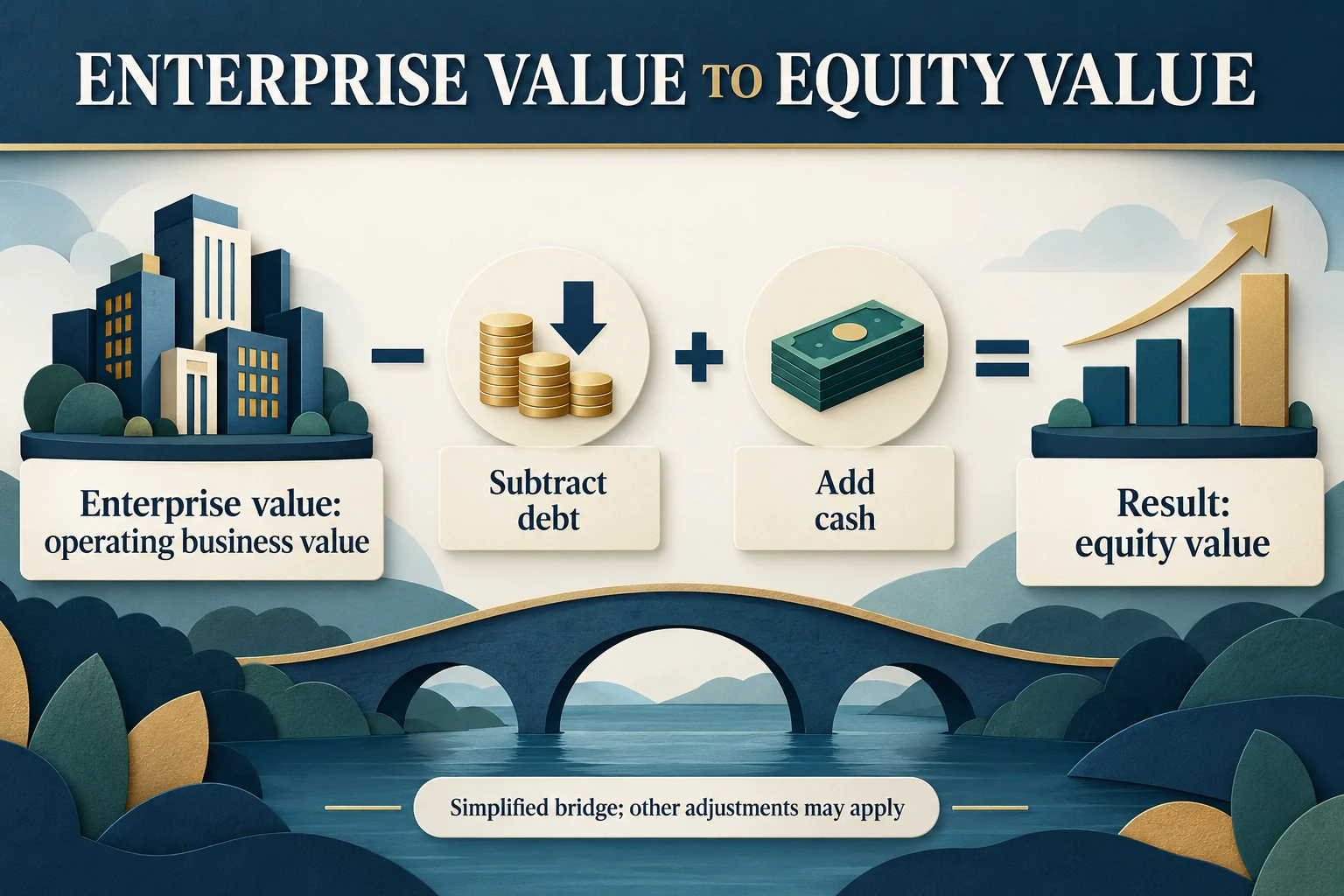
Enterprise value is the value of a company’s operating business before considering how operations are financed. Equity value is the residual value attributable to owners after adjusting enterprise value for debt, debt-like obligations, cash, and sometimes nonoperating assets.
A simplified bridge is:
Equity value = Enterprise value + cash and nonoperating assets – debt and debt-like liabilities
| Item | Example amount | Treatment | Result |
|---|---|---|---|
| Enterprise value | $4,000,000 | Starting operating value | $4,000,000 |
| Cash | $300,000 | Add | $4,300,000 |
| Bank debt | $1,100,000 | Subtract | $3,200,000 |
| Preferred claims | $200,000 | Subtract if applicable | $3,000,000 |
If the company has $4 million of enterprise value, $300,000 of cash, and $1.1 million of debt, its simplified equity value is $3.2 million before other adjustments. A buyer may negotiate working-capital targets, assumed liabilities, escrow, earn-outs, or seller financing separately.
Which Business Valuation Methods Are Used?
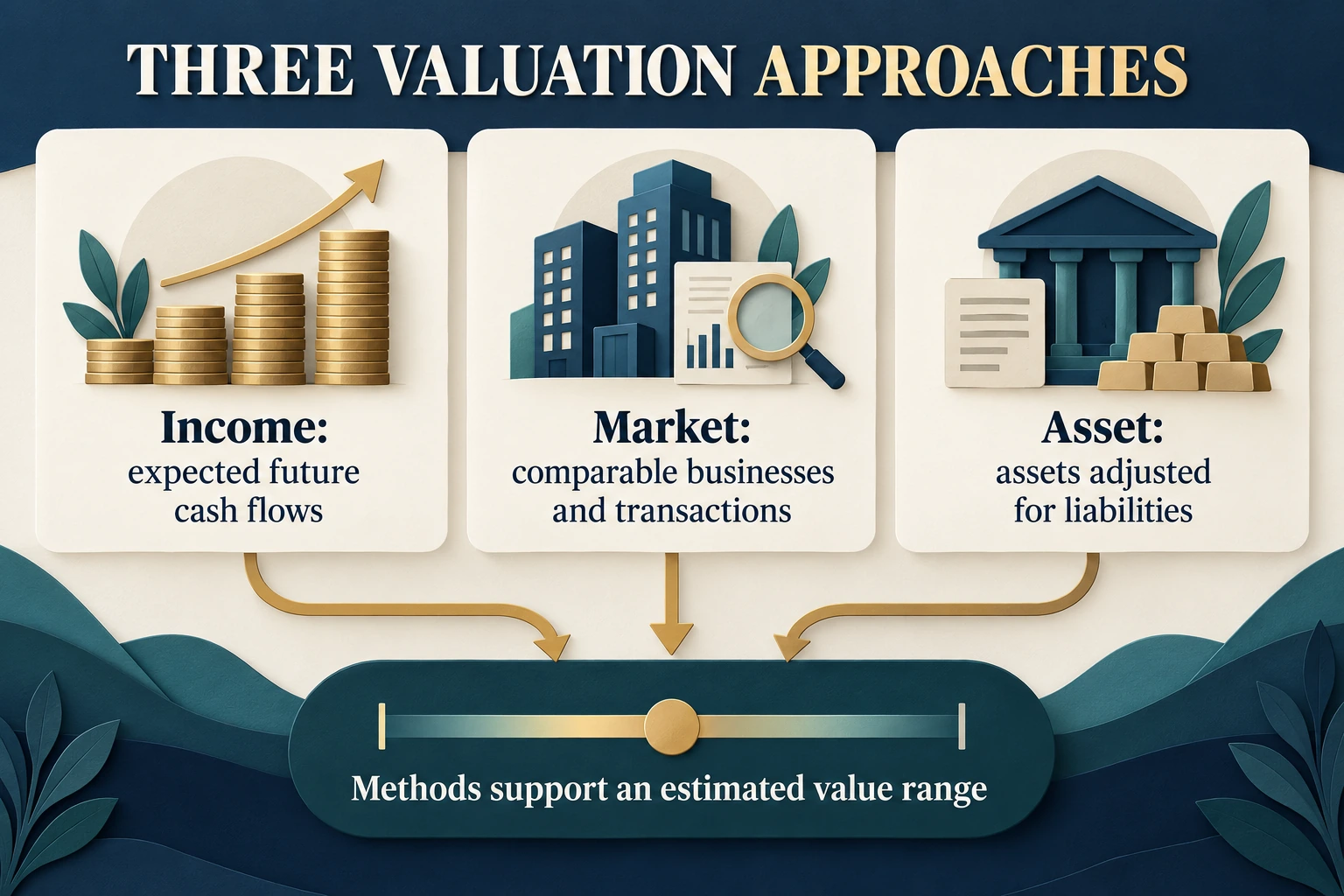
The income approach values expected economic benefits, the market approach uses observed pricing evidence, and the asset-based approach values the company’s net assets. Method selection depends on profitability, forecastability, asset intensity, industry evidence, and assignment purpose.
| Method | Core calculation | Best fit | Main weakness |
|---|---|---|---|
| DCF | Present value of forecast cash flows | Predictable cash generation | Sensitive to forecasts |
| Comparable companies | Benchmark EV/EBITDA, EV/revenue, or P/E | Industries with public data | Public firms differ in scale |
| Precedent transactions | Analyze completed acquisition multiples | M&A and sale analysis | Terms may be confidential |
| Asset-based | Fair-value assets minus liabilities | Holding, distressed, asset-heavy firms | May understate goodwill |
Income Approach: Discounted Cash Flow
A discounted cash flow model estimates future free cash flow and discounts it to present value using a rate that reflects business and financing risk:
Value = Σ [FCFₜ / (1 + WACC)ᵗ] + [Terminal Value / (1 + WACC)ⁿ]
The model requires revenue growth, margins, taxes, capital expenditure, working capital, terminal growth, and WACC. Terminal value can represent a large share of DCF value, so small changes in terminal growth or WACC can materially change the result.
DCF is useful for a company with credible forecasts. It is weak when management forecasts are speculative, customer retention is unstable, or cash flow is negative without a well-supported path to profitability.
Market Approach: Multiples and Transactions
Market valuation applies a multiple observed in comparable public companies or private transactions. For example, a company with $2 million of maintainable EBITDA and a 5.0x multiple has an implied enterprise value of $10 million before debt, cash, and transaction adjustments.
| Multiple | Numerator | Denominator | Common use |
|---|---|---|---|
| EV/EBITDA | Enterprise value | EBITDA | Mature operating companies |
| EV/revenue | Enterprise value | Revenue | Growth or low-profit firms |
| P/E | Equity value | Net income | Public profitable companies |
| Price/SDE | Equity or transaction price | Seller’s discretionary earnings | Small owner-operated firms |
Comparable selection should consider industry, revenue scale, growth, margins, geography, customer concentration, recurring revenue, and control rights. A 20% growth software company should not automatically receive the same multiple as a 3% growth firm with concentrated customers.
Asset-Based Approach
The asset-based approach estimates fair market value for assets and subtracts liabilities. It can include inventory, real estate, equipment, receivables, patents, trademarks, and internally developed software when those assets can be reliably valued.
The approach often provides a floor for an asset-heavy company, but it may miss workforce capability, customer relationships, brand strength, and going-concern earnings. Liquidation value is usually lower than orderly net asset value because forced sales reduce proceeds and increase costs.
What Adjustments Change a Valuation?
Control premiums, minority-interest discounts, discounts for lack of marketability, excess cash, debt-like liabilities, and working-capital requirements can change the value of an ownership interest. Adjustments must match the interest being valued and cannot be added mechanically.
A 30% noncontrolling private-company interest may lack voting power and a ready resale market. A controlling interest may command greater influence, but a control premium is not automatically justified when the selected market multiples already represent controlling transactions.
| Adjustment | Applies to | Typical reason | Caution |
|---|---|---|---|
| Control premium | Controlling interest | Decision authority | Avoid double counting |
| Minority discount | Noncontrolling interest | Limited influence | Legal standards differ |
| DLOM | Private, illiquid interest | No public resale market | Depends on restrictions |
| Key-person adjustment | Business dependent on owner | Transfer risk | Quantify replacement cost |
| Debt-like item | Equity bridge | Deferred payments or leases | Review transaction definition |
How Much Does a Business Valuation Cost?
A typical business valuation costs $500-$1,500 for software-based analysis, $5,000-$15,000 for an independent small or midsize-company engagement, and $30,000-$100,000 or more for complex M&A, fairness, litigation, or investment-banking work. Cost depends on complexity, urgency, documentation, and legal reliance.
| Provider or product | Typical cost | Typical timeframe | Suitable purpose |
|---|---|---|---|
| Online valuation software | $500-$1,500 | 1-3 days | Internal planning |
| CPA or valuation analyst | $5,000-$15,000 | 3-5 weeks | Buyout or sale preparation |
| Specialist valuation firm | $10,000-$30,000 | 4-8 weeks | Tax or dispute support |
| Investment bank | $30,000-$100,000+ | 6-10 weeks | M&A or fairness opinion |
A software estimate is not equivalent to a signed valuation report. Courts, tax authorities, lenders, and option-plan administrators may require an independent professional, defined standard, supporting schedules, and documented independence.
Which Method Fits Each Business Situation?
Method choice follows the business model and decision being made. A buyer should not rely on one seller-selected method, while a seller should prepare the evidence that makes maintainable earnings and transferability clear.
| Situation | Primary method | Supporting analysis | Main question |
|---|---|---|---|
| Profitable SaaS company | DCF and EV/revenue | Churn and cohort data | Are recurring revenues durable? |
| Owner-operated service firm | SDE or EBITDA multiple | Customer concentration | Can a buyer replace the owner? |
| Manufacturing company | EBITDA and asset-based | Equipment condition | Are margins and assets sustainable? |
| Distressed retailer | Asset-based and liquidation | Inventory aging | What can assets actually recover? |
| Employee option grant | 409A valuation | Capital structure | What is fair common-stock value? |
For Sellers Preparing an Exit
Sellers should normalize records, separate personal expenses, document recurring revenue, reduce customer concentration, and prepare a data room 12-24 months before a sale. Buyers pay for transferable earnings, not merely historical revenue.
For Buyers Evaluating an Acquisition
Buyers should rebuild the forecast, test downside cases, verify add-backs, inspect debt-like obligations, and compare implied value with asset recovery. A conservative DCF and a market-multiple cross-check can expose an optimistic pitch-deck valuation.
For Partner Buyouts and Minority Interests
A partner buyout requires analysis of the governing agreement, voting rights, transfer restrictions, distributions, and valuation date. A minority interest may not equal the company’s total value multiplied by the ownership percentage because control and marketability can differ.
For 409A and Employee Equity
A 409A valuation estimates the fair market value of private-company common stock for option pricing under U.S. tax rules. Preferred financing prices cannot simply be copied onto common shares because liquidation preferences, voting rights, and conversion terms differ.
What Common Valuation Errors Reduce Accuracy?
The most damaging errors are unsupported earnings add-backs, inconsistent debt treatment, unrealistic forecasts, and use of inappropriate comparables. A polished spreadsheet cannot repair unreliable operating evidence.
- Treating revenue as value: revenue requires margin, retention, working-capital, and capital-intensity analysis.
- Adding back every owner expense: a future buyer must replace necessary labor and operating costs.
- Double-counting growth: aggressive forecasts and a premium multiple may price the same growth twice.
- Ignoring customer concentration: one customer representing 40% of revenue creates transfer risk.
- Confusing EV with equity value: debt can materially reduce shareholder proceeds.
- Using a single-point estimate: a range with sensitivity cases better communicates uncertainty.
Expert Rule: Test the Terminal Value
If terminal value represents 75% of DCF output, the conclusion depends heavily on long-term assumptions rather than near-term evidence. Run downside cases using slower growth, lower margins, and a higher discount rate before treating the midpoint as decision-ready.
Expert Rule: Separate Add-Backs From Improvements
A cost that disappears after acquisition is an add-back. A cost that management hopes to reduce is an improvement opportunity, not historical normalized earnings. Buyers often price the first and negotiate the second through an earn-out.
Expert Rule: Check Transferability Before Applying a Multiple
A business that requires the founder’s relationships, approvals, and technical knowledge may deserve a lower multiple than a similar business with documented processes and independent management. Transferability affects risk, not just convenience.
Business Valuation FAQ
Is business valuation based on revenue or profit?
Business valuation can use revenue, EBITDA, SDE, free cash flow, assets, or combinations of these measures. Revenue multiples are more common when profit is temporarily low or business models are subscription-based, while profitable mature companies are often analyzed using EBITDA or cash flow.
What is a reasonable EBITDA multiple?
There is no universal EBITDA multiple. A typical illustrative range for a small private operating company might be 3x-7x EBITDA, but industry, growth, margins, concentration, size, geography, and transaction terms can move the result substantially. Comparable evidence should determine the selected range.
Can I value a business without an accountant?
An owner can create an internal estimate using normalized earnings and market multiples. A professional is usually warranted for tax filings, litigation, partner disputes, financing, employee options, or a material sale because those situations require evidence, independence, and defensible documentation.
How long does a valuation remain valid?
A valuation applies to its stated valuation date and assumptions. Internal planning estimates may become outdated within months after a major customer loss, financing round, acquisition, regulatory change, or sharp earnings movement. Formal reports often require an update when material conditions change.
Does goodwill appear on a business valuation?
Goodwill may be included in enterprise value when the company is valued as a going concern. Goodwill represents residual value associated with relationships, reputation, workforce, systems, and expected excess earnings. An asset-based calculation may show little goodwill even when the operating business has substantial earning power.
The Bottom Line
Valuation meaning in business is the disciplined estimation of a company’s economic worth for a defined purpose, ownership interest, standard, and date. The strongest conclusion connects normalized earnings, cash flow, comparable evidence, assets, risk, debt, and transferability. Use a range, test downside assumptions, and distinguish business value from the final negotiated price.