

A merger in business is a transaction in which two companies combine their ownership, operations, and economic resources into one continuing or newly structured enterprise. The term often implies a negotiated combination of relatively comparable companies, but legally a merger can also involve unequal parties, cash or stock consideration, and the survival of one company’s legal entity.
Key Facts at a Glance
- A merger combines two businesses through a legally documented transaction, rather than through an informal partnership.
- A merger may use stock, cash, debt, or a combination of consideration.
- A “merger of equals” describes the negotiated relationship between parties, not a guarantee of equal governance or value.
- Typical mid-market merger execution takes about 6-12 months; large or heavily regulated transactions can take 12-24 months.
- Typical advisory and transaction expenses range from 1%-5% of transaction value, excluding the purchase price and integration costs.
- A merger creates value only when validated synergies exceed transaction costs, execution risk, and any premium paid.
What Does a Merger Mean in Business?
A business merger is a legally approved combination of two corporate entities into one economic and operational organization. The parties may exchange shares, pay cash, assume liabilities, transfer assets, or use a combination of those methods, while the post-transaction company operates under a unified ownership and governance structure.
The word “merger” has both a legal meaning and a commercial meaning. In a statutory merger, one corporation may survive and absorb another, so a new legal entity is not required. In a consolidation, both original corporations disappear and a newly formed corporation succeeds them. Business news often calls both structures mergers.
The phrase “merger of equals” usually describes negotiation optics and governance expectations. It does not mean the companies have identical revenue, market capitalization, voting power, or contribution to the combined company.
How Does a Merger Work?
A merger works by converting two separate ownership and operating structures into one approved structure with a defined exchange ratio, governance model, liability treatment, and integration plan. The transaction becomes effective only after contractual conditions, shareholder approvals, regulatory requirements, and closing procedures are satisfied.
Ownership and Consideration
Shareholders can receive common stock, cash, debt instruments, or mixed consideration. In a stock-for-stock merger, the exchange ratio determines how many shares of the combined company each target shareholder receives. For example, a 0.50 exchange ratio gives one target share 0.50 shares in the surviving company.
The exchange ratio affects ownership, voting power, earnings per share, and control. A target board may support a transaction because the consideration reflects a premium to the target’s unaffected share price, while the buyer’s shareholders may focus on dilution and the credibility of projected synergies.
Legal Structure
| Structure | What happens to original entities | Common use | Main legal consequence |
|---|---|---|---|
| Statutory merger | One company survives; the other disappears | Domestic corporate combinations | Surviving entity generally succeeds to rights and liabilities |
| Consolidation | Both companies disappear; a new company is formed | True combination of equals | New charter and governance documents are required |
| Reverse triangular merger | Buyer subsidiary merges into target; target survives temporarily | Preserving contracts and licenses | Often reduces assignment problems |
| Forward triangular merger | Target merges into buyer subsidiary | Isolating liabilities | Target entity generally disappears |
| Share merger | Buyer acquires target shares | Maintaining target subsidiary | Target may remain a separate legal entity |
| Asset combination | Selected assets and liabilities transfer | Carve-outs or distressed deals | Each contract and liability requires specific analysis |
A practitioner should never infer the legal structure from the press release headline. The merger agreement, certificate of merger, proxy statement, and regulatory filings control the actual consequences.
Where Do Synergies Come From?
Merger synergies are measurable improvements that the combined business can produce beyond the companies’ standalone forecasts. Cost synergies may come from overlapping facilities, procurement volume, duplicated public-company costs, or consolidated technology systems; revenue synergies may come from cross-selling, distribution access, or expanded geographic coverage.
A simple synergy test is:
Net merger value = standalone value of Company A + standalone value of Company B + present value of synergies – premium – transaction costs – integration costs.
| Synergy category | Typical source | Measurement | Frequent failure |
|---|---|---|---|
| Headcount | Duplicate finance, HR, or executive roles | Annual payroll and benefit savings | Severance and lost expertise exceed forecast |
| Procurement | Combined supplier volume | Price reduction per unit multiplied by volume | Suppliers refuse concessions |
| Facilities | Office, plant, and warehouse consolidation | Rent, utilities, and maintenance avoided | Lease termination penalties are omitted |
| Revenue | Cross-selling to existing customers | Incremental gross profit, not sales alone | Customers reject unfamiliar products |
| Technology | Fewer systems and licenses | License, hosting, and support savings | Migration creates outages and churn |
| Tax and financing | Combined deductions or lower borrowing cost | Cash tax and interest forecast | Law, debt covenants, or valuation limits benefits |
The strongest diligence practice is to put revenue synergies at zero in the base case unless customer evidence supports them. Cost synergies should have named owners, implementation dates, one-time costs, and monthly tracking.
What Are the Main Types of Business Mergers?
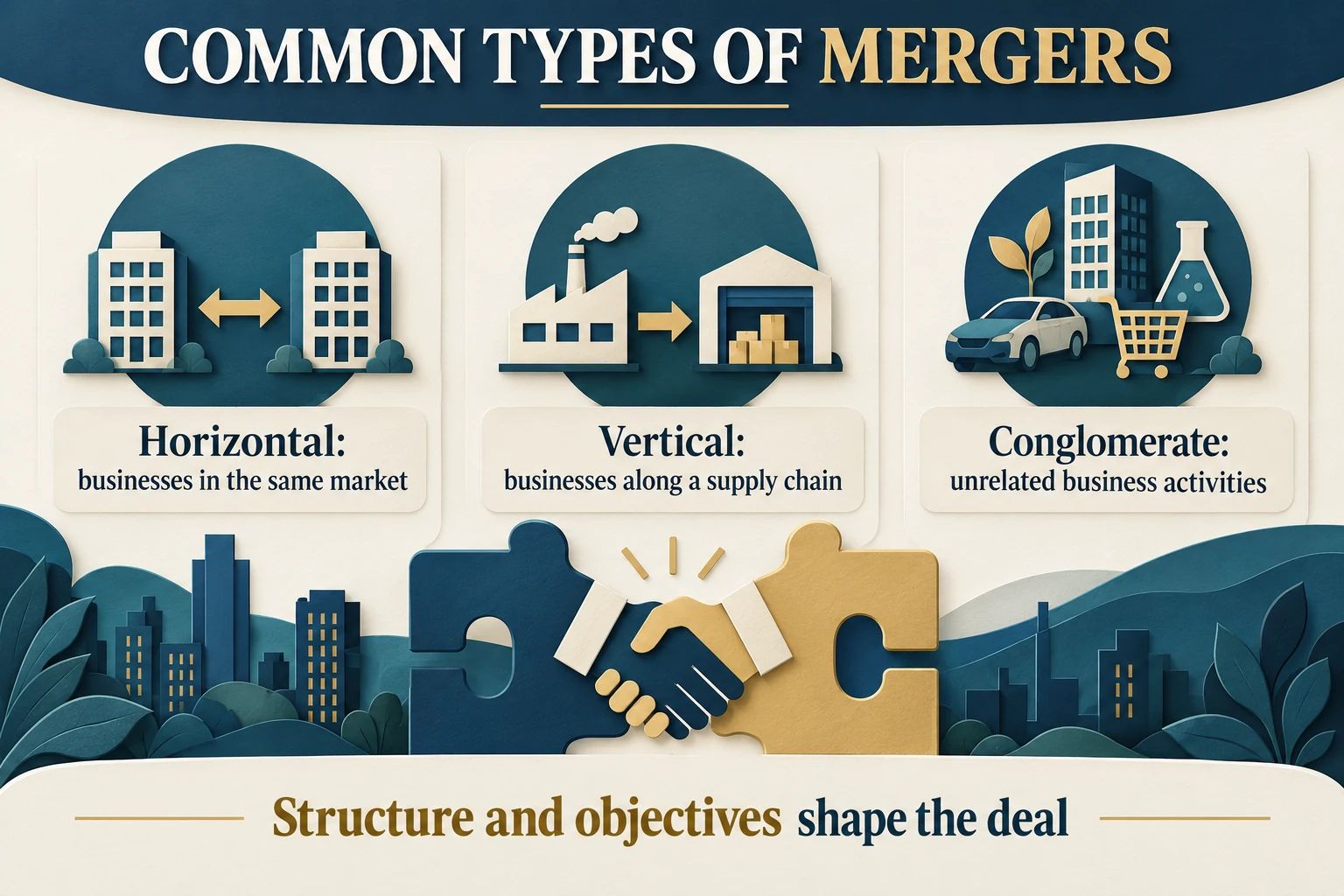
Merger types describe the economic relationship between the combining companies, not merely their legal paperwork. Horizontal mergers combine competitors, vertical mergers combine supply-chain stages, and conglomerate mergers combine unrelated businesses.
| Merger type | Company relationship | Strategic objective | Example |
|---|---|---|---|
| Horizontal | Same industry and overlapping products | Scale, capacity, market share | Exxon and Mobil |
| Vertical | Different stages of one supply chain | Supply security or distribution control | Live Nation and Ticketmaster |
| Market extension | Same product, different geographic markets | Enter a new territory | NationsBank and BankAmerica |
| Product extension | Related products sold to similar customers | Cross-selling and channel leverage | Mobilink and Warid |
| Conglomerate | Unrelated industries | Diversification and capital allocation | Berkshire Hathaway acquisitions |
| Concentric | Different products with related capabilities | Share technology, customers, or channels | A software firm combining with a cybersecurity provider |
A horizontal transaction usually receives the most direct competition scrutiny because overlapping products can reduce customer choice. A vertical transaction may still raise concerns if the combined company can foreclose rivals from essential inputs, distribution, data, or infrastructure.
What Is the Typical Merger Process?
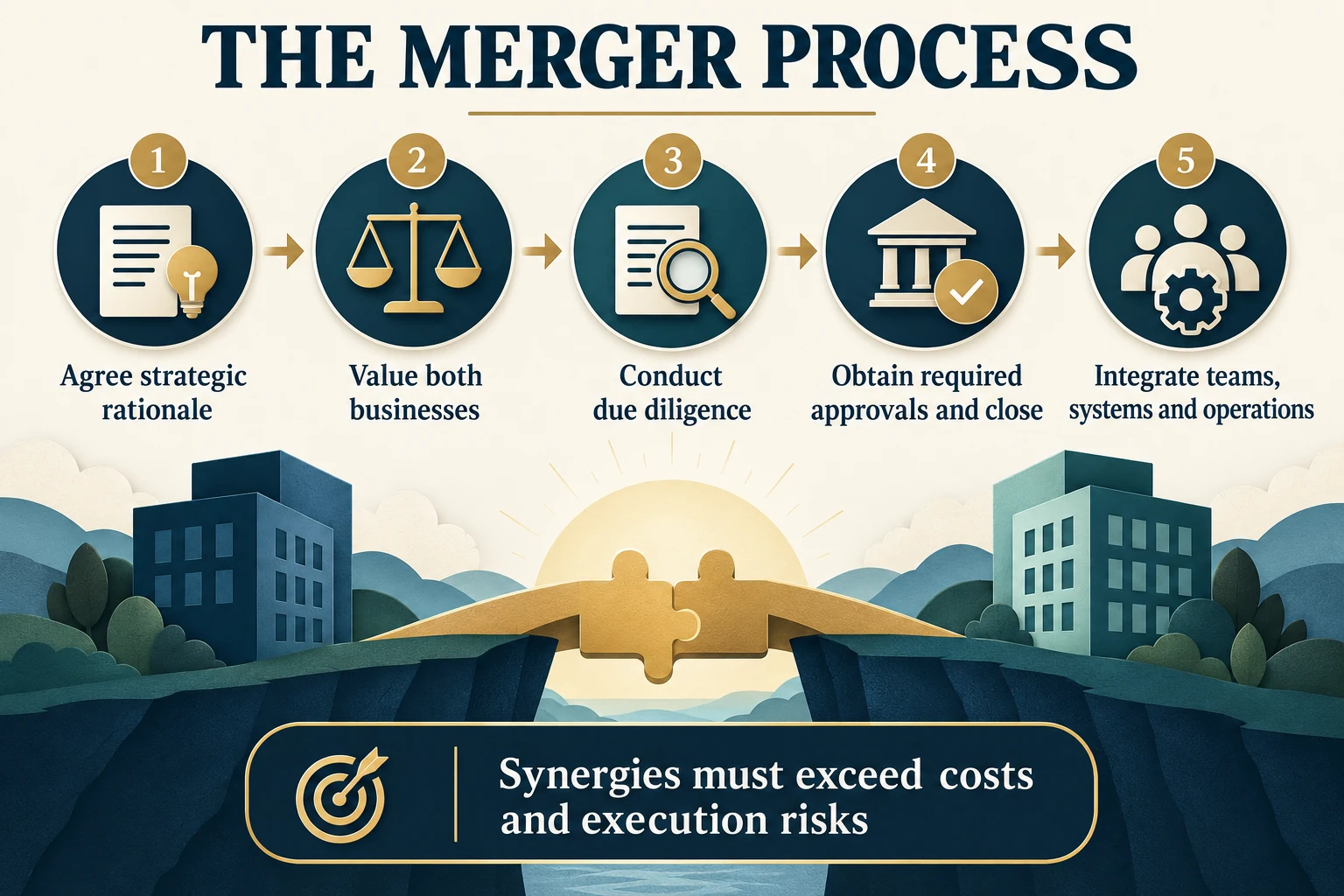
A typical merger follows six commercial phases, but regulatory review and shareholder procedures can add substantial time. A mid-market transaction often takes 6-12 months from serious negotiations to closing, while complex public-company or cross-border transactions can take 12-24 months.
1. Define the Strategy
The board identifies the business problem the transaction must solve. Examples include entering a country, obtaining intellectual property, increasing manufacturing capacity, reducing supplier dependence, or acquiring talent.
The strategic thesis should state a measurable outcome. “Become larger” is weak. “Reduce unit manufacturing cost by 8% within 24 months” is testable.
2. Identify and Screen Targets
Management or an investment bank screens candidates using revenue, growth, margins, geography, customer concentration, debt, ownership, and regulatory exposure. A target that fits strategically but cannot integrate technically may be inferior to a smaller, less obvious candidate.
3. Sign an NDA and Negotiate an LOI
The parties usually sign a nondisclosure agreement before exchanging sensitive information. A letter of intent commonly addresses valuation, consideration, exclusivity, conditions, expenses, and the proposed legal structure.
Most LOI provisions are non-binding, but confidentiality, exclusivity, expense reimbursement, and access rights may be enforceable. The wording matters.
4. Complete Due Diligence
Due diligence examines financial statements, tax filings, contracts, litigation, employment, intellectual property, cybersecurity, data privacy, environmental exposure, insurance, customers, suppliers, and technology architecture.
| Diligence area | Documents or tests | Red flag | Possible remedy |
|---|---|---|---|
| Financial | Audits, quality-of-earnings report, bank statements | EBITDA depends on unsupported adjustments | Lower price or escrow |
| Legal | Material contracts, litigation docket, permits | Change-of-control termination rights | Consent or special indemnity |
| Tax | Returns, nexus, payroll, sales tax | Unpaid historical liabilities | Tax escrow or purchase-price adjustment |
| Cybersecurity | Penetration tests, incident history, access logs | Unpatched critical systems | Remediation covenant or price reduction |
| Human capital | Turnover, compensation, benefit plans | Key staff lack retention incentives | Retention pool or employment agreements |
| Commercial | Customer concentration, churn, renewal data | One customer exceeds 25% of revenue | Earn-out, holdback, or revised forecast |
5. Obtain Approvals and Sign the Definitive Agreement
The definitive agreement specifies consideration, representations, warranties, covenants, closing conditions, termination rights, indemnities, and remedies. Boards approve the agreement before it proceeds to the required shareholder and regulatory processes.
In the United States, the Federal Trade Commission and the Department of Justice enforce federal antitrust law. The Securities and Exchange Commission regulates public-company disclosures and filings, but the SEC is not the primary federal merger-clearance agency.
6. Close and Integrate
At closing, the parties deliver the required certificates, approvals, funds, shares, and legal filings. Post-merger integration then combines systems, reporting lines, brands, policies, facilities, customer teams, and cultures.
Closing is a legal milestone, not proof that the merger has created value.
How Long Does a Merger Take?
A merger typically takes 6-18 months from serious initial discussions through early integration, although a small private transaction may close faster and a regulated public transaction may take more than two years. Antitrust review, shareholder litigation, financing, cross-border approvals, and complex information technology are the largest schedule variables.
| Transaction profile | Signing-to-closing estimate | Total integration horizon | Main time driver |
|---|---|---|---|
| Small private company | 3-6 months | 6-12 months | Financial and legal diligence |
| Mid-market company | 6-12 months | 12-24 months | Diligence, financing, and integration |
| Public-company merger | 9-18 months | 18-36 months | Proxy process, disclosures, regulators |
| Cross-border merger | 12-24 months | 24-48 months | Foreign investment and competition approvals |
| Highly regulated sector | 12-30 months | 24-48 months | Banking, healthcare, energy, or telecom consent |
How Much Does a Merger Cost?
Merger transaction expenses commonly equal 1%-5% of deal value in mid-market and enterprise transactions, excluding the consideration paid to shareholders. Investment banking fees may range from 1%-3%, legal fees can exceed $400 per hour, and accounting, tax, technology, and integration work can add hundreds of thousands or millions of dollars.
| Cost item | Typical range | Usually paid by | Cost driver |
|---|---|---|---|
| Investment banking | 1%-3% of deal value | Client company | Size, complexity, success fee |
| Legal counsel | $400-$1,500+ per hour | Client company | Jurisdiction, negotiations, filings |
| Quality of earnings | $50,000-$250,000+ | Buyer or both parties | Revenue and accounting complexity |
| Tax diligence | $25,000-$150,000+ | Buyer or both parties | Countries, entities, tax exposure |
| Cybersecurity review | $25,000-$200,000+ | Buyer | Systems, data, incident history |
| Integration planning | $100,000-$1,000,000+ | Combined company | Employees, systems, geography |
| Severance and retention | 5%-20% of affected payroll | Combined company | Redundancies and key-person risk |
A public target’s premium often falls within 20%-40% of its unaffected share price in negotiated transactions, but the range varies by sector, market conditions, competitive bidding, and the target’s standalone prospects. A premium is not automatically justified by projected synergies.
How Are Mergers Valued?
Mergers are valued by estimating standalone enterprise value, adjusting for debt and cash, and adding only defensible synergies after considering the premium and execution costs. Buyers commonly use discounted cash flow analysis, comparable-company multiples, precedent transactions, and accretion-dilution modeling.
| Valuation method | Primary input | Useful output | Main limitation |
|---|---|---|---|
| Discounted cash flow | Forecast free cash flow and discount rate | Intrinsic enterprise value | Highly sensitive to terminal growth |
| Comparable companies | Revenue, EBITDA, or earnings multiples | Market-based valuation range | Public peers may not be comparable |
| Precedent transactions | Historical deal multiples | Control-value benchmark | Old deals reflect different markets |
| Leveraged buyout | Debt capacity and exit value | Maximum financeable price | Less useful for strategic buyers |
| Accretion-dilution | Earnings, shares, financing cost | EPS effect after closing | EPS growth can hide weak value creation |
The key distinction is between accretion and value creation. A merger can increase earnings per share through financing or accounting effects while destroying economic value if the buyer overpays.
What Are the Benefits and Risks?
The main benefits of a merger are scale, market access, capabilities, and potential cost savings. The main risks are overpayment, customer attrition, employee departures, regulatory remedies, technology disruption, and the failure to capture forecast synergies.
Potential Benefits
- Expanded geographic coverage without building every local capability internally.
- Greater purchasing power with suppliers and technology vendors.
- Access to patents, licenses, data, distribution, or specialized staff.
- More diversified revenue and potentially stronger borrowing capacity.
- Lower duplicated costs in finance, facilities, procurement, and public-company administration.
Common Risks
A merger can destroy value even when the strategic logic is sound. The buyer may pay the full value of projected synergies to the seller, leaving shareholders with the integration risk and none of the upside.
Culture is operational rather than cosmetic. Conflicting decision rights, sales incentives, promotion systems, and risk tolerances can cause high performers to leave before the combined company captures savings.
Customer concentration deserves separate testing. If two sales teams compete for the same accounts after closing, the company may lose revenue precisely where the merger forecast assumed cross-selling.
Merger Versus Acquisition, Joint Venture, and Alliance
A merger is usually preferable when the parties want permanent combination and shared governance. An acquisition is usually preferable when one party needs clear control, while a joint venture or alliance is better when the parties want to share a project without combining all operations.
| Strategy | Legal ownership | Control | Typical timeline | Best fit |
|---|---|---|---|---|
| Merger | One combined entity or surviving entity | Shared or negotiated | 6-24 months | Permanent combination |
| Acquisition | Buyer owns target or assets | Buyer-controlled | 3-18 months | Technology, talent, or control |
| Joint venture | New or existing jointly owned entity | Contractually shared | 3-12 months | Market entry or shared project |
| Strategic alliance | Separate companies | No unified control | 1-6 months | Distribution or co-development |
| Asset purchase | Buyer selects assets and liabilities | Buyer-controlled assets | 2-12 months | Carve-out or distressed purchase |
An acquisition can be marketed as a merger to reduce employee or customer resistance. The economic substance remains an acquisition if one company pays for control and the other becomes a subsidiary or disappears.
What Happens After a Merger Closes?
Post-merger integration turns legal combination into operational performance. The integration management office should assign owners, deadlines, baselines, and escalation rules for every synergy, system migration, employee transition, and customer-risk action.
The first 100 days usually prioritize payroll, cash controls, customer continuity, cybersecurity, legal entity administration, and decision rights. Large platform migrations often require 12-24 months and should not be rushed merely to create an appearance of unity.
A practical integration scorecard tracks:
- Revenue retention and customer churn.
- Employee retention in critical roles.
- Realized savings against the approved synergy case.
- System incidents and unresolved security findings.
- Working capital, cash conversion, and debt compliance.
- Regulatory commitments and divestiture obligations.
When Should a Company Avoid a Merger?
A company should avoid a merger when the transaction depends on unverified revenue synergies, requires unaffordable leverage, has unresolved ownership disputes, or cannot protect customers and key employees during integration. Strategic fit cannot compensate for defective records, weak governance, or an unrealistic implementation plan.
Small businesses should be particularly cautious about merging merely because both owners want growth. If the companies have different accounting systems, customer definitions, compensation models, or personal-owner dependencies, a staged alliance or minority investment may reveal compatibility at lower risk.
A merger is also a poor choice when the objective is temporary collaboration. A joint venture can test a market while preserving separate legal entities and allowing the parties to exit under defined conditions.
What Are the Most Common Merger Mistakes?
The most common merger mistakes are overvaluing synergies, treating due diligence as a checklist, delaying integration planning, and failing to define who controls decisions after closing. These errors often appear before signing, when enthusiasm suppresses challenge and the target’s internal forecasts become the buyer’s assumptions.
Overestimating Synergies
Create a bottom-up synergy register with a named owner, baseline, annual value, one-time cost, start date, and confidence rating. Do not count gross revenue as a synergy; count incremental gross profit after churn, sales expense, support costs, and working capital.
Ignoring Contracts and Technology
A contract may prohibit assignment, require customer consent, or impose a change-of-control payment. A system may contain undocumented integrations that support billing, payroll, or regulatory reporting. Contract inventories and architecture diagrams should be tested before the definitive agreement is signed.
Communicating Too Late
Employees fill information gaps with assumptions about layoffs, relocation, and reporting lines. A communication plan should identify what can be disclosed before closing, what requires regulatory clearance, and which key employees need retention agreements.
Confusing EPS With Value
A transaction can be accretive to earnings per share while producing a return below the buyer’s cost of capital. The investment committee should review cash returns, return on invested capital, leverage, and downside cases alongside EPS.
FAQ
Is a merger the Same as Buying a Company?
No. A merger combines companies through an agreed legal and economic structure, while an acquisition gives one buyer control over another company, its shares, or selected assets. In practice, transactions described publicly as mergers may have acquisition economics if one party controls the combined company.
Do Both Companies Have to Be the Same Size?
No. Equal size is not a legal requirement. The phrase “merger of equals” usually signals negotiated governance and shared ownership expectations, but the parties may differ substantially in revenue, market value, profitability, voting power, or strategic contribution.
Do Shareholders Always Receive Stock?
No. Shareholders may receive stock, cash, debt, or mixed consideration. Stock consideration preserves more cash but may dilute the buyer’s shareholders; cash provides certainty but can increase leverage and financing risk.
Can a Merger Fail After Shareholders Approve It?
Yes. A merger can still fail if regulatory clearance is denied, a closing condition is not satisfied, financing collapses, a material adverse effect occurs, required third-party consent is missing, or one party terminates under the agreement. Termination fees may apply.
What Is a Reverse Merger?
A reverse merger is a transaction in which a private company becomes public by combining with an existing public company, often a shell corporation. The structure can be faster than a traditional initial public offering, but it requires extensive securities-law compliance and does not eliminate disclosure, governance, or investor risks.
Is a Merger Good for Employees?
A merger can create career opportunities, stronger resources, and broader operations, but it can also produce duplicate-role reductions, changed benefits, relocation, and new reporting lines. Employee outcomes depend on the integration plan, overlap between functions, labor rules, and the combined company’s financial performance.
Conclusion: What Does Merger Meaning in Business Really Imply?
The merger meaning in business is a permanent or intended-permanent combination of companies under one ownership and operating structure, completed through legal agreements, approvals, consideration, and integration. The sound decision is not the transaction with the most attractive headline, but the one whose verified strategic benefits exceed its premium, fees, financing burden, regulatory exposure, and integration risk.