

An acquisition in business occurs when one company, the acquirer, purchases enough shares or assets of another company, the target, to obtain control or economic ownership. The transaction may leave the target operating as a subsidiary, transfer selected assets into the buyer, or combine both businesses under one corporate structure.
Key Facts at a Glance
- A business acquisition transfers control, ownership, assets, or a combination of those interests from a target to an acquirer.
- A stock purchase transfers the target company with its existing assets, contracts, employees, and potential liabilities.
- An asset purchase lets the buyer select assets and liabilities, but individual contracts, licenses, and employee arrangements may require transfer.
- Private-company acquisitions commonly take 3-9 months; regulated or multinational transactions can take longer.
- Typical valuation ranges vary widely: small businesses may trade at 2x-4x SDE or EBITDA, while enterprise technology deals may use revenue or ARR multiples.
- Acquisition value depends on cash flow, growth, recurring revenue, debt, working capital, customer concentration, intellectual property, and integration risk.
What Does Acquisition Mean in Business?
A business acquisition is a transaction in which an acquirer obtains control of a target company by buying its shares, voting rights, assets, or a negotiated combination of them. Control usually means the acquirer can appoint directors, direct operating decisions, receive economic benefits, and determine the target’s strategic future.
The target may remain a separate legal entity after closing. Alternatively, the buyer may dissolve it, merge it into an existing subsidiary, or transfer its operations into a new entity. “Acquisition” describes the change in control; it does not by itself specify the tax treatment, payment method, management structure, or post-closing identity.
| Term | Meaning | Typical decision right |
|---|---|---|
| Acquirer | Company or investor buying control | Chooses transaction strategy |
| Target | Company, division, or assets being purchased | Provides information and negotiates |
| Shareholder | Owner selling shares in a stock deal | Approves sale or receives consideration |
| Consideration | Value paid for the transaction | Cash, shares, debt, or combination |
| Closing | Legal completion of the purchase | Ownership changes hands |
| Integration | Combining systems, people, and processes | Buyer captures planned value |
An acquisition is therefore broader than “one company buys another.” A corporation can acquire a product line, patent portfolio, customer contracts, business unit, or controlling stake without purchasing every operation associated with the seller.
How Does a Business Acquisition Work?
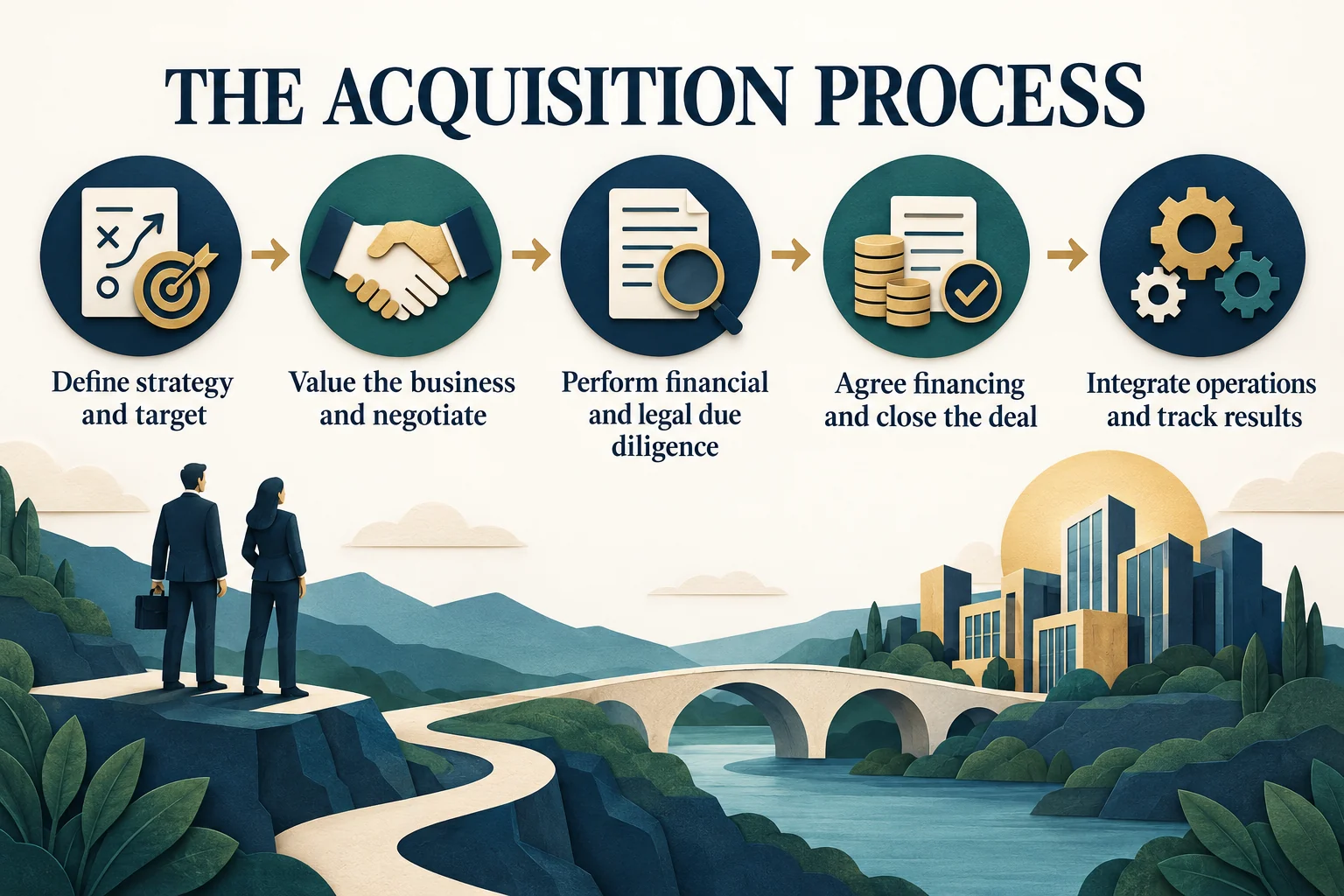
A business acquisition moves from strategic rationale to target selection, valuation, diligence, documentation, closing, and integration. A straightforward private-company deal often requires 3-9 months, while antitrust review, public shareholders, international operations, financing conditions, or complex technology can extend the process beyond 12 months.
The buyer should define its investment thesis before contacting targets. An acquisition designed to obtain software talent requires different diligence from one designed to consolidate manufacturing capacity. The thesis determines the screening criteria, price ceiling, integration model, and evidence required before signing.
The Six Main Acquisition Stages
| Stage | Typical duration | Main output | Approval question |
|---|---|---|---|
| Strategy and criteria | 2-6 weeks | Investment thesis and target profile | Why buy rather than build? |
| Origination and screening | 2-12 weeks | Shortlist and initial financials | Does the target fit? |
| Valuation and LOI | 2-6 weeks | Valuation range and letter of intent | Is the price defensible? |
| Due diligence | 4-10 weeks | Risk findings and adjusted model | What liabilities remain? |
| Definitive agreement | 3-8 weeks | SPA or APA and disclosure schedules | Are protections sufficient? |
| Closing and integration | 1 day to 24 months | Ownership transfer and PMI plan | Can expected value be captured? |
- Set the acquisition strategy. Define the desired market, revenue range, geography, technology, customer profile, maximum leverage, and required return.
- Screen and approach targets. Review revenue quality, margins, customer concentration, management depth, competitive position, and strategic fit.
- Build a valuation and issue an LOI. The letter of intent commonly states the indicative price, transaction form, exclusivity period, financing assumptions, and major conditions. Most commercial terms remain subject to definitive documentation.
- Perform due diligence. Legal, financial, tax, commercial, operational, human-resources, information-security, and environmental reviews test the seller’s claims.
- Negotiate and sign definitive documents. A share purchase agreement governs equity transfers; an asset purchase agreement identifies purchased assets, excluded assets, assumed liabilities, and required consents.
- Close and integrate. The buyer transfers funds or securities, satisfies closing conditions, assumes control, and executes the post-merger integration plan.
A signed agreement is not always the closing. Conditions such as lender funding, shareholder approval, regulatory clearance, third-party consent, or the absence of a material adverse change may remain outstanding.
What Are the Main Types of Acquisitions?
The main acquisition types are classified by the relationship between the companies, the assets purchased, or the buyer’s strategic objective. Horizontal deals combine competitors, vertical deals join supply-chain stages, and conglomerate deals connect unrelated industries.
| Acquisition type | Buyer-target relationship | Primary objective | Example |
|---|---|---|---|
| Horizontal | Same industry and market level | Scale and market share | Facebook acquiring Instagram |
| Vertical backward | Buyer purchases a supplier | Supply security and quality control | Manufacturer buying a component supplier |
| Vertical forward | Buyer purchases a distributor | Channel control and customer access | Producer buying a retail network |
| Conglomerate | Unrelated industries | Revenue diversification | Amazon acquiring Whole Foods |
| Market extension | Same product, new geography or segment | Faster market entry | Regional bank buying another region’s bank |
| Product extension | Related customers, additional product | Cross-selling and product breadth | Software firm buying an adjacent application |
A strategic acquisition can fit more than one category. A medical-device company buying a distributor in another country may be both vertical and market-extending. Classification helps explain rationale, but it does not determine whether the price or integration plan is sound.
How Are Acquisitions Structured?
Acquisitions are usually structured as stock purchases, asset purchases, mergers, or combinations involving rollover equity and contingent payments. The best structure depends on liability exposure, tax advice, transferability of contracts, shareholder approval, financing, and the buyer’s desired control.
| Structure | Buyer receives | Liability profile | Main complication |
|---|---|---|---|
| Stock purchase | Shares and the existing company | Buyer generally inherits known and unknown company liabilities | Requires extensive corporate and liability diligence |
| Asset purchase | Listed assets and assumed liabilities | Buyer can often exclude specified liabilities | Contracts, licenses, and employees may need separate transfer |
| Statutory merger | Target combines into buyer or merger subsidiary | Governed by applicable corporate law | Requires approvals and detailed closing mechanics |
| Rollover equity | Seller retains a minority stake | Seller shares future upside and risk | Governance and exit rights require precision |
| Earnout structure | Immediate payment plus contingent amount | Part of price depends on future results | Accounting definitions can create disputes |
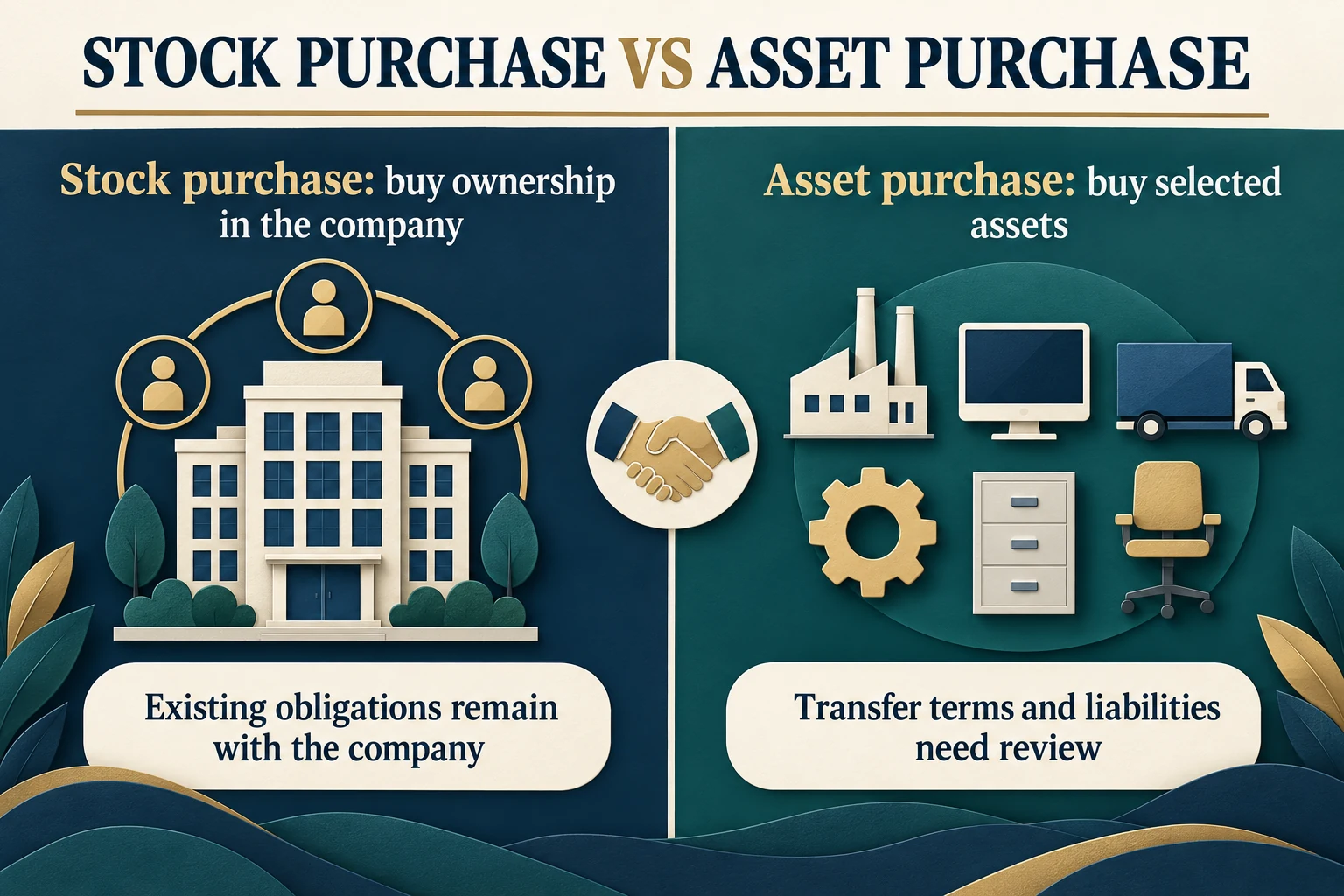
Stock Purchase Versus Asset Purchase
A stock purchase is often administratively simpler because the target company keeps its contracts, permits, employees, and operating history. The same continuity means the buyer may inherit litigation, tax exposure, data-protection violations, pension obligations, and unfavorable contracts.
An asset purchase gives the buyer more control over what it accepts. The buyer may select intellectual property, equipment, inventory, customer contracts, and goodwill while excluding specified liabilities. Transfer restrictions can make the transaction slower, and some licenses or government approvals cannot be assigned without consent.
Neither structure automatically eliminates risk. A buyer needs transaction-specific legal and tax advice because liability allocation, successor-liability rules, employee protections, and tax treatment vary by jurisdiction.
How Much Does a Business Acquisition Cost?
A business acquisition may cost anywhere from a few hundred thousand dollars for a small owner-operated company to billions for a public-company transaction. Typical private-market valuation ranges are approximately 2x-4x seller’s discretionary earnings for many small businesses, 5x-12x EBITDA for many mid-market companies, and 4x-10x recurring revenue for some growing SaaS businesses, although sector, growth, retention, margins, and market conditions can move multiples substantially.
| Target profile | Common metric | Typical range | Main adjustment |
|---|---|---|---|
| Owner-operated small business | SDE | 2x-4x | Owner dependence and customer concentration |
| Profitable mid-market company | EBITDA | 5x-12x | Growth, margins, debt, and defensibility |
| Subscription software company | ARR or revenue | 4x-10x ARR | Net retention, churn, growth, and gross margin |
| Asset-heavy manufacturer | EBITDA plus asset review | 4x-8x EBITDA | Equipment age, capex, inventory, and backlog |
| Professional-services firm | EBITDA or SDE | 3x-7x | Partner retention and recurring engagements |
A multiple is not a purchase price by itself. Enterprise value commonly converts to equity value through a bridge:
Equity value = enterprise value – debt + cash, adjusted for working capital and other agreed items.
For example, a target with $2 million of normalized EBITDA at a 6x multiple has $12 million of implied enterprise value. If it carries $3 million of debt and $500,000 of excess cash, the indicative equity value is approximately $9.5 million before transaction-specific adjustments.
How Are Acquisitions Paid For?
Buyers commonly use cash, acquisition debt, newly issued shares, seller financing, earnouts, or a combination. Payment design changes risk allocation: cash gives the seller certainty, while an earnout leaves some value dependent on future performance.
| Payment method | Buyer advantage | Seller advantage | Typical use |
|---|---|---|---|
| Cash at closing | Clear ownership and no dilution | Immediate certainty | Stable, financeable targets |
| Acquisition debt | Preserves buyer equity | Can support a higher offer | Predictable cash-flow businesses |
| Buyer shares | Conserves cash | Participates in future upside | Public or well-funded strategic buyers |
| Seller note | Keeps seller economically involved | Creates installment income | Small-business transactions |
| Earnout | Bridges valuation disagreement | Rewards future performance | Founder-dependent or high-growth targets |
| Escrow or holdback | Funds indemnity claims | Provides closing proceeds | Warranty and liability protection |
Control premiums for public companies are often discussed in the 20%-40% range, but the actual premium depends on market price, competing bidders, expected synergies, and the quality of the unaffected share price. Earnouts have no universal standard; the percentage and measurement period should reflect the specific uncertainty being priced.
How Long Does an Acquisition Take?
A small, clean, privately negotiated acquisition can close in 8-16 weeks, while a mid-market transaction commonly takes 4-9 months. Public-company, cross-border, heavily regulated, or highly leveraged transactions may require 9-18 months because approvals, financing, disclosure, and integration planning add work.
The fastest deals are not necessarily the safest. Accelerating diligence can reduce the buyer’s ability to verify revenue recognition, inspect cybersecurity controls, contact customers, or identify change-of-control clauses.
| Transaction situation | Typical time to close | Common delay |
|---|---|---|
| Small asset purchase | 8-16 weeks | Contract and license transfers |
| Private stock purchase | 3-6 months | Quality of earnings and indemnities |
| Mid-market financed acquisition | 4-9 months | Lender underwriting and diligence |
| Public-company acquisition | 6-12 months | Board, shareholder, and disclosure requirements |
| Cross-border regulated deal | 9-18 months | Antitrust, foreign investment, and approvals |
What Does Due Diligence Examine?
Due diligence tests whether the target’s reported performance, assets, rights, obligations, and future prospects support the proposed price. Financial diligence validates normalized earnings, while legal, tax, commercial, operational, technology, and human-resources reviews identify risks that the income statement may not reveal.
| Diligence area | Documents or tests | Red flag |
|---|---|---|
| Financial | Bank statements, general ledger, customer revenue | Revenue recorded before delivery |
| Tax | Returns, audits, payroll filings, sales tax | Unpaid indirect or employment taxes |
| Legal | Litigation, contracts, licenses, corporate records | Change-of-control termination rights |
| Commercial | Churn, pipeline, customer concentration | One customer exceeds 30% of revenue |
| Technology | Architecture, access logs, vulnerabilities | Unsupported systems or weak credentials |
| People | Employment agreements, turnover, incentives | Founder controls essential relationships |
| Operations | Suppliers, capacity, quality, inventory | Single-source supply dependency |
A buyer should normalize owner compensation, one-time expenses, related-party transactions, deferred maintenance, unusual revenue, and working-capital seasonality before applying a valuation multiple. The American Institute of Certified Public Accountants describes quality-of-earnings work as an analysis of the sustainability and accuracy of reported earnings, rather than a simple restatement of historical accounts.
An independent red-team review improves discipline. The red team should receive authority to reduce the price, demand protections, or recommend termination rather than being rewarded for closing the transaction.
What Happens After Closing?
Post-merger integration combines the target and buyer’s systems, people, processes, customer experience, and reporting. Integration should begin during diligence, because the buyer needs a Day One plan, named workstream owners, retention arrangements, and a realistic synergy schedule before signing.
| Integration workstream | First 30-day action | Success measure |
|---|---|---|
| People | Confirm roles and retention agreements | Key-person retention rate |
| Finance | Establish reporting and cash controls | Monthly close within agreed days |
| Technology | Secure accounts and map systems | No critical access gaps |
| Customers | Communicate ownership and support continuity | Churn and service levels |
| Operations | Map duplicate processes and vendors | Realized cost savings |
| Culture | Identify decision norms and friction points | Voluntary turnover and engagement |
Synergies fall into revenue, cost, capital, and capability categories. Cost savings may come from duplicate software, facilities, procurement, or administrative functions; revenue synergies depend on customer permission, sales capacity, product compatibility, and timing.
A practical rule is to separate committed synergies from speculative synergies. Do not fund the purchase price with cross-selling that has no validated customer evidence. Integration failure often begins when a financial model treats hoped-for revenue as certain cash flow.
Acquisition Compared With Other Growth Paths
An acquisition is usually the fastest route to ownership of an existing customer base, capability, or geographic footprint, but organic growth generally offers more control over design and culture. A joint venture or alliance reduces capital exposure while also limiting unilateral decision-making.
| Decision factor | Acquisition | Organic growth | Joint venture or alliance |
|---|---|---|---|
| Access to revenue | Existing revenue at closing | Revenue develops gradually | Access depends on partner execution |
| Upfront capital | High, often millions | Spread across operating budgets | Shared or staged |
| Control | Usually majority or full control | Full control | Shared or contract-based |
| Main risk | Price, liabilities, integration | Slow execution and missed timing | Governance conflict and partner dependence |
| Best use case | Proven capability must be obtained quickly | Capability can be built internally | Partners hold complementary assets |
Should a Company Acquire or Build?
A company should acquire when the capability is scarce, time-sensitive, difficult to replicate, and supported by verifiable economics. Building is usually better when the target price embeds aggressive synergies, the capability is common in the labor market, or the buyer’s existing culture and systems would make integration expensive.
An acquisition is not a substitute for strategy. Buying a weak competitor can add customers and liabilities without improving competitive position.
Why Do Acquisitions Fail?
Acquisitions fail when the buyer overpays, misunderstands the target’s earnings, loses key employees, disrupts customers, or cannot capture projected synergies. Cultural conflict matters, but measurable problems such as churn, delayed systems integration, unplanned capex, and working-capital leakage usually reveal the failure first.
Common failure modes include:
- Confirmation bias: The deal team explains away adverse findings because it wants approval. Use an independent red-team review.
- Inflated synergy assumptions: The model counts savings without naming owners, dates, or implementation costs. Add a bottom-up synergy plan.
- Founder dependence: Customers and employees remain loyal to the seller rather than the company. Use a documented transition and retention package.
- Weak earnout definitions: Terms such as “profit” or “revenue” lack accounting rules. Define treatment of discounts, acquired sales, shared costs, and control rights.
- Ignored consent requirements: A customer, landlord, lender, or regulator can block assignment. Review every material contract before signing.
- Underfunded integration: The buyer budgets for purchase price but not migration, redundancy, retention, consulting, or duplicate systems. Create a separate integration budget.
The historical claim that 70%-90% of acquisitions fail is too broad to use responsibly without defining failure, time horizon, deal population, and measurement method. Practitioners should measure whether a specific acquisition meets its approved revenue, EBITDA, retention, cash-flow, and strategic milestones.
Practical Scenarios for Buyers and Sellers
A small-business buyer often prefers an asset purchase, seller financing, and a transition period because those tools can limit inherited liabilities and preserve seller knowledge. The buyer still needs legal review, tax advice, customer-contract analysis, and verification that the transferred assets actually generate the stated earnings.
A mid-market executive should appoint an integration leader before signing the LOI. A target that appears inexpensive at 6x EBITDA can become expensive when customer retention falls, redundant systems remain in place, and required capital expenditure was excluded from the forecast.
A founder preparing for an exit should organize clean financial statements, assign intellectual-property rights, document customer contracts, resolve tax filings, and reduce personal dependence in operations. Buyers pay more confidently when earnings are transferable rather than tied to one individual.
Frequently Asked Questions
Is an acquisition the same as buying a company?
An acquisition usually means obtaining control or ownership of a company, but the buyer may purchase shares, selected assets, or a business division instead of the entire legal entity. Buying a company commonly refers to a stock purchase, while acquisition is the broader transaction term covering several legal structures.
Who owns the company after an acquisition?
The acquirer owns the company after a completed stock acquisition, subject to any retained minority ownership or shareholder rights. In an asset acquisition, the buyer owns the purchased assets and may not own the seller’s legal entity, which can continue operating with excluded assets and liabilities.
Are employees automatically transferred in an acquisition?
Employees may transfer automatically in some jurisdictions or transaction structures, but not universally. An asset purchase may require new employment agreements, consultation, benefits enrollment, or regulatory steps. The buyer should review employment law, retention risk, incentive plans, and key-person dependencies before closing.
What is an earnout in an acquisition?
An earnout is a contingent payment made after closing when the target meets defined financial or operational milestones. Earnouts can bridge a valuation gap, but disputes arise when the buyer controls pricing, staffing, investment, or accounting after closing. Definitions, reporting rights, and dispute procedures must be explicit.
Does an acquisition create goodwill?
An acquisition can create goodwill when the purchase price exceeds the fair value of identifiable net assets acquired. Goodwill may represent assembled workforce, customer relationships, expected synergies, or going-concern value. Accounting treatment depends on the applicable reporting framework and the transaction structure.
What is the best acquisition structure for a small business?
No structure is universally best, but a buyer often examines an asset purchase when unknown historical liabilities are a major concern. A stock purchase may be preferable when licenses, contracts, permits, or customer relationships are difficult to transfer. Legal and tax advisers should compare both structures for the specific jurisdiction.
Conclusion
Acquisition meaning in business is the transfer of control, ownership, or selected operating assets from a target to an acquirer. The right decision depends on strategic purpose, valuation, payment structure, diligence findings, regulatory requirements, and the buyer’s ability to integrate the business. A disciplined buyer verifies earnings, prices downside risk, protects against unknown liabilities, and plans integration before signing.