
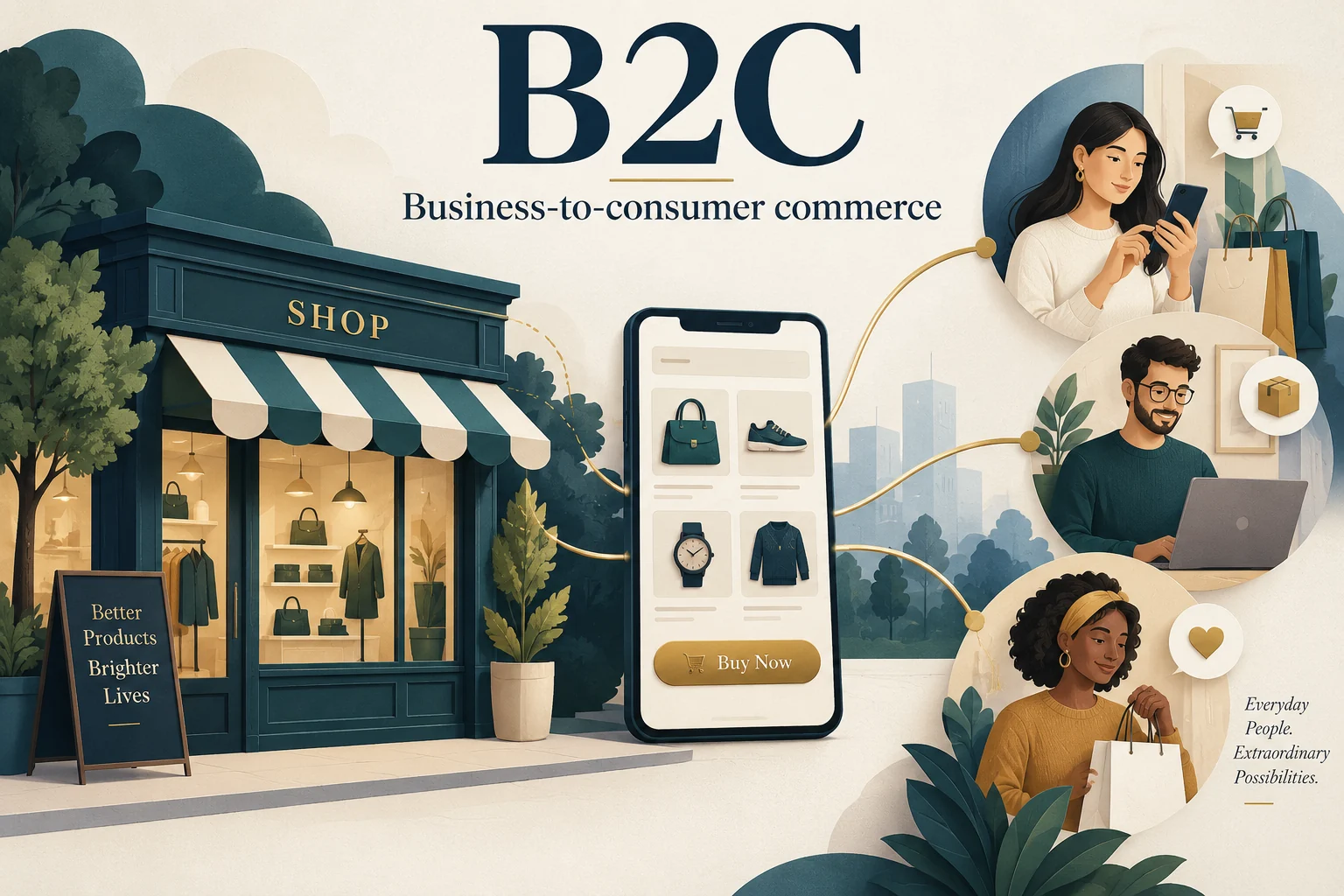
B2C means Business-to-Consumer, a business model in which a company sells products or services directly to individual end-users. The buyer usually makes the purchase for personal use, pays through a consumer payment method, and completes a shorter buying journey than a typical organizational purchaser.
Key Facts About B2C
- B2C stands for Business-to-Consumer and targets individuals rather than organizations.
- A B2C transaction can occur through a website, app, physical shop, social platform, marketplace, or call center.
- D2C, or Direct-to-Consumer, is one type of B2C in which a manufacturer or brand controls the direct sales relationship.
- Typical consumer e-commerce conversion rates often fall around 1.5%-3%, but category, traffic quality, device, and price change the result.
- A B2C business must manage acquisition, payment, delivery or provisioning, support, returns, and repeat purchase behavior.
- B2C does not automatically mean low prices, impulse buying, or online selling. Luxury goods, professional services, and long-term memberships can all be B2C.
What Does B2C Mean in Business?
B2C means that a business markets and sells to a person who will normally consume, use, or experience the offering personally. Apple selling an iPhone to a household, Netflix billing an individual subscriber, and a dentist treating a patient are all B2C examples, although their channels and economics differ.
The defining relationship is between the commercial provider and the individual end-user. The business may use wholesalers, retailers, payment processors, marketplaces, delivery companies, or advertising platforms, but the final customer is a consumer rather than a purchasing department.
B2C describes the customer relationship, not one specific product category. A company can sell physical products, software, entertainment, education, travel, healthcare, financial services, food, or home repairs under a B2C model.
What Is a B2C Example?
A clothing brand selling a $75 jacket through its website is B2C because the purchaser is an individual buying for personal use. A grocery chain, streaming service, ride-hailing app, online course provider, and local plumber also operate in B2C contexts.
| Example business | Product or service | Primary buyer | Typical channel |
|---|---|---|---|
| Nike | Athletic footwear | Individual athlete | Website, store, retailer |
| Netflix | Video subscription | Household subscriber | Mobile app, website, smart TV |
| Expedia | Travel booking | Individual traveler | Website, mobile app |
| Local dentist | Dental treatment | Patient or household | Clinic, phone, website |
| Etsy seller | Handmade product | Individual gift buyer | Online marketplace |
| Spotify | Music access | Individual listener | App, website, partner bundle |
A purchase can remain B2C even when another person pays. For example, a parent may purchase a laptop for a child, or an employer may give a consumer subscription as a benefit. The relevant question is whether the commercial use and buying experience center on an individual consumer.
How Does a B2C Business Work?
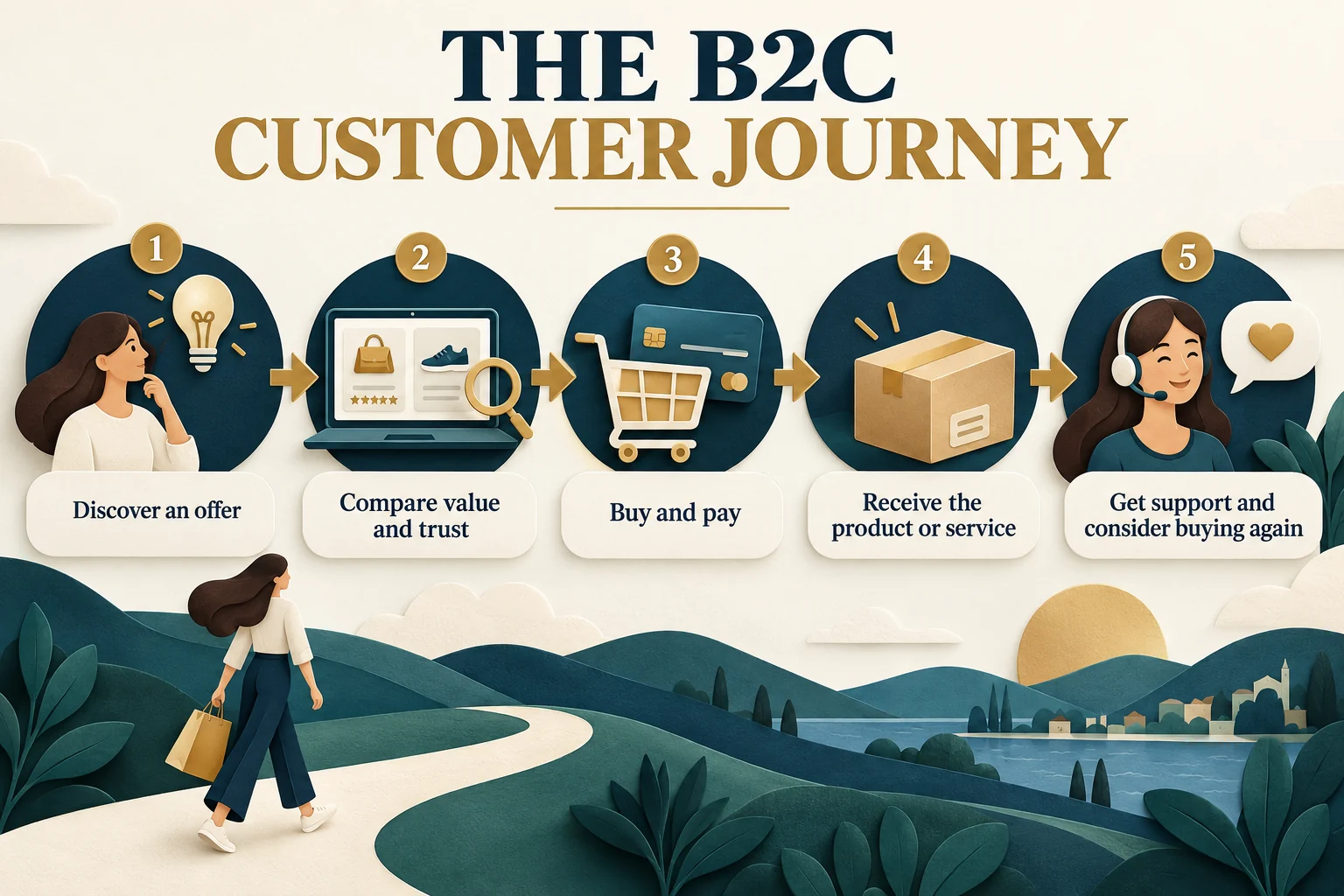
A B2C business converts consumer demand into revenue through a sequence of discovery, evaluation, purchase, delivery, use, and retention. The operating chain normally includes market research, offer creation, customer acquisition, checkout, fulfillment, support, and repeat-purchase activity.
The steps are connected. A marketing campaign cannot compensate indefinitely for poor delivery, and a fast checkout cannot repair an offer that lacks perceived value. B2C operators therefore manage both the front-end customer experience and the back-end economics.
| B2C stage | Core activity | Example output | Useful checkpoint |
|---|---|---|---|
| Research | Identify a consumer problem | Survey, search analysis, prototype | At least one validated pain point |
| Offer creation | Build product or service | Inventory, app, consultation package | Defined price and delivery promise |
| Acquisition | Generate qualified demand | SEO page, paid campaign, creator partnership | Measured visits and CAC |
| Conversion | Complete transaction | Cart, booking, subscription, payment | Conversion and abandonment rate |
| Fulfillment | Deliver the promised value | Shipment, download, appointment | On-time delivery or activation |
| Retention | Encourage continued use | Renewal, reorder, loyalty offer | Repeat rate, churn, or referrals |
What Are the Main B2C Sales Channels?
B2C companies commonly sell through owned channels, third-party channels, physical locations, or a combination of them. An owned website gives a brand more control over customer data and merchandising, while a marketplace can provide faster demand at the cost of fees and reduced customer access.
An omnichannel strategy connects channels rather than merely adding them. A customer might discover a product on TikTok, compare it on a website, purchase through a mobile wallet, collect it in a store, and request support through chat.
| Channel | Typical cost structure | Customer-data control | Best use |
|---|---|---|---|
| Brand website | Hosting plus payment fees | High, subject to consent laws | D2C margin and retention |
| Marketplace | Commission often 8%-30% | Low to moderate | Demand discovery and reach |
| Physical store | Rent, labor, inventory | Moderate | Demonstration and immediate purchase |
| Social commerce | Platform fee plus media cost | Moderate to low | Impulse and creator-led discovery |
| Mobile application | Development and maintenance | High after permission | Frequent use and personalization |
| Retail partner | Wholesale discount | Low | Broad distribution and physical availability |
B2C brands should not treat every channel as interchangeable. A marketplace may produce volume but restrict remarketing, while a physical store can increase trust but impose fixed costs that online sales avoid.
What Are the Main Types of B2C Business Models?
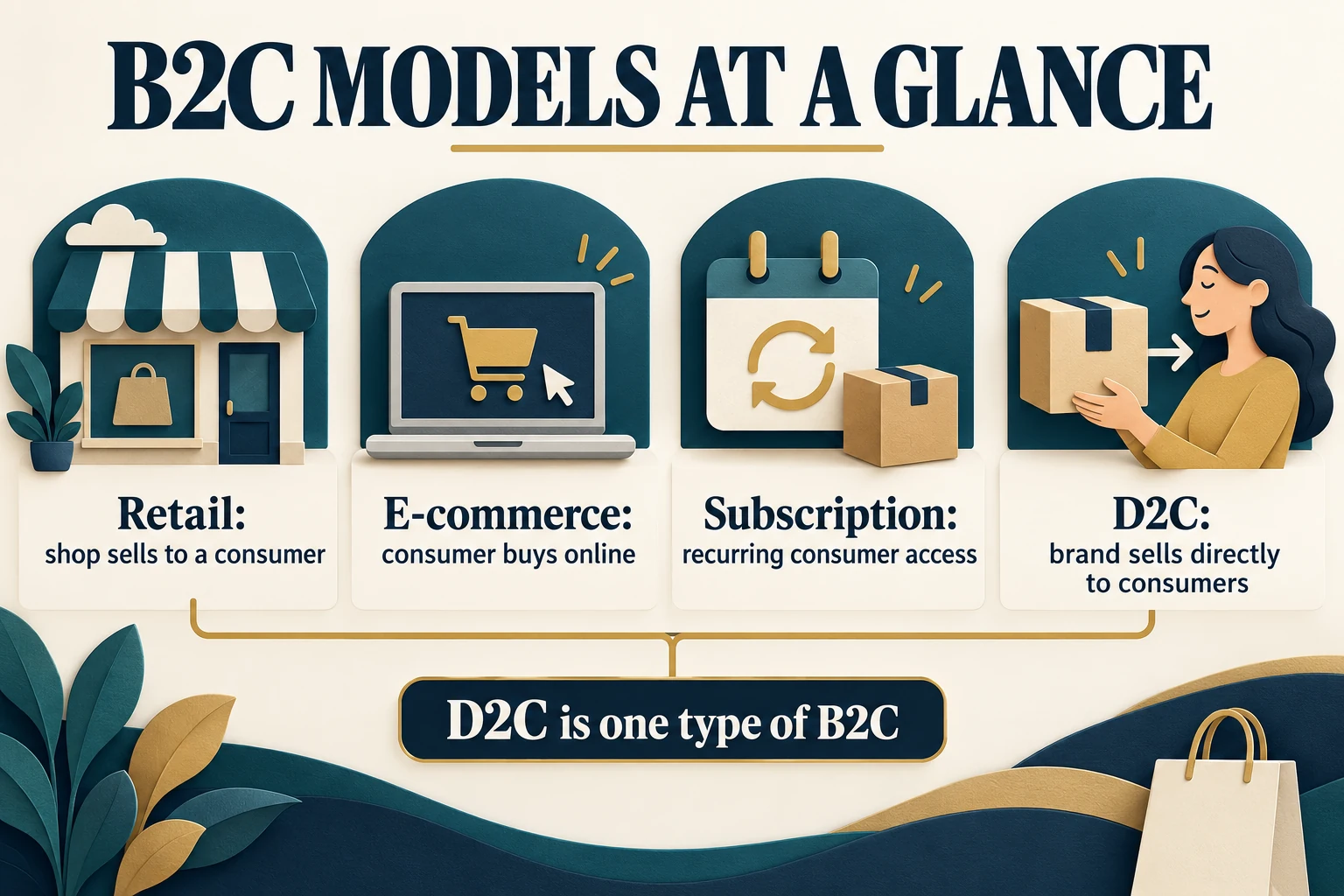
The main B2C models are direct sellers, retailers, marketplaces, advertising-funded platforms, community businesses, and subscription providers. Many modern companies combine two or more models, such as a retailer with a loyalty membership or a free app with paid consumer upgrades.
| Model | Revenue source | Customer relationship | Example |
|---|---|---|---|
| Direct-to-consumer | Product margin | Brand owns checkout relationship | Allbirds website |
| Retail | Product margin and services | Retailer owns transaction | Target store |
| Marketplace | Commission or listing fee | Platform mediates buyer and seller | Etsy |
| Advertising-funded | Advertiser spending | Audience uses free service | YouTube |
| Community-based | Membership, commerce, or sponsorship | Shared-interest network | Peloton community |
| Subscription | Recurring customer payment | Account and billing relationship | Spotify Premium |
Is D2C the Same as B2C?
D2C is a subset of B2C, not a complete synonym. D2C means a manufacturer, producer, or brand sells directly to consumers without relying on a traditional retailer or distributor for the final sale.
A consumer-product company that sells through Walmart is B2C but not purely D2C. The same company selling through its own website is both B2C and D2C. This distinction matters because D2C usually increases control over pricing, customer data, merchandising, and post-purchase communication, but it also transfers marketing, fulfillment, and support responsibilities to the brand.
Can Services and Subscriptions Be B2C?
Services and subscriptions are B2C when individuals purchase them for personal consumption or household use. The customer may pay monthly, annually, per appointment, per trip, or according to usage.
Subscription economics depend on retention rather than a single order. A streaming service with a $12 monthly plan may generate more lifetime revenue from a customer who stays 18 months than from a customer who purchases a one-time product for $100, but cancellation risk and ongoing content costs change the calculation.
How Is B2C Different From B2B?
B2C sells primarily to individual consumers, while B2B sells to organizations that buy for operations, resale, or employee use. B2C usually has a shorter purchase path and immediate payment, whereas B2B often involves multiple stakeholders, formal approval, negotiated pricing, and invoice terms.
The difference is a pattern, not an absolute rule. A consumer buying a $20,000 vehicle may deliberate for weeks, while an employee may purchase a $30 software tool on a company card within minutes.
| Attribute | B2C | B2B |
|---|---|---|
| Economic buyer | Individual or household | Company or institution |
| User count | Usually one household or person | Often multiple employees |
| Typical payment | Card, wallet, cash, instant transfer | Invoice, purchase order, card |
| Decision time | Minutes to weeks | Days to many months |
| Pricing | Public and standardized | Negotiated or tiered |
| Main message | Value, convenience, identity, need | ROI, risk, productivity, compliance |
| Support pattern | Self-service and rapid response | Account management and implementation |
| Order profile | Many smaller transactions | Fewer larger contracts |
B2C marketing can use emotion, identity, convenience, urgency, and social proof because the user and buyer are often the same person. B2B messaging must usually satisfy finance, operations, security, legal, procurement, and an end-user group.
What Is B2B2C?
B2B2C means Business-to-Business-to-Consumer. The first business reaches consumers through a partner business, such as a food delivery platform connecting restaurants with diners or a bank distributing an insurance product through its app.
B2B2C is useful when a partner already owns trusted access to the desired audience. The trade-off is shared margin, shared data, and possible dependence on the intermediary. A supplier should define who owns the customer record, who handles complaints, and what happens if the partnership ends.
How Much Does a B2C Business Cost?
A basic digital B2C launch can cost roughly $500-$10,000 before substantial inventory, payroll, or paid advertising, while a physical retail launch commonly requires $25,000-$250,000 or more. The range depends on product complexity, inventory, compliance, premises, technology, and customer-acquisition requirements.
These are planning ranges, not universal prices. A digital service can launch cheaply but require substantial product development, whereas a physical brand may spend heavily on inventory before receiving its first order.
| Cost category | Lean digital range | Established small-business range | Main cost driver |
|---|---|---|---|
| Website or storefront | $30-$500 monthly | $500-$5,000 setup | Platform and customization |
| Initial inventory | $0-$5,000 | $10,000-$75,000 | Minimum order quantity |
| Branding and creative | $200-$3,000 | $5,000-$30,000 | Packaging and production |
| Launch marketing | $300-$5,000 | $10,000-$100,000 | Paid reach and content |
| Payment processing | Often 2%-4% per order | Negotiated at high volume | Card and fraud costs |
| Fulfillment | $3-$15 per parcel | Contract-dependent | Size, weight, and destination |
| Legal and compliance | $300-$5,000 | $5,000-$50,000 | Product and jurisdiction |
Typical e-commerce conversion rates of 1.5%-3% are useful starting assumptions, not performance guarantees. A website with 10,000 qualified visits and a 2% conversion rate would produce about 200 orders. At a $75 average order value, gross revenue would be approximately $15,000 before product, delivery, tax, refunds, and marketing costs.
Which B2C Metrics Matter Most?
B2C operators should monitor contribution margin, customer acquisition cost, average order value, conversion rate, repeat-purchase rate, and customer lifetime value. Revenue alone can hide a loss if discounts, shipping, returns, payment fees, and advertising consume the order margin.
| Metric | Calculation | Typical planning use | Warning signal |
|---|---|---|---|
| Conversion rate | Orders divided by sessions | Measures purchase efficiency | High traffic, few orders |
| CAC | Acquisition spend divided by new customers | Sets allowable marketing cost | CAC exceeds contribution margin |
| AOV | Revenue divided by orders | Guides bundles and thresholds | Falling basket size |
| Repeat rate | Returning customers divided by customers | Measures retention | One-time purchase dependence |
| Churn | Cancellations divided by subscribers | Measures subscription loss | Rising cancellations |
| Contribution margin | Revenue minus variable costs | Tests order-level viability | Negative after fulfillment |
| Payback period | CAC divided by monthly contribution | Tests cash requirements | Payback exceeds retention |
A useful practitioner rule is to calculate profitability at the order and customer levels separately. A first order may lose money while a repeat customer remains profitable, but that strategy requires enough cash to fund acquisition and evidence that repeat behavior actually occurs.
How Do You Start a B2C Business?
Start by validating a specific consumer problem, defining a narrow offer, calculating contribution margin, selecting one primary channel, and testing demand before committing to large inventory or fixed premises. A lean digital test can take 2-4 weeks, while a physical retail launch often takes 3-9 months.
Step 1: Define the Consumer and Problem
Specify who buys, what situation creates demand, and what alternative the person uses now. “People who want fitness” is too broad; “office workers seeking a 20-minute home strength routine” supports a clearer offer and message.
Step 2: Validate Willingness to Pay
Use interviews, landing-page tests, preorders, small advertising experiments, or paid pilots. Interest without payment is weak evidence. A useful validation test records the offer, price, traffic source, conversion, objections, and refund requests.
Step 3: Build the Smallest Deliverable Offer
A physical seller may begin with one product variation, while a service provider may offer one fixed package. A subscription business should define the initial content or service cadence before promising unlimited access.
Step 4: Select the First Channel
Choose the channel that matches customer behavior and purchase complexity. Search can capture existing demand, creators can demonstrate products, marketplaces can provide discovery, and local stores can reduce trust barriers.
Step 5: Configure Transaction and Compliance Controls
Set up payment processing, tax collection, privacy notices, terms, refunds, accessibility basics, fraud screening, and age or industry restrictions where relevant. Consumer rules vary by jurisdiction, so a business operating across countries may need separate tax and returns procedures.
Step 6: Launch a Measured Test
Track traffic, conversion, CAC, gross margin, delivery time, support contacts, refunds, and repeat intent. Do not scale paid traffic until the business understands which customers are profitable and why unsuccessful visitors do not buy.
What Are the Advantages and Disadvantages of B2C?
B2C offers a large potential market, rapid payment, direct feedback, and the possibility of repeat purchases at scale. B2C also exposes companies to intense competition, high acquisition costs, price comparison, returns, demand volatility, and public customer complaints.
| Advantage | Business value | Limitation |
|---|---|---|
| Large audience | Supports volume and specialization | Competition raises acquisition costs |
| Immediate payment | Improves cash collection | Refunds and chargebacks remain possible |
| Direct feedback | Speeds product improvement | Feedback can be biased toward vocal users |
| Brand control | Enables differentiated positioning | Requires continuous creative investment |
| Repeat purchase | Raises customer lifetime value | Retention needs consistent delivery |
| Digital scale | Reaches many locations quickly | Privacy and platform rules constrain targeting |
B2C is not automatically appropriate for every product. High-consideration industrial goods, complex implementation services, and products requiring extensive customization may perform better through B2B, channel sales, or a hybrid route.
What Common B2C Problems Need Fixing?
The most common B2C failures involve unclear value, expensive acquisition, checkout friction, unreliable fulfillment, weak retention, and poor mobile usability. Each problem requires a different intervention, so adding more advertising rarely fixes the underlying cause.
| Failure mode | Likely cause | Diagnostic signal | Corrective action |
|---|---|---|---|
| Cart abandonment | Unexpected fees or forced account creation | Drop at checkout | Show landed cost and offer guest checkout |
| Low mobile sales | Slow or difficult interface | Mobile conversion below desktop | Compress assets and simplify forms |
| High CAC | Broad targeting or weak offer | CAC rises with spend | Narrow audience and test message-market fit |
| Refund surge | Product mismatch or poor expectations | Refunds after delivery | Improve specifications, images, and onboarding |
| Low repeat rate | Weak post-purchase value | Few second orders | Add replenishment, support, and relevant offers |
| Delivery complaints | Unrealistic promise or carrier failure | Late-order tickets | Set geographic delivery rules and buffers |
| Subscription churn | Low usage or billing surprise | Cancellations in first cycle | Improve activation and clarify renewal terms |
One counterintuitive truth is that a lower price can worsen B2C economics. Discounting may increase conversion while reducing contribution margin, attracting customers with low retention, and training buyers to wait for promotions.
Another practitioner rule concerns checkout speed. A shorter checkout helps only after the offer is trusted. Removing fields from a product page cannot overcome unclear delivery dates, weak reviews, missing returns information, or an unexplained price.
Which B2C Model Fits Different Businesses?
A D2C model fits a brand that can create demand and manage fulfillment, while a marketplace fits a business that needs discovery or sells a varied catalog. Subscription models fit recurring value, community models fit repeated participation, and retail fits consumers who need physical access or demonstration.
| Business situation | Suitable starting model | Main reason | Main risk |
|---|---|---|---|
| Handmade niche products | Marketplace plus owned site | Existing discovery and later retention | Platform dependence |
| Consumable branded goods | D2C subscription option | Replenishment and first-party data | Churn and delivery costs |
| Local appointments | Owned booking site | Geographic demand and direct scheduling | No-show management |
| User-generated content | Advertising-funded platform | Audience monetization | Moderation and ad dependency |
| Complex physical product | Retail plus online research | Demonstration and reach | Inventory and channel conflict |
| Digital professional service | Direct service funnel | High margin and expertise | Founder capacity |
Beginners often start with print-on-demand or dropshipping because those models reduce inventory exposure. They do not eliminate customer-service, quality-control, delivery, refund, or advertising risks, and margins can be too thin to support paid acquisition.
Small and medium businesses usually benefit from connecting a physical point of sale with e-commerce inventory. Larger companies should prioritize consent-based first-party data, reliable identity resolution, recommendation quality, and fulfillment resilience rather than adding personalization without a measurable customer benefit.
Frequently Asked Questions About B2C
What Does B2C Stand for?
B2C stands for Business-to-Consumer. The term describes a commercial relationship in which a company sells to an individual end-user for personal or household consumption. The sale may occur online, in a store, through an app, by phone, or through a marketplace.
Is Amazon B2C or B2B?
Amazon operates in both B2C and B2B. Amazon Retail sells products to individual consumers, while Amazon Business provides organizational purchasing features such as approvals, quantity pricing, and business invoicing. A marketplace can therefore support different customer relationships at the same time.
Is B2C More Profitable Than B2B?
B2C is not inherently more profitable than B2B. B2C can provide high order volume and fast payment, but customer acquisition, returns, support, and price competition may reduce margins. B2B often has larger contracts and longer retention, but sales, implementation, and payment cycles can be more expensive.
What Is the Difference Between B2C and C2C?
B2C is a business selling to a consumer, while C2C means one consumer sells to another consumer. A company such as eBay can facilitate C2C transactions without owning the listed products, whereas a brand selling its own inventory through its website is B2C.
Can One Company Be Both B2B and B2C?
A company can serve both markets through separate offers, pricing, channels, and support processes. A software provider might sell individual licenses to consumers and volume agreements to companies. Mixing the audiences without separating permissions, billing, messaging, and onboarding can create operational confusion.
What Is the Best B2C Business to Start?
The best B2C business is the one with a specific customer problem, reachable demand, defensible economics, and a delivery process the founder can operate reliably. A narrow service or specialized product often provides stronger early learning than a broad store competing on price.
The Bottom Line
B2C meaning in business is straightforward: Business-to-Consumer describes a company selling directly or indirectly to individual end-users. The important strategic questions follow the definition: which consumer problem is being solved, which channel owns the relationship, what each order contributes after variable costs, and whether customers return. A viable B2C model combines a clear offer with measurable acquisition, reliable fulfillment, compliant transactions, and retention strong enough to support growth.