
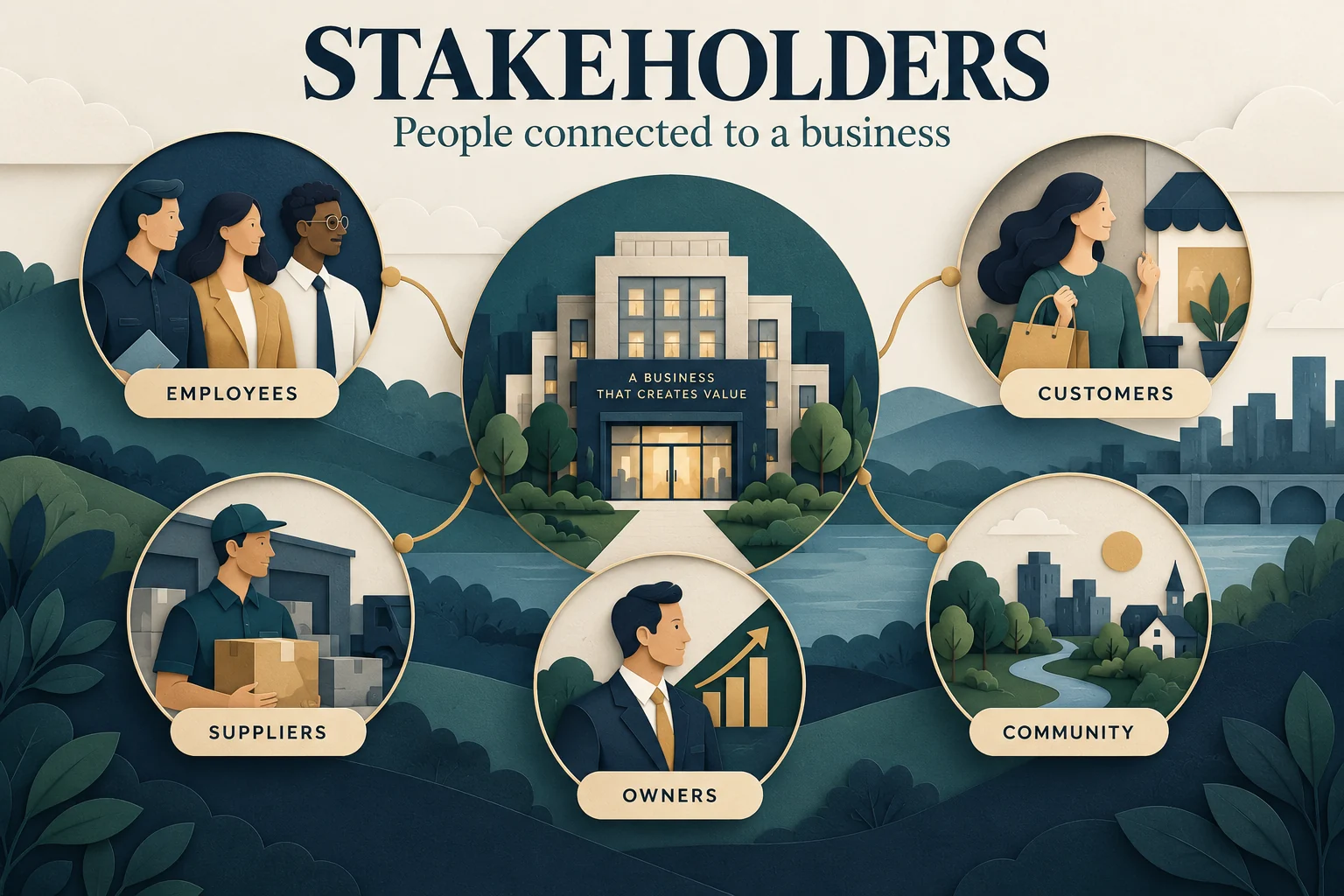
A stakeholder in business is any person, group, or organization that can affect a company, be affected by its decisions, or claim a legitimate interest in its activities. Stakeholders include owners, employees, customers, suppliers, lenders, regulators, communities, and sometimes groups indirectly exposed to business outcomes.
Key Facts at a Glance
- A stakeholder has an interest in a business, but does not necessarily own shares.
- Stakeholder influence and stakeholder impact are separate attributes.
- Shareholders are one stakeholder group, while stakeholders include many nonowners.
- A power-interest grid helps determine communication priority, not moral importance.
- Stakeholder engagement requires two-way feedback, documented decisions, and follow-up.
- A stakeholder map should be reviewed when strategy, risk, ownership, regulation, or operating conditions change.
What Does Stakeholder Mean in Business?
A stakeholder is an entity with a meaningful connection to a company’s decisions, operations, resources, risks, or results. The connection may be financial, contractual, legal, social, operational, or environmental.
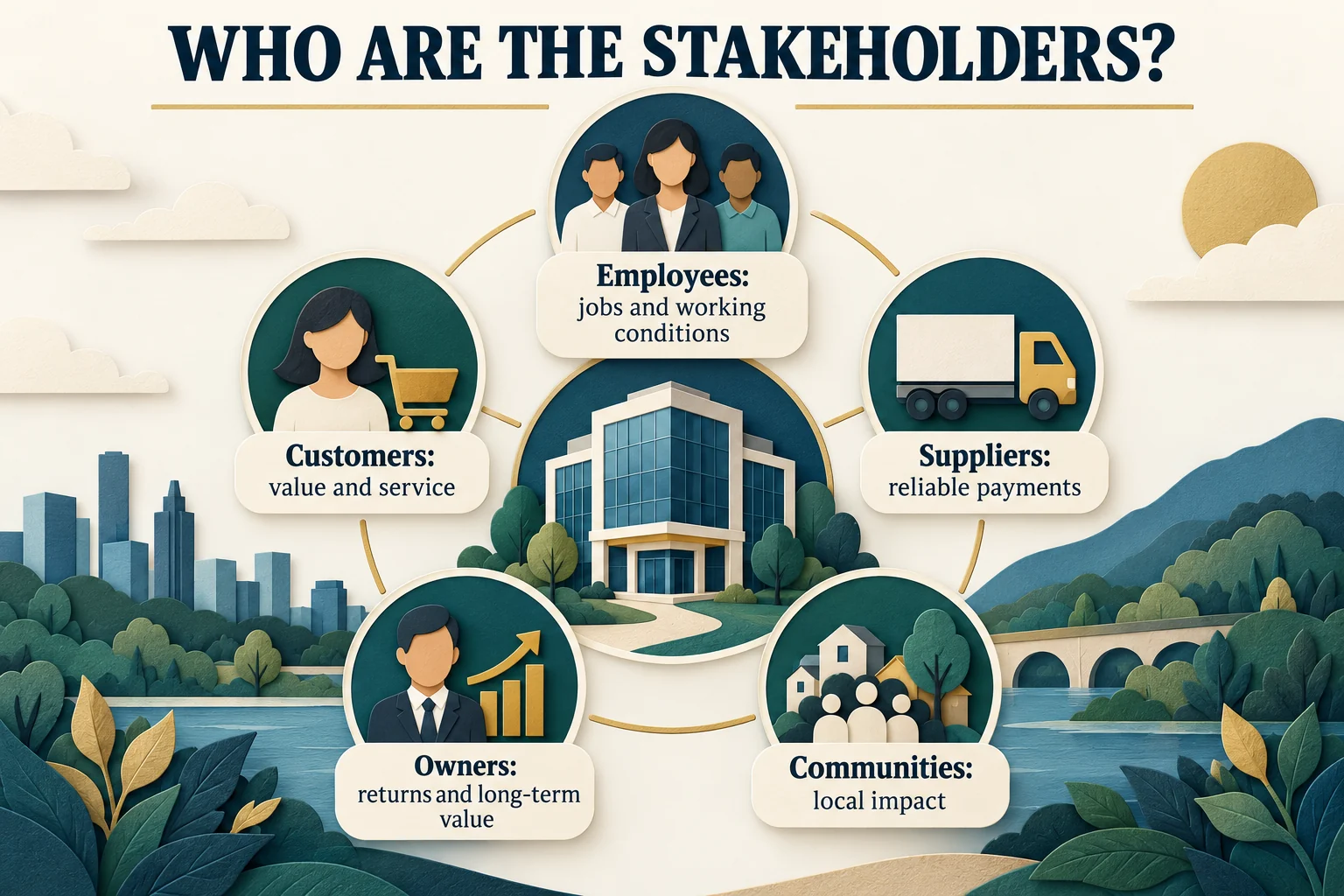
For example, a software company’s employees create the product, customers pay for access, investors provide capital, cloud suppliers support delivery, regulators define legal obligations, and users’ communities may experience privacy or employment effects. Each group has a different interest and decision relationship.
The term does not mean that every stakeholder has equal authority. A regulator may have legal authority, an employee may have operational knowledge, and a customer may have purchasing power. A local community may have limited formal control but still face significant environmental consequences.
Stakeholder, shareholder, and beneficiary
A shareholder owns an equity interest in a company. A stakeholder has a broader interest or exposure, which may exist without ownership. A beneficiary receives a benefit from a program, trust, nonprofit, or service and may or may not influence the organization.
| Term | Core relationship | Typical right or exposure | Business example |
|---|---|---|---|
| Shareholder | Equity ownership | Voting, dividends, capital appreciation | Common-stock investor |
| Stakeholder | Interest, influence, or impact | Varies by contract, law, market, or ethics | Employee or regulator |
| Customer | Purchase or use | Product value, safety, privacy | Subscription user |
| Beneficiary | Receives intended benefit | Service access or program outcome | Nonprofit grant recipient |
The distinction matters because a company can increase quarterly earnings while damaging employee retention, customer trust, supplier viability, or regulatory standing. A stakeholder view examines those connected effects rather than treating share price as the only outcome.
Why Are Stakeholders Important to a Business?
Stakeholders matter because they control or influence resources a company needs to operate, including labor, revenue, finance, permits, supply, knowledge, trust, and social acceptance. Stakeholder decisions therefore affect execution risk as well as reputation.
The World Economic Forum’s 2020 Davos Manifesto described stakeholder capitalism as a model in which a company serves “not only its shareholders, but all its stakeholders.” That statement is a governance principle, not a rule that every interest receives identical weight in every decision.
Stakeholder management is especially important when interests conflict. A manufacturer may need to reduce costs while employees seek wage stability, customers demand lower prices, suppliers need payment certainty, and regulators require safety investment. A responsible decision identifies the conflict, states the trade-off, and records why the chosen action is proportionate.
Stakeholder interests and business outcomes
| Stakeholder | Primary interest | Main influence | Potential business effect |
|---|---|---|---|
| Employees | Pay, safety, development | Execution and knowledge | Productivity or turnover |
| Customers | Value, quality, privacy | Revenue and reviews | Retention or churn |
| Suppliers | Volume, payment, predictability | Input availability | Delays or continuity |
| Regulators | Legal compliance | Permission and sanctions | Approval or penalty |
| Lenders | Repayment and liquidity | Capital access | Financing cost |
| Community | Jobs, safety, environment | Social acceptance | Delay or local support |
What Are the Main Types of Stakeholders?
The main categories are internal and external stakeholders, although a useful analysis also distinguishes primary, secondary, voluntary, involuntary, and directly affected groups.
Internal stakeholders
Internal stakeholders participate in the organization or directly depend on its operation. Common examples include owners, shareholders, board members, executives, managers, employees, and long-term contractors.
Internal stakeholders usually have faster access to information and stronger influence over execution. Their interests can still diverge. An executive may favor a restructuring plan that improves margins, while employees experience uncertainty, workload increases, or job losses.
External stakeholders
External stakeholders sit outside the formal organization but affect or experience its activities. Customers, suppliers, banks, insurers, regulators, local residents, media organizations, trade associations, competitors, and advocacy groups may all qualify.
External status does not mean low importance. A licensing agency can stop a project, a major supplier can interrupt production, and a customer segment can change revenue through collective switching behavior.
| Classification | Meaning | Examples | Typical management need |
|---|---|---|---|
| Primary | Directly connected to operations | Employees, customers, suppliers | Frequent operational coordination |
| Secondary | Indirectly affected or influential | Media, advocacy groups, analysts | Monitoring and transparent updates |
| Voluntary | Chose the relationship | Investor, customer, employee | Clear value and exit options |
| Involuntary | Exposed without choosing it | Nearby residents, downstream users | Impact assessment and remedy |
| Positive | May benefit from an outcome | New hires, customers | Benefit delivery and feedback |
| Adversely affected | May bear costs or risks | Displaced residents, suppliers | Mitigation, consultation, remedy |
The involuntary category deserves special attention. A person does not need to sign a contract with a business to be affected by noise, pollution, data use, congestion, or job displacement.
How Do You Identify Business Stakeholders?
Identify stakeholders by tracing the company’s resources, decisions, dependencies, impacts, and accountability obligations. A practical first pass takes 2-4 hours for a small project and 1-3 weeks for a complex enterprise initiative, depending on geography and regulatory scope.
Use these steps:
- Define the decision or project. State the product launch, site expansion, restructuring, acquisition, or policy being analyzed.
- Trace inputs and outputs. List labor, capital, suppliers, data, permits, customers, waste, emissions, and services.
- Review obligations. Check contracts, licenses, employment rules, privacy requirements, safety standards, and financing covenants.
- Ask who gains and who bears risk. Include groups with positive benefits and groups carrying costs.
- Validate the list. Interview process owners, frontline employees, legal advisers, customer teams, and local representatives.
- Record evidence. Note the stakeholder’s interest, influence, affected population, concerns, owner, and last contact date.
A stakeholder register should contain more than names. It should explain why each group matters and what evidence supports the classification.
Stakeholder register fields
| Field | Example entry | Review frequency | Evidence |
|---|---|---|---|
| Stakeholder | Regional logistics supplier | Monthly | Active contract |
| Interest | Stable volume and payment | Monthly | Supplier meeting |
| Influence | High over delivery continuity | Weekly during launch | Capacity data |
| Impact | Moderate revenue dependence | Quarterly | Spend analysis |
| Decision owner | Operations director | Monthly | Governance chart |
| Engagement need | Forecast sharing and escalation | Biweekly | Service-level agreement |
How Do You Prioritize Stakeholders?
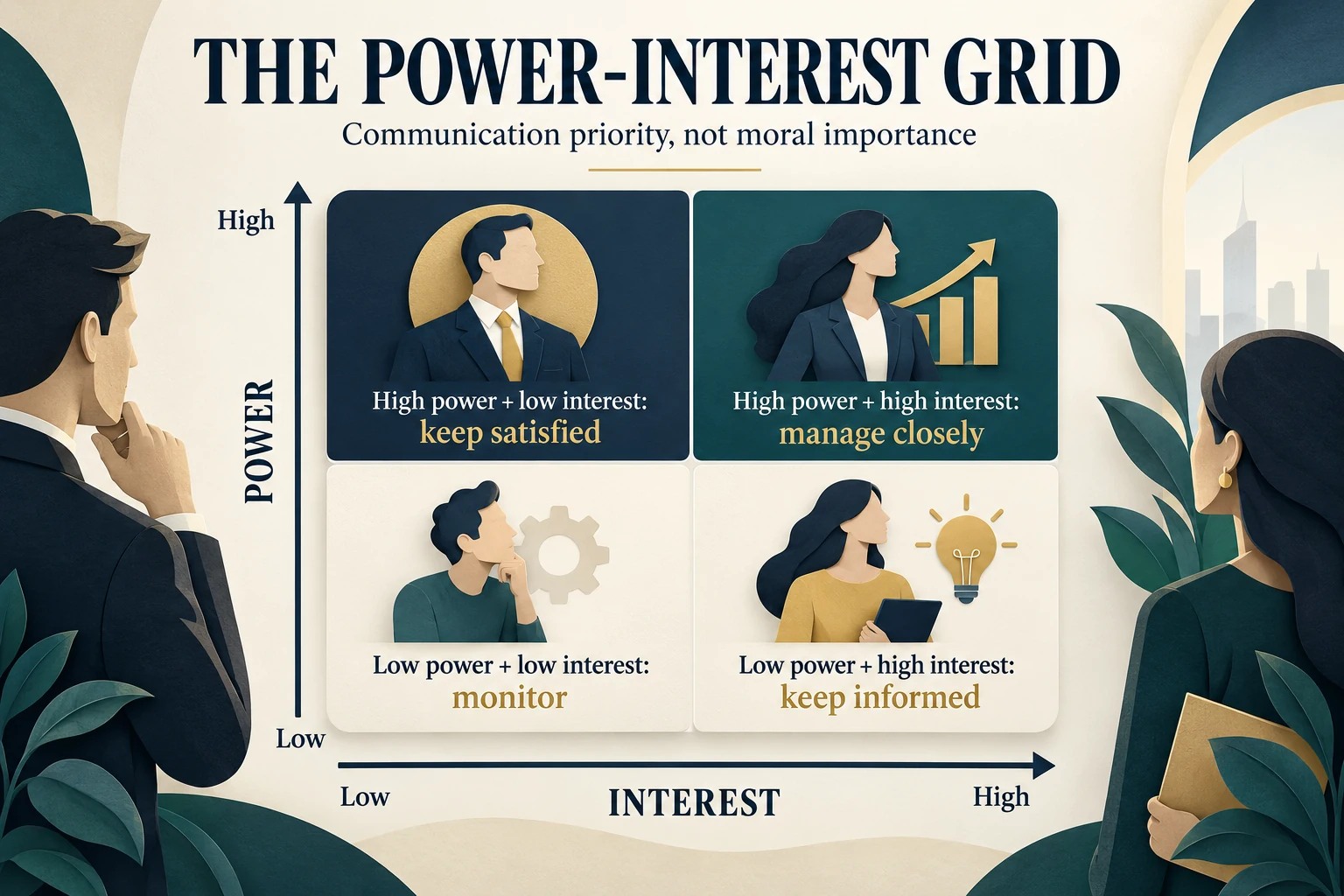
Prioritize stakeholders using power, interest, impact, legitimacy, urgency, and dependency rather than power alone. The power-interest grid is a useful starting tool, but a high-power stakeholder should not automatically outrank a vulnerable group experiencing severe harm.
| Power | Interest | Default approach | Example |
|---|---|---|---|
| High | High | Manage closely | Major regulator during licensing |
| High | Low | Keep satisfied | Diversified institutional lender |
| Low | High | Keep informed and listen | Local residents near a project |
| Low | Low | Monitor proportionately | Distant industry observer |
The salience model, associated with stakeholder theory developed by Ronald K. Mitchell, Bradley R. Agle, and Donna J. Wood in 1997, adds legitimacy and urgency to power. This produces a more realistic assessment: a group may have limited formal power but a legitimate, urgent safety concern.
A practical score can use a 1-5 scale for each attribute. Do not turn the score into a false mathematical truth. Use it to prompt discussion, reveal omissions, and assign ownership.
When should a stakeholder be escalated?
Escalate when a stakeholder faces serious harm, has legal authority, controls a critical dependency, signals a credible public risk, or cannot obtain a response through normal channels. Escalation should record the concern, evidence, responsible decision-maker, deadline, and remedy considered.
How Should a Business Engage Stakeholders?
Engagement should match the stakeholder’s decision rights, information needs, risk exposure, and ability to respond. A quarterly report may suit diversified investors, while employees facing an immediate safety change need direct briefings, anonymous reporting, and a documented response timeline.
| Stakeholder group | Suitable channel | Typical cadence | Useful measure |
|---|---|---|---|
| Employees | Town hall, pulse survey, manager briefing | Monthly or biweekly during change | Retention, eNPS, unresolved issues |
| Customers | Support data, interviews, product testing | Continuous or quarterly | CSAT, NPS, churn |
| Investors | Earnings call, annual report | Quarterly | Guidance, capital return, questions |
| Suppliers | Forecast meeting, scorecard | Monthly | On-time delivery, payment days |
| Community | Public meeting, impact report | Monthly during construction | Complaints resolved, commitments |
| Regulators | Formal filing, compliance meeting | Per obligation or milestone | Findings, approvals, corrective actions |
The strongest engagement loop has four parts: collect input, assess it, decide openly, and report what happened. A survey without a response plan measures sentiment but does not create trust.
What should a communication plan contain?
A communication plan should name the audience, purpose, message, channel, sender, timing, feedback method, escalation route, and evidence of completion. It should also state what the organization cannot change, because unlimited promises create avoidable credibility risk.
What Is the Difference Between Internal and External Stakeholders?
Internal stakeholders influence daily execution from within the company, while external stakeholders provide resources, impose constraints, purchase outputs, or experience consequences outside the company. The boundary can change: contractors may operate inside a facility but remain external legal parties.
| Attribute | Internal stakeholders | External stakeholders |
|---|---|---|
| Access | Usually direct and frequent | Often mediated by contracts or public channels |
| Main contribution | Labor, leadership, operational knowledge | Revenue, capital, supply, permission, legitimacy |
| Main risk | Turnover, conflict, execution failure | Regulation, disruption, opposition, market loss |
| Typical evidence | HR data, meeting records, performance data | Contracts, complaints, filings, surveys |
| Management challenge | Alignment and internal politics | Limited control and competing interests |
Neither category is automatically more important. A small internal engineering team may determine whether a product ships, while an external regulator may determine whether the product can legally be sold.
How Do Stakeholders Differ From Customers and Investors?
Customers and investors are stakeholders, but each group has a specific relationship with the business. Customers exchange money or attention for value, while investors provide capital expecting financial return, influence, or both.
A customer may have high interest and low formal power individually, yet a large customer base can exert substantial market power. An investor may have low day-to-day interest but retain high influence through voting rights, financing conditions, or board representation.
The correct analysis asks what each relationship enables, constrains, or exposes. Labels alone do not determine priority.
How Do You Measure Stakeholder Relationships?
Measure stakeholder relationships with outcome indicators, not communication volume alone. Useful measures include customer retention, employee turnover, supplier payment performance, regulatory findings, complaint resolution time, community commitments completed, and investor confidence indicators.
| Stakeholder area | Metric | Typical interpretation | Review period |
|---|---|---|---|
| Customer | CSAT, churn rate | Satisfaction and continued demand | Monthly |
| Employee | Voluntary turnover, eNPS | Retention and workplace sentiment | Monthly or quarterly |
| Supplier | On-time delivery, payment days | Supply health and commercial reliability | Monthly |
| Compliance | Open findings, incident rate | Control performance | Monthly |
| Community | Resolved complaints, commitments met | Impact response | Monthly during high-impact work |
| Investor | Earnings guidance variance, voting results | Financial and governance confidence | Quarterly or annually |
No single score proves that stakeholder management is effective. High employee survey participation, for example, may coexist with poor safety performance. Pair perception measures with operational evidence.
How Much Does Stakeholder Management Cost?
Stakeholder management costs depend on project complexity, geography, required expertise, and whether consultation is legally mandated. Typical small-business work may cost $0-$5,000 when owners use spreadsheets, interviews, and existing customer tools; formal research, facilitation, legal review, or environmental consultation can raise costs substantially.
| Business context | Typical mapping time | Typical direct cost | Common tools |
|---|---|---|---|
| Solo business or microbusiness | 2-8 hours | $0-$500 | Spreadsheet, interviews |
| Small project | 1-2 weeks | $500-$5,000 | Survey tool, workshop |
| Mid-sized change program | 2-6 weeks | $5,000-$30,000 | Facilitator, CRM, legal review |
| Enterprise or regulated project | 1-6 months | $30,000-$500,000+ | Consultants, ESG systems, public consultation |
These are practitioner ranges, not universal prices. Statutory impact assessments, multilingual consultation, travel, specialist environmental studies, and litigation risk can exceed the upper ranges.
What Are Common Stakeholder Management Mistakes?
Treating shareholders as the only stakeholders
Shareholders have important ownership rights, but shareholder return depends on employees, customers, suppliers, infrastructure, law, and public trust. A balanced scorecard can add customer, process, employee, risk, and financial measures to executive decisions.
Mapping only visible groups
A procurement team may list the contracting supplier but omit subcontractors, temporary workers, downstream users, or nearby residents. Require every project to ask who bears indirect effects and who lacks a formal voice.
Confusing communication with engagement
Sending a newsletter does not establish dialogue. Engagement requires a way to submit concerns, receive a response, influence a decision where appropriate, and verify commitments.
Giving every stakeholder equal attention
Equal treatment is not always fair treatment. A group facing severe irreversible harm may require more attention than a large group receiving minor inconvenience, even when the latter has greater commercial power.
Ignoring changing power
A low-interest stakeholder can become influential during a crisis, regulatory inquiry, viral complaint, supply shortage, or election. Review the map at milestones and whenever assumptions change.
How Should Different Businesses Use Stakeholder Analysis?
Startups and small businesses
Use a one-page register with customers, employees, founders, investors, lenders, suppliers, and regulators. Review it monthly, assign one owner per relationship, and focus on risks that could threaten cash runway, product delivery, legal operation, or staff retention.
Project managers
Add stakeholder analysis to the project charter before scope is finalized. Identify decision-makers, approvers, affected operators, technical dependencies, and groups able to delay delivery. Reassess at design approval, procurement, launch, and post-launch review.
Large enterprises
Use defined relationship owners, issue escalation rules, materiality assessments, privacy controls, grievance mechanisms, and board-level reporting where appropriate. Enterprise systems can store interactions, but software cannot resolve a conflict that leadership has refused to decide.
Nonprofits and public-interest organizations
Include donors, staff, volunteers, service users, beneficiaries, partner agencies, regulators, and communities. Beneficiaries may have high impact exposure but low institutional power, so representation and accessible feedback channels are especially important.
What Is the Best Stakeholder Management Framework?
The best framework is the simplest one that captures interest, influence, impact, legitimacy, urgency, relationship owner, and next action. The power-interest grid is efficient for routine projects; the salience model is better when vulnerable groups, legal claims, or urgent risks may be overlooked.
A practical operating cycle is:
- Define the decision and affected boundary.
- Build and validate the stakeholder register.
- Assess power, interest, impact, legitimacy, urgency, and dependency.
- Prioritize attention and assign relationship owners.
- Agree on communication and feedback methods.
- Make decisions using documented evidence.
- Track outcomes, complaints, commitments, and changing risks.
- Review the map at milestones or trigger events.
Stakeholder frameworks are decision aids, not substitutes for legal compliance, ethical judgment, or direct remedy.
FAQ
Are employees stakeholders or shareholders?
Employees are stakeholders because they contribute labor and depend on the organization’s decisions for pay, safety, development, and job continuity. Employees become shareholders only if they own equity, such as shares purchased personally or received through an employee stock plan.
Can a competitor be a stakeholder?
A competitor can be a stakeholder when the company’s actions affect market conditions, industry standards, shared infrastructure, regulation, or supply availability. Competitors are usually secondary stakeholders, but their influence can increase during mergers, standards negotiations, or antitrust reviews.
Is a stakeholder always affected directly?
No. A stakeholder can be directly affected, indirectly affected, or influential without experiencing a direct operational effect. A regulator may influence a company through legal authority, while a community may experience indirect effects from traffic, employment, pollution, or land-use change.
What is a stakeholder map used for?
A stakeholder map helps a business identify relevant groups, assess their relationships to a decision, assign engagement priorities, and anticipate resistance or support. The map is most useful when it links each stakeholder to evidence, an accountable owner, a communication method, and a next action.
How often should stakeholder analysis be updated?
Update stakeholder analysis at major project milestones and whenever ownership, regulation, strategy, suppliers, risks, or affected populations change. Routine projects may need quarterly review, while construction, crisis, transformation, and regulated programs may require weekly or monthly review.
What is stakeholder capitalism?
Stakeholder capitalism is a governance approach that considers the interests of employees, customers, suppliers, communities, investors, and other affected groups alongside shareholder returns. It does not mean abandoning profitability; it treats long-term business performance as dependent on broader relationships and impacts.
The Bottom Line
Stakeholder meaning in business extends beyond ownership: a stakeholder is any person, group, or organization that affects a company, is affected by it, or has a legitimate interest in its decisions and outcomes. Effective stakeholder management identifies those relationships, prioritizes them using evidence, communicates two ways, measures results, and revises priorities when conditions change.