
A business liability is a present financial or legal obligation that a company owes to another party and will settle by transferring cash, goods, services, or another economic benefit. Liabilities include accounts payable, loans, wages owed, taxes payable, leases, customer deposits, and probable legal obligations recorded under applicable accounting rules.
Key Facts at a Glance
- Liabilities appear on the balance sheet and help finance a company’s assets and operations.
- The basic accounting equation is Assets = Liabilities + Owners’ Equity.
- A current liability is generally due within 12 months or one normal operating cycle.
- Unearned revenue is a liability because the company still owes goods or services to the customer.
- A contingent liability is recorded only when applicable accounting rules’ recognition conditions are met.
- Total liabilities are not the same as total debt because liabilities also include non-borrowing obligations.
What Does Liability Meaning in Business Include?
Business liability meaning includes an obligation created by a contract, purchase, law, employment relationship, tax rule, or past business event. The external party may be a bank, supplier, employee, government agency, landlord, customer, investor, or claimant.
A liability is recognized when the business has a present obligation and the obligation can be measured under the relevant accounting framework. Settlement may involve a cash payment, delivery of inventory, performance of services, replacement of a defective product, or transfer of another asset.
The accounting definition is narrower than the everyday legal meaning. A company may face legal exposure that is not recorded as a balance-sheet liability because the outcome is uncertain or the amount cannot be estimated reliably. The exposure may still require disclosure in financial-statement notes.
Liability, Debt, and Expense Compared
A liability is the broadest category. Debt is usually a liability created by borrowing money, while an expense is a cost recognized because resources were consumed during a reporting period.
| Term | Meaning | Example | Balance-sheet effect |
|---|---|---|---|
| Liability | Present obligation owed to another party | $8,000 supplier invoice | Increases accounts payable |
| Debt | Borrowed money requiring repayment | $100,000 bank loan | Increases loan payable |
| Expense | Cost recognized for resources consumed | $8,000 monthly rent | Reduces profit |
| Accrued expense | Expense incurred but not yet paid | $4,000 wages earned | Increases accrued liabilities |
A rent expense can create a rent payable liability if the business has used the premises but has not paid the landlord. The expense affects profit, while the unpaid amount affects the balance sheet.
How Do Liabilities Work in Accounting?
Liabilities work through double-entry accounting: an obligation is recorded with a corresponding asset, expense, revenue, or equity entry. The obligation remains on the balance sheet until the business pays it, performs what it promised, legally releases it, or transfers it through an approved restructuring.
The accounting equation explains the relationship:
Assets = Liabilities + Owners’ Equity
Suppose a company borrows $50,000. Cash increases by $50,000, and the loan liability increases by $50,000. When the company repays $10,000 of principal, cash and the loan liability each decrease by $10,000. Interest is recorded separately as an expense and normally reduces profit.
The Four-Stage Liability Lifecycle
- Incurrence: A contract, purchase, loan, employment period, or other event creates the obligation.
- Recording: The bookkeeper posts the transaction to the general ledger using double-entry bookkeeping.
- Measurement: The business updates principal, interest, foreign-exchange effects, estimates, or current-versus-long-term classification.
- Settlement: The company pays cash, delivers goods or services, replaces a product, receives a waiver, or restructures the obligation.
| Event | Debit | Credit | Immediate result |
|---|---|---|---|
| Buy inventory on credit for $12,000 | Inventory, $12,000 | Accounts payable, $12,000 | Assets and liabilities increase |
| Pay the supplier $7,000 | Accounts payable, $7,000 | Cash, $7,000 | Liability and cash decrease |
| Borrow $50,000 | Cash, $50,000 | Loan payable, $50,000 | Cash and debt increase |
| Record $500 loan interest | Interest expense, $500 | Interest payable, $500 | Profit and liability decrease |
The timing matters. A loan principal payment usually does not create an expense, but the interest portion does. Confusing the two overstates expenses and understates outstanding debt.
What Are the Main Types of Business Liabilities?
The main types are current liabilities, non-current liabilities, and contingent liabilities. Accountants also group obligations by source, such as operating liabilities, financing liabilities, tax liabilities, employee liabilities, lease liabilities, and customer-related liabilities.
Current Liabilities
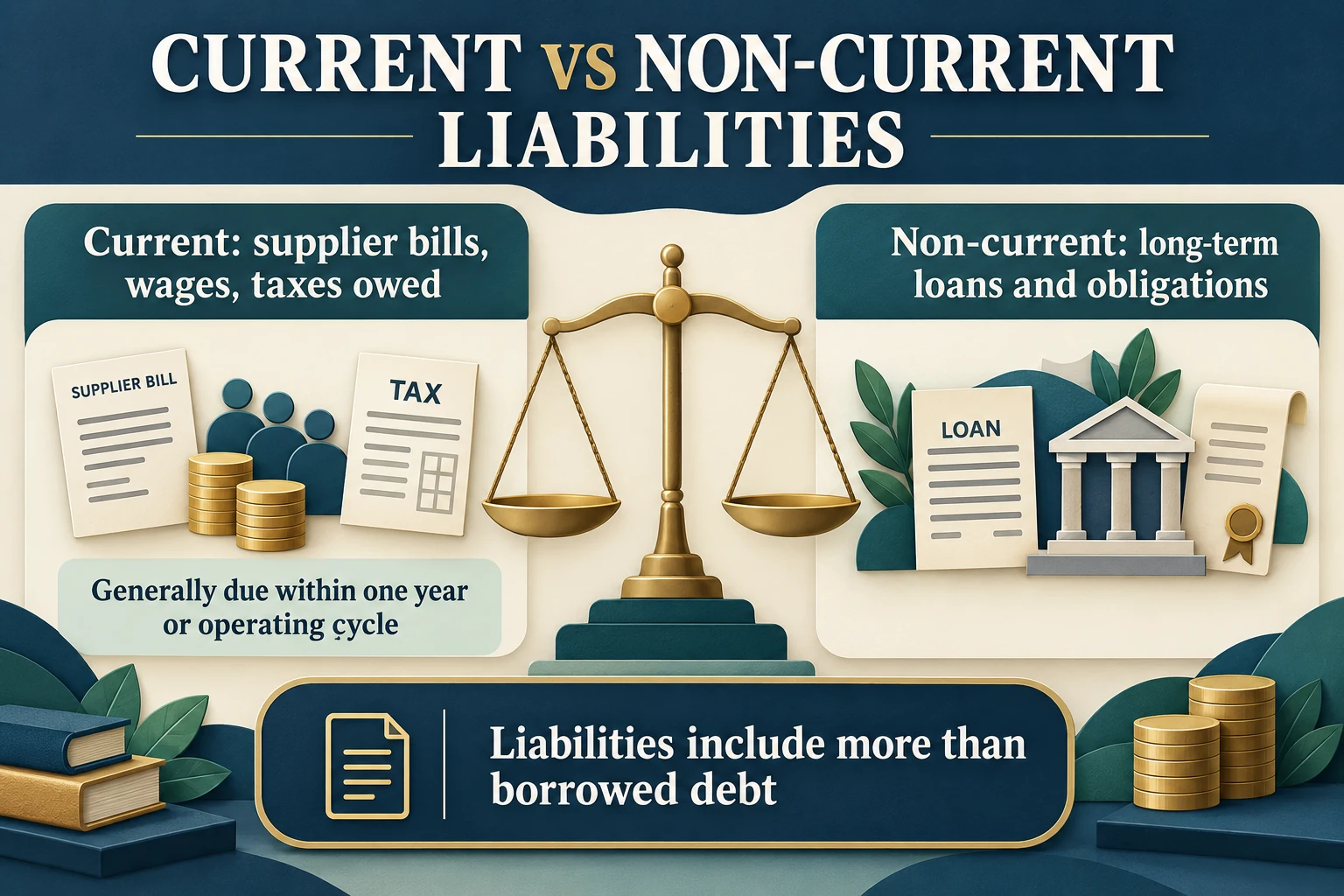
Current liabilities are generally due within 12 months or the company’s normal operating cycle, whichever is longer under the applicable framework. They determine whether near-term assets and operating cash flows can cover near-term obligations.
| Current liability | Typical timing | Example amount | Common settlement |
|---|---|---|---|
| Accounts payable | 30-90 days | $18,000 | Cash payment to supplier |
| Payroll payable | 7-30 days | $24,000 | Wage and benefit payment |
| Sales tax payable | Monthly or quarterly | $6,500 | Remittance to tax authority |
| Current loan portion | Within 12 months | $15,000 | Principal repayment |
| Unearned revenue | Service period, 1-12 months | $30,000 | Product delivery or service |
| Accrued utilities | 15-60 days | $2,400 | Utility payment |
Accounts payable arises after a supplier delivers goods or services on credit. Accrued expenses arise when the business has received the benefit but has not yet received or paid the invoice.
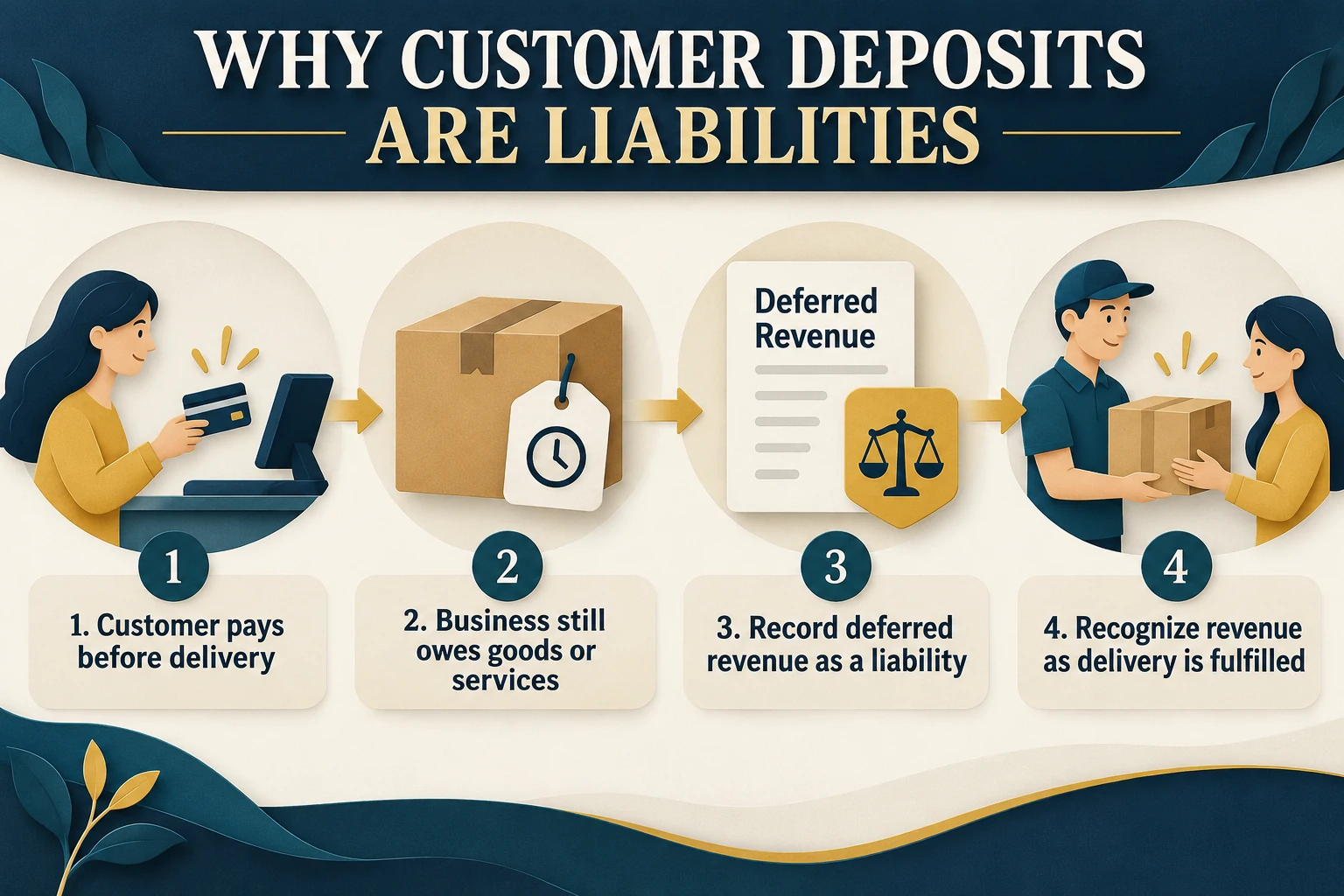
Unearned revenue, also called deferred revenue or contract liability, is a liability rather than immediate revenue when the customer pays before the company performs. A software company receiving $12,000 for a one-year subscription may initially record $12,000 of cash and deferred revenue, then recognize revenue as service is delivered.
Non-Current Liabilities
Non-current liabilities are obligations expected to be settled beyond the next 12 months or normal operating cycle. They often fund long-lived assets, acquisitions, property, equipment, or expansion.
| Non-current liability | Typical term | Common cost or adjustment | Example |
|---|---|---|---|
| Term loan | 3-10 years | Fixed or variable interest | $500,000 equipment loan |
| Corporate bond | 5-30 years | Coupon and market yield | $10 million notes |
| Lease liability | 2-15 years | Lease discount rate | Office or vehicle lease |
| Deferred tax liability | Variable | Temporary tax difference | Accelerated tax depreciation |
| Pension obligation | Multi-year | Actuarial estimate | Defined-benefit plan |
The portion of long-term debt due within the next year is reclassified as the current portion of long-term debt. A five-year loan can therefore appear partly in current liabilities and partly in non-current liabilities.
Contingent Liabilities
A contingent liability is a possible obligation whose existence or amount depends on a future event, such as a lawsuit outcome, product warranty claim, tax dispute, or guarantee being called. Recognition depends on the accounting framework, probability assessment, and ability to estimate the amount.
Under US GAAP, a loss contingency that is probable and reasonably estimable is generally accrued, while a reasonably possible loss is generally disclosed. IFRS uses the concept of a provision when an obligation is present, an outflow is probable, and a reliable estimate can be made. Exact treatment requires professional judgment.
A company should not hide a material lawsuit merely because no cash has left the bank. Legal counsel, auditors, and management normally assess the claim, probability, expected range, insurance coverage, and disclosure requirement.
Which Obligations Count as Liabilities?
An obligation counts as a liability when the company has a present duty created by a past event, settlement will probably or potentially require economic resources, and the amount can be accounted for under the relevant rules. The following obligations commonly qualify.
| Obligation | Why it qualifies | Typical accounting treatment | Key risk |
|---|---|---|---|
| Supplier invoice | Goods or services already received | Accounts payable | Late-payment penalties |
| Customer deposit | Company owes future delivery or refund | Contract liability | Refund or fulfillment pressure |
| Employee wages | Work already performed | Payroll payable | Penalties and employee claims |
| Income or sales tax | Taxable event has occurred | Tax payable | Interest, fines, audit |
| Personal guarantee | Owner may owe lender if company defaults | Disclosure or recognition depends on facts | Personal asset exposure |
| Lease commitment | Right-of-use asset creates payment obligation | Lease liability under GAAP or IFRS | Long-term cash commitment |
Personal guarantees deserve special attention. A company may be legally separate from its owner, yet a signed guarantee can expose the owner’s personal assets if the business defaults. The guarantee may not appear as an ordinary company loan on the balance sheet.
How Are Liabilities Measured and Classified?
Liabilities are measured using the amount owed, the present value of future payments, an expected-value estimate, or another method required by the accounting standard. Classification depends mainly on settlement timing, refinancing rights, covenant compliance, and the company’s operating cycle.
A $100,000 loan due in five years may initially be recorded at proceeds adjusted for fees and then measured using the effective interest method. A variable-rate loan changes its interest cost as the reference rate changes. A foreign-currency payable changes in reported value when exchange rates move.
Current Versus Non-Current Classification
| Test | Current classification | Non-current classification |
|---|---|---|
| Settlement date | Due within 12 months | Due after 12 months |
| Operating cycle | Due within normal cycle | Beyond normal cycle |
| Refinancing | No enforceable long-term right | Long-term refinancing right may exist |
| Covenant breach | Payable soon if waiver absent | Long-term treatment may apply with valid waiver |
A covenant breach can turn apparently long-term debt into a current obligation. A company that misses a minimum interest-coverage ratio may need to classify the loan as current unless the lender provides an appropriate waiver before the reporting date.
How Do Liabilities Affect Profit, Cash Flow, and Risk?
Liabilities affect financial statements in different ways depending on the transaction. Borrowing increases cash and liabilities without immediately increasing revenue or profit, while interest, wages, and depreciation-related obligations can affect profit.
Cash flow risk is often more urgent than accounting profit. A profitable company can fail if customers pay in 90 days but suppliers, payroll, taxes, and lenders require payment in 30 days. The mismatch creates a working-capital gap.
| Transaction | Profit effect at inception | Cash-flow effect | Liability effect |
|---|---|---|---|
| Bank loan proceeds | $0 | Cash increases | Debt increases |
| Inventory bought on credit | Usually $0 | Cash unchanged | Accounts payable increases |
| Interest accrued | Profit decreases | Cash may remain unchanged | Interest payable increases |
| Customer deposit | Revenue usually $0 | Cash increases | Deferred revenue increases |
| Principal repayment | Profit usually $0 | Cash decreases | Debt decreases |
An obligation can be economically expensive without being immediately reported as an expense. A lease, purchase commitment, or minimum-volume contract may restrict future cash even before payment is due.
Which Liability Ratios Should a Business Monitor?
The most useful liability ratios depend on the decision. Liquidity ratios test near-term payment capacity, leverage ratios test financial structure, and coverage ratios test whether operating earnings can support financing costs.
| Ratio | Formula | Illustrative result | Interpretation |
|---|---|---|---|
| Current ratio | Current assets ÷ current liabilities | $300,000 ÷ $200,000 = 1.50 | $1.50 of current assets per $1 owed soon |
| Quick ratio | (Cash + marketable securities + receivables) ÷ current liabilities | $180,000 ÷ $200,000 = 0.90 | Immediate assets cover 90% of current liabilities |
| Debt-to-equity | Interest-bearing debt ÷ equity | $600,000 ÷ $400,000 = 1.50 | $1.50 of debt per $1 of equity |
| Debt ratio | Total liabilities ÷ total assets | $700,000 ÷ $1,200,000 = 58.3% | 58.3% of assets financed by liabilities |
| Interest coverage | EBIT ÷ interest expense | $150,000 ÷ $30,000 = 5.0x | Operating earnings cover interest five times |
The quick-ratio formula should use receivables, not accounts payable. Accounts payable is an obligation, so including it in the numerator is a calculation error.
No universal “healthy” liability ratio applies to every industry. A grocery chain, software company, construction firm, and regulated utility have different working-capital cycles, asset bases, and financing structures. Compare a company with its historical results, lender covenants, and industry peers.
How Much Do Business Liabilities Cost?
The cost of a liability ranges from zero stated interest for ordinary trade credit to more than 12% annually for higher-risk unsecured or subordinated borrowing. Actual pricing depends on credit quality, collateral, term, benchmark rates, lender competition, fees, covenants, and market conditions.
| Liability or financing | Typical timing | Typical pricing pattern | Main cost |
|---|---|---|---|
| Supplier credit | 30-90 days | 0% stated interest, discount may be lost | Late fees or missed discounts |
| Bank line of credit | 1-5 years, renewable | Benchmark rate plus spread | Interest and commitment fee |
| Secured term loan | 3-10 years | Often lower than unsecured debt | Interest, collateral, covenants |
| Unsecured small-business loan | 1-7 years | Often higher than secured debt | Interest and origination fee |
| Mezzanine financing | 3-7 years | Often 12%-20% or negotiated | High interest and possible warrants |
| Corporate bonds | 5-30 years | Coupon plus issuance costs | Interest and refinancing risk |
These are typical directional ranges, not quotations. A company should calculate the annual percentage cost, fees, required compensating balances, prepayment penalties, and covenant restrictions before comparing offers.
Trade credit can also have a hidden cost. If a supplier offers “2% discount if paid in 10 days, net 30,” refusing the discount may produce a very high annualized cost compared with a bank facility.
Liability Financing Versus Equity Financing
Liability financing preserves ownership but creates mandatory repayment obligations. Equity financing avoids scheduled principal payments but dilutes ownership and may transfer voting rights, board influence, or a share of future value.
| Decision factor | Liability financing | Equity financing |
|---|---|---|
| Ownership | Founders usually retain ownership | Investors receive an ownership interest |
| Repayment | Principal and interest usually required | No scheduled repayment |
| Business risk | Default can trigger enforcement | Investors share downside risk |
| Cost | Interest and fees are explicit | Dilution and future profit share |
| Tax treatment | Interest may be deductible, subject to rules | Dividends generally are not deductible |
| Control | Covenants can limit decisions | Investors may receive votes or board seats |
| Best fit | Predictable cash flow and collateral | High-growth, uncertain cash flow |
Debt is often suitable for equipment with predictable cash generation, while equity may suit a pre-revenue company whose future value is uncertain. A business should match liability duration to asset life: using a 90-day facility to fund equipment used for seven years creates refinancing pressure.
What Common Liability Errors Should Businesses Avoid?
The most damaging errors are usually classification, timing, and omission errors rather than arithmetic mistakes. They distort liquidity, profit, lender reporting, and management decisions.
- Treating all liabilities as debt: Total liabilities include payables, taxes, leases, deposits, and provisions, not only bank borrowings.
- Leaving the current loan portion in long-term debt: Update the classification from the amortization schedule at every reporting date.
- Recording customer cash as immediate revenue: Recognize revenue as the company delivers the promised goods or services.
- Ignoring payroll and sales taxes: These obligations can generate penalties, liens, and personal liability for responsible officers.
- Using short-term funds for long-term assets: Refinance risk rises when the funding expires before the asset generates cash.
- Omitting guarantees and lawsuits: Review contracts with legal counsel and document probability, estimate, insurance, and disclosure.
- Relying on one ratio: A current ratio of 1.5 can conceal slow receivables, obsolete inventory, or a large payment due next week.
A practical monthly review should reconcile supplier statements, payroll accruals, tax accounts, debt schedules, lease records, customer deposits, and legal exposures. The review should also compare due dates with the rolling 13-week cash forecast.
How Can a Business Reduce Liability Risk?
A business can reduce liability risk by controlling payment timing, matching financing terms to asset lives, negotiating covenants, and maintaining accurate records. Reducing the accounting balance alone is not always the goal because liabilities can support profitable growth when cash flows are predictable.
Use a liability-management process with these steps:
- List every obligation: Include loans, leases, credit cards, supplier balances, taxes, payroll, deposits, guarantees, and legal claims.
- Assign due dates: Build a 13-week cash schedule and a 12-month maturity calendar.
- Separate operating and financing liabilities: This shows whether pressure comes from normal trading or borrowing.
- Test covenant headroom: Calculate interest coverage, leverage, minimum liquidity, and borrowing-base limits.
- Match assets and liabilities: Fund a five-year equipment purchase with financing that does not mature in 90 days.
- Stress-test cash flow: Model a 20% sales decline, 15-day customer delay, higher interest rates, and a major unexpected repair.
- Escalate exceptions: Obtain lender, tax, legal, or accounting advice before a missed payment becomes a default.
The best liability profile is not necessarily the smallest one. It is the profile that supports operations while preserving enough liquidity for adverse conditions.
Liability Examples by Business Situation
A retailer buying inventory on 60-day terms records accounts payable. A consulting firm that invoices after completing work may record accrued employee costs before receiving customer cash. A subscription company records a contract liability when customers pay for future service.
| Business situation | Liability created | When recognized | Main management question |
|---|---|---|---|
| Retail inventory on credit | Accounts payable | Supplier delivers goods | Can sales convert inventory to cash before payment? |
| Annual software subscription paid upfront | Deferred revenue | Customer pays before service | Can the company deliver the full service period? |
| Employees work before payday | Wages payable | Work has been performed | Is payroll funding available on payday? |
| New office lease signed | Lease liability | Lease commencement under applicable rules | Does the fixed payment fit forecast cash flow? |
| Product defect claim is probable | Warranty provision | Expected cost is estimable | Is the reserve supported by claim history? |
| Owner guarantees a company loan | Guarantee exposure | Contract is signed, treatment depends on facts | Could personal assets be at risk? |
Liabilities are therefore not automatically negative. Supplier credit can fund inventory efficiently, and customer deposits can finance production. Risk appears when the company cannot settle obligations on time or does not understand the restrictions attached to them.
Frequently Asked Questions
Is a liability an asset?
No. An asset is a resource controlled by the business that is expected to provide future economic benefit, while a liability is an obligation that will require future economic sacrifice. A bank loan increases both cash, an asset, and loan payable, a liability, at the time of borrowing.
Is accounts payable a liability or an expense?
Accounts payable is a liability. The related purchase may create an expense when the business consumes a service, or inventory when the business buys goods for resale. The unpaid supplier balance remains a liability until payment or another settlement removes it.
Does a liability reduce profit?
A liability does not automatically reduce profit. Borrowing principal and recording a customer deposit generally do not reduce profit at inception, while interest expense, wages incurred, and consumed supplies do. The liability records what remains owed, whereas the expense records resources consumed during the period.
Are leases liabilities?
Yes, most recognized business leases create lease liabilities representing the present value of future lease payments, although detailed treatment differs under US GAAP and IFRS. Short-term or low-value exemptions may apply in some cases. Lease commitments can still affect cash flow even when accounting presentation differs.
Can a company have too many liabilities if it is profitable?
Yes. Profit does not guarantee liquidity because accounting revenue and cash collection occur at different times. A profitable company can become unable to pay suppliers, employees, taxes, or lenders when receivables arrive slowly, inventory absorbs cash, or debt repayments mature together.
How can a company lower its liabilities?
A company can lower liabilities by paying balances, converting short-term debt to appropriate long-term financing, negotiating supplier terms, settling disputes, issuing equity, or improving working-capital collection. Each option has a trade-off: paying debt consumes cash, while equity reduces liabilities but may dilute ownership.
The Bottom Line
Liability meaning in business centers on an obligation that a company must settle with cash, goods, services, or another economic benefit. Classify each obligation by source and timing, distinguish debt from total liabilities, monitor liquidity and coverage ratios, and match financing maturities with the assets and cash flows they support.