

Turnover meaning in business depends on context: it can mean a company’s net sales for a period, or the speed at which inventory, receivables, employees, or other assets move through the business. In UK and Australian usage, turnover commonly means revenue, while financial analysts often use turnover to describe an efficiency ratio.
Key Facts at a Glance
- Business turnover can mean net sales revenue or an operating-cycle ratio.
- Turnover is not profit: a company can report $10 million in sales and still lose money.
- Inventory turnover measures how many times stock is sold and replaced during a period.
- Accounts receivable turnover measures how efficiently credit sales become cash.
- Staff turnover measures employee departures as a percentage of average headcount.
- High turnover is useful only when service levels, margins, quality, and cash flow remain healthy.
What Does Turnover Mean in Business?
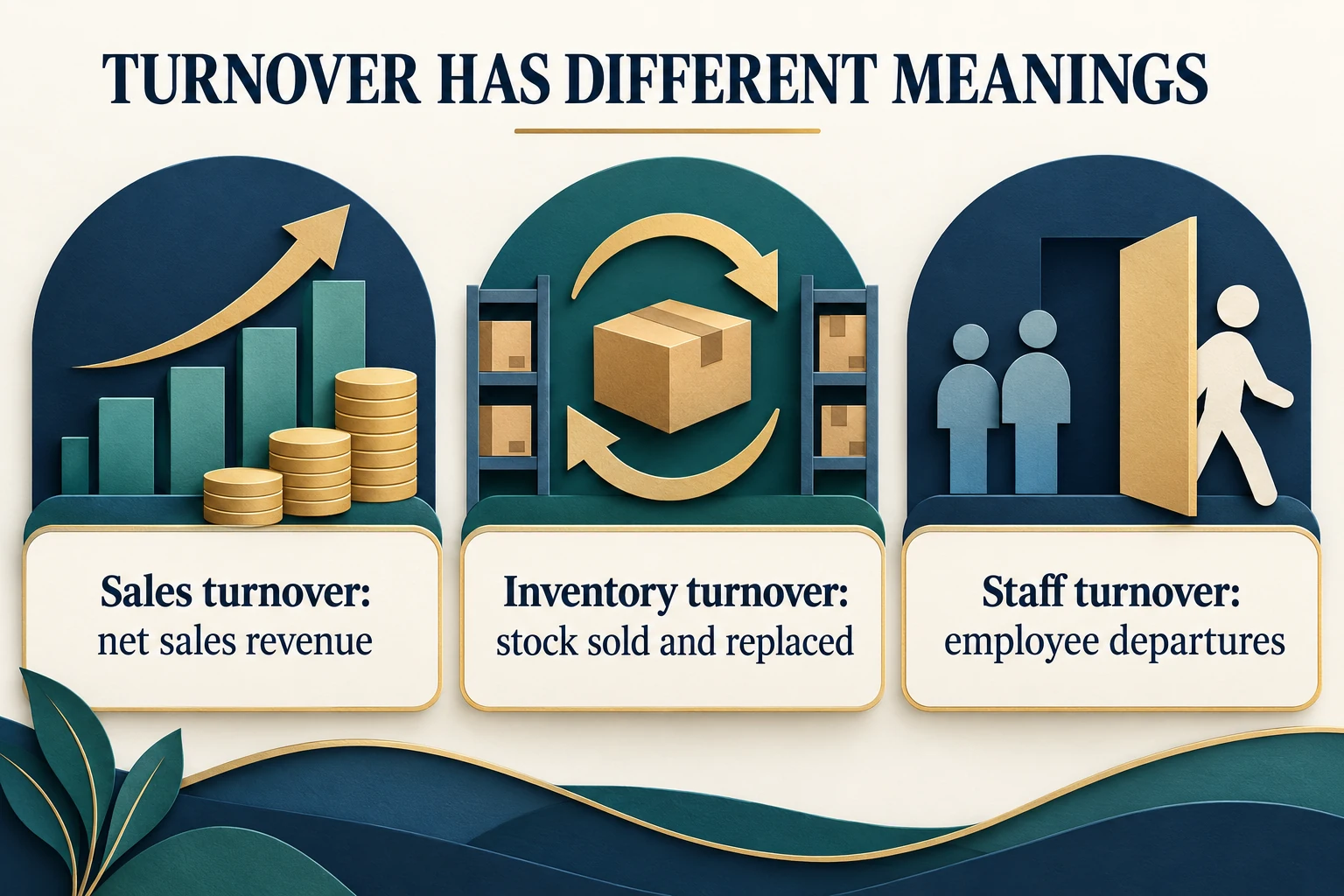
Business turnover has two established meanings. In financial reporting and everyday UK or Australian business language, turnover usually means net revenue from selling goods or services during a specified period. In management accounting, “turnover” often describes how frequently an asset or resource cycles, such as inventory turnover or employee turnover.
The correct interpretation comes from the noun attached to it. “Annual turnover” usually means sales revenue. “Inventory turnover” means stock velocity. “Staff turnover” means employee departures. “Accounts receivable turnover” means collection efficiency.
Why the word creates confusion
Turnover does not have one universal value or unit. Sales turnover is stated in currency, inventory turnover in turns per year, receivables turnover as a ratio, and staff turnover as a percentage.
A retailer with $2 million of annual net sales has monetary turnover of $2 million. If its average inventory is $400,000 and cost of goods sold is $1.6 million, its inventory turnover is 4.0 times. Those figures describe different attributes of the same business.
Is Turnover the Same as Revenue?
Turnover and revenue are often interchangeable, but usage varies by jurisdiction and accounting context. In the United Kingdom and Australia, “turnover” commonly refers to sales revenue, whereas US financial communication more often uses “revenue” or “sales.”
For a precise calculation, use net sales rather than cash received. Net sales normally exclude returns, rebates, trade discounts, and collected sales taxes such as VAT or GST. A business that invoices $500,000 but records $20,000 of returns has net turnover of $480,000 before any other accounting adjustments.
| Term | Meaning | Typical unit | Included example | Usually excluded |
|---|---|---|---|---|
| Gross sales | Customer billings before deductions | $500,000 | Invoices issued | Returns and discounts |
| Net sales turnover | Sales after normal deductions | $480,000 | Product revenue | VAT, GST, returns |
| Revenue | Recognized income under accounting rules | $480,000 | Earned product sales | Unearned deposits |
| Cash receipts | Money collected from customers | $430,000 | Bank receipts | Unpaid invoices |
Businesses should define turnover in contracts, loan documents, and performance reports. A sales target based on gross billings is not comparable with a statutory revenue target based on net sales.
Is Turnover the Same as Profit or Cash Flow?
Turnover is neither profit nor cash flow. Turnover measures sales volume when used as revenue, while profit subtracts costs and cash flow measures actual cash movement over time.
Consider a wholesaler reporting $1,000,000 in turnover. Its goods cost $650,000, payroll and operating expenses total $300,000, and interest costs $30,000. The company has a $20,000 loss before tax despite its large sales figure. If customers have 60-day payment terms, the company may also need financing to pay suppliers before collecting invoices.
| Measure | Formula | Example | What it answers |
|---|---|---|---|
| Turnover | Net sales | $1,000,000 | How much was sold? |
| Gross profit | Sales minus COGS | $350,000 | What remains after product cost? |
| Operating profit | Gross profit minus operating costs | $50,000 | Does core activity earn money? |
| Net profit | Profit after interest and tax | -$20,000 | What remains for owners? |
| Operating cash flow | Cash generated by operations | -$80,000 | Did operations provide cash? |
A practitioner rule is to pair every turnover target with a gross-margin and cash-conversion target. Revenue growth without financing capacity can create overtrading, where a growing company becomes unable to fund inventory, payroll, or supplier payments.
Which Types of Business Turnover Matter?
The relevant turnover measure depends on the resource being evaluated. Sales turnover measures commercial scale, inventory turnover measures stock movement, receivables turnover measures collection speed, staff turnover measures workforce stability, and asset turnover measures capital productivity.
| Turnover type | Formula | Unit | Main question |
|---|---|---|---|
| Sales turnover | Net sales | Currency | How much did the business sell? |
| Inventory turnover | COGS ÷ average inventory | Turns per year | How often was stock replaced? |
| Receivables turnover | Net credit sales ÷ average receivables | Turns per year | How quickly are customers paying? |
| Staff turnover | Leavers ÷ average employees × 100 | Percentage | How frequently do employees leave? |
| Fixed-asset turnover | Net sales ÷ average fixed assets | Turns per year | How productively is equipment used? |
| Total-asset turnover | Net sales ÷ average total assets | Turns per year | How much sales does the asset base generate? |
How Do You Calculate Sales Turnover?
Sales turnover is calculated by subtracting returns, allowances, and discounts from gross sales. A business with $800,000 of gross invoices, $25,000 of returns, and $15,000 of discounts reports $760,000 of net sales turnover.
Businesses using agency, subscription, or marketplace models need extra care. A marketplace may record only its commission as revenue rather than the full value of goods sold by third-party sellers. Comparing gross transaction value with statutory turnover can overstate the company’s economic sales.
How Do You Calculate Inventory Turnover?
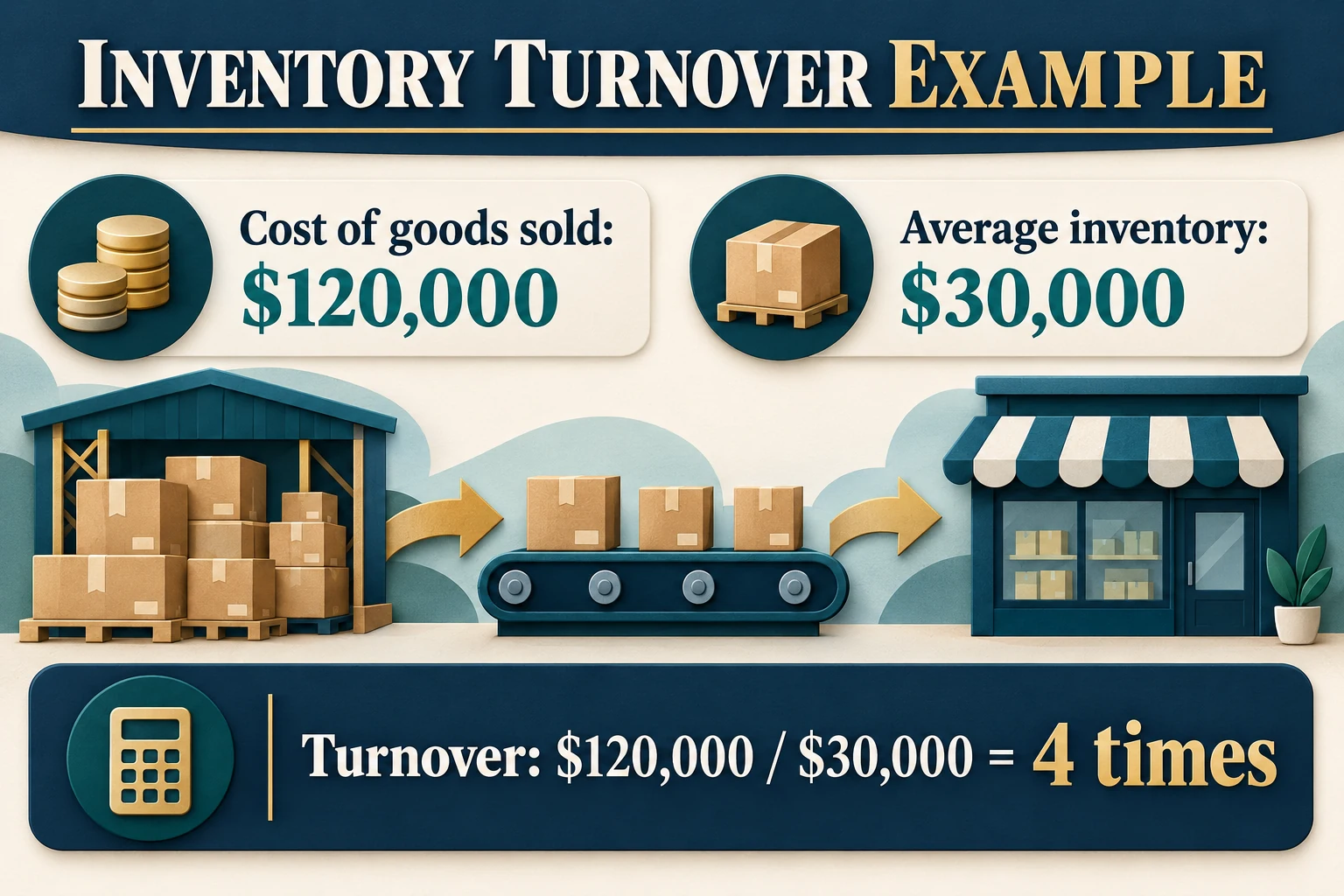
Inventory turnover equals cost of goods sold divided by average inventory. Average inventory is commonly calculated as beginning inventory plus ending inventory, divided by two.
Example:
- Beginning inventory: $300,000
- Ending inventory: $500,000
- Average inventory: $400,000
- COGS: $1,600,000
- Inventory turnover: $1,600,000 ÷ $400,000 = 4.0 turns
The ratio means the business sold and replaced an amount of inventory equal to its average stock four times during the year. It does not mean every item sold exactly four times.
| Inventory turnover | Approximate days of inventory | Possible interpretation | Immediate check |
|---|---|---|---|
| 2.0 turns | 183 days | Slow movement or long production cycle | Aging report |
| 4.0 turns | 91 days | Moderate stock velocity | Category margin |
| 6.0 turns | 61 days | Faster retail movement | Stockout rate |
| 10.0 turns | 37 days | Lean inventory position | Service level |
| 15.0 turns | 24 days | Very rapid movement | Lost-sales estimate |
The days calculation is:
Days inventory outstanding = 365 ÷ inventory turnover
High inventory turnover can indicate excellent demand forecasting. It can also indicate chronic understocking, which creates stockouts and lost sales. The right target depends on product life, supplier lead time, minimum order quantities, seasonality, and required service levels.
How Do You Measure Collection Efficiency?
Accounts receivable turnover equals net credit sales divided by average accounts receivable. A higher ratio generally means customers pay faster, but an excessively high ratio can result from restrictive credit terms that reduce sales.
Example:
- Net credit sales: $1,200,000
- Beginning receivables: $140,000
- Ending receivables: $160,000
- Average receivables: $150,000
- Receivables turnover: 8.0 times
- Approximate collection period: 365 ÷ 8 = 45.6 days
| Receivables turnover | Approximate collection period | Typical concern | Management response |
|---|---|---|---|
| 4.0 turns | 91 days | Slow collection | Review credit limits |
| 6.0 turns | 61 days | Moderate delay | Automate reminders |
| 8.0 turns | 46 days | Depends on contract terms | Compare with agreed terms |
| 10.0 turns | 37 days | Strong collection | Monitor customer retention |
| 15.0 turns | 24 days | Very tight terms possible | Check lost-account rate |
Use an aged receivables report alongside the ratio. A 45-day average can conceal a small number of invoices that are more than 120 days overdue, particularly when a few large customers dominate sales.
How Is Staff Turnover Calculated?
Staff turnover equals the number of employees who leave during a period divided by average headcount, multiplied by 100. A company with 18 departures and average headcount of 180 has annual staff turnover of 10%.
Separate voluntary resignations, dismissals, retirements, redundancies, and seasonal workers. Each category has a different management meaning. A high resignation rate in a scarce technical role creates more operational risk than the same percentage among short-term seasonal roles.
| Staff measure | Calculation | Example | Decision use |
|---|---|---|---|
| Overall turnover | All leavers ÷ average headcount | 18 ÷ 180 = 10% | Workforce stability |
| Voluntary turnover | Resignations ÷ average headcount | 12 ÷ 180 = 6.7% | Retention risk |
| First-year turnover | New-hire exits ÷ new hires | 8 ÷ 40 = 20% | Hiring and onboarding |
| Critical-role turnover | Critical-role exits ÷ critical-role headcount | 4 ÷ 50 = 8% | Capability risk |
| Regrettable turnover | Wanted employees lost ÷ average headcount | 5 ÷ 180 = 2.8% | Retention investment |
A universal “good” staff turnover rate does not exist. Compare roles, location, employment model, and labor market. The US Bureau of Labor Statistics publishes industry and occupational separations data, but national averages should not become automatic targets for one employer.
When Should You Use Fixed-Asset Turnover?
Fixed-asset turnover is useful when equipment, buildings, vehicles, or machinery represent a material share of the business’s capital. The formula is net sales divided by average net fixed assets.
A manufacturer with $12 million of sales and $4 million of average net machinery has fixed-asset turnover of 3.0 times. A falling ratio may indicate underused capacity, a recent expansion, weak demand, or accounting depreciation that has reduced the denominator.
| Business model | Fixed assets | Sales | Ratio example | Main interpretation |
|---|---|---|---|---|
| Software company | $500,000 | $10,000,000 | 20.0 turns | Low physical-capital need |
| Retail chain | $8,000,000 | $32,000,000 | 4.0 turns | Store productivity |
| Manufacturer | $4,000,000 | $12,000,000 | 3.0 turns | Plant utilization |
| Transport operator | $15,000,000 | $30,000,000 | 2.0 turns | Fleet productivity |
The ratio is less informative for service firms with limited tangible assets. Intangible assets, leased assets, and different depreciation policies can make cross-company comparisons misleading.
What Is a Good Turnover Ratio?
A good turnover ratio is one that supports the company’s margin, service level, liquidity, and operating model. There is no universal benchmark for inventory, receivables, staff, or fixed-asset turnover.
Use four comparison points:
- Compare the business with similar companies, not unrelated sectors.
- Compare the current period with the same seasonal period last year.
- Compare the ratio with customer service measures, such as stockouts or complaints.
- Compare the ratio with margin and cash-flow outcomes.
| Measure | Useful companion metric | Warning sign | Better question |
|---|---|---|---|
| Sales turnover | Gross-margin percentage | Sales rise, margin falls | Are incremental sales profitable? |
| Inventory turnover | Stockout percentage | Ratio rises sharply | Is stock too low? |
| Receivables turnover | Bad-debt rate | Ratio falls | Which customers are overdue? |
| Staff turnover | Absence and vacancy time | Resignations cluster | Which roles or managers are affected? |
| Asset turnover | Capacity utilization | Ratio falls after investment | Is new capacity producing output? |
A ratio should be interpreted as a trend, not a score. One unusually high month can result from seasonal sales, delayed purchasing, a bulk shipment, or an accounting reclassification.
How Does Turnover Affect Cash Flow?
Turnover affects cash flow through the operating cycle, not through sales volume alone. Inventory consumes cash before sale, receivables delay collection after sale, and supplier credit partially funds the gap.
The cash conversion cycle is commonly expressed as:
Cash conversion cycle = days inventory outstanding + days sales outstanding – days payables outstanding
| Component | Formula | Example days | Cash effect |
|---|---|---|---|
| Inventory days | 365 ÷ inventory turnover | 91 | Cash tied in stock |
| Receivable days | 365 ÷ receivables turnover | 46 | Cash tied in invoices |
| Payable days | 365 ÷ payable turnover | 45 | Supplier funding |
| Cash conversion cycle | 91 + 46 – 45 | 92 | Funding required |
Reducing inventory days by 10 can release substantial working capital in a large distributor. However, extending supplier payment beyond agreed terms can damage supply reliability and credit relationships, so the cash benefit must be weighed against procurement risk.
Why Is Turnover Falling?
Falling turnover can result from weaker demand, price reductions, customer concentration, stock shortages, slower collections, employee departures, or an asset base that grew faster than sales. The remedy depends on which turnover measure declined.
Use a monthly dashboard that separates volume, price, customer, product, and timing effects. A sales decline caused by a discontinued low-margin product may be positive, while a decline caused by lost strategic customers is serious.
Inventory turnover troubleshooting
Check stock aging, forecast accuracy, supplier lead times, markdowns, and product-level margins. Bundle or discount obsolete stock only after calculating whether the cash release outweighs the margin loss. Renegotiate minimum order quantities when supplier constraints are causing excess inventory.
Receivables turnover troubleshooting
Match invoice dates with contractual due dates, then examine disputes, missing purchase orders, billing errors, and customer concentration. Automated reminders help only when invoices are accurate and sent to the correct accounts-payable contact.
Staff turnover troubleshooting
Analyze exits by manager, tenure, role, shift, location, pay band, and reason. A concentrated first-year resignation pattern usually points toward recruitment accuracy, onboarding, workload, or supervision rather than a company-wide culture problem.
Which Turnover Measure Should You Prioritize?
Small businesses should usually prioritize receivables turnover and cash runway because delayed collection can threaten payroll even when sales are growing. Retail and ecommerce operators should prioritize inventory turnover alongside stockout and gross-margin data. Asset-heavy enterprises should add fixed-asset turnover and capacity utilization.
| Situation | Priority measure | First action | Risk if ignored |
|---|---|---|---|
| Startup with unpaid invoices | Receivables turnover | Set deposits and credit limits | Cash shortfall |
| Seasonal retailer | Inventory turnover | Forecast by season and category | Overstock or stockouts |
| Fast-growing wholesaler | Sales and receivables turnover | Fund working capital | Overtrading |
| High-churn service firm | Staff turnover | Segment exits by role and manager | Capability loss |
| New manufacturing plant | Fixed-asset turnover | Track utilization and output | Idle capital |
The best measure is the bottleneck metric. Improving a ratio that is not constraining cash, margin, capacity, or service quality may produce a better dashboard without improving the business.
Common Mistakes When Interpreting Turnover
Treating high turnover as automatically positive
High inventory turnover may indicate stockouts. High staff turnover may indicate poor retention. High receivables turnover may indicate credit terms so strict that customers leave.
Using ending balances instead of average balances
A seasonal company can produce a distorted ratio if December inventory is used as the denominator for a year with high summer sales. Use monthly or quarterly averages when seasonality is material.
Comparing different accounting bases
One company may report gross sales while another reports net revenue after returns. One manufacturer may capitalize costs differently from another. Normalize definitions before comparing ratios.
Ignoring concentration
A receivables ratio can look healthy because most customers pay promptly while one major account is overdue. Review the top ten balances and the aging profile separately.
Improving the ratio by damaging the operation
Reducing inventory purchases can improve inventory turnover temporarily, but the decision is poor if fill rates fall from 98% to 85%. Ratios are management signals, not objectives detached from customer outcomes.
FAQ
What does annual turnover mean for a company?
Annual turnover usually means the company’s net sales revenue during a twelve-month period, especially in UK and Australian business usage. It does not normally mean annual profit, cash collected, or total assets. Confirm whether the figure excludes returns, discounts, VAT or GST, and sales made as an agent.
Is turnover important for a small business?
Turnover is important, but sales volume alone does not show financial health. A small business should evaluate turnover alongside gross margin, operating expenses, receivables days, inventory days, tax obligations, and cash reserves. Rapid sales growth can increase borrowing needs before it improves available cash.
What is the difference between turnover and sales?
Sales usually means the value of goods or services sold. Turnover often means the same thing when used as a revenue term, although turnover can also describe an efficiency ratio such as inventory or staff turnover. The surrounding phrase determines the meaning.
Can turnover be negative?
Sales turnover is normally zero or positive, although accounting adjustments can produce a negative net figure for a specific period if returns and credits exceed recorded sales. Turnover ratios are generally non-negative, while percentage changes in turnover can be negative when sales or activity decline.
How often should a business review turnover?
A business should review sales turnover monthly and review inventory, receivables, staff, and asset turnover at a frequency suited to their volatility. Weekly monitoring is useful for fast-moving inventory and overdue invoices. Annual review alone can conceal a cash or staffing problem until recovery becomes expensive.
Does higher turnover always mean better performance?
Higher turnover is better only when the business preserves margin, product availability, collection quality, employee capability, and cash flow. A company can increase sales while losing money, accelerate inventory movement by understocking, or reduce receivables through restrictive terms that weaken customer retention.
The Bottom Line
Turnover meaning in business changes with context. It can mean net sales revenue, inventory movement, customer collection speed, employee departures, or asset productivity. Start with the exact turnover measure, calculate it using consistent definitions and average balances, then judge the result against margin, cash flow, service quality, seasonality, and comparable businesses.