
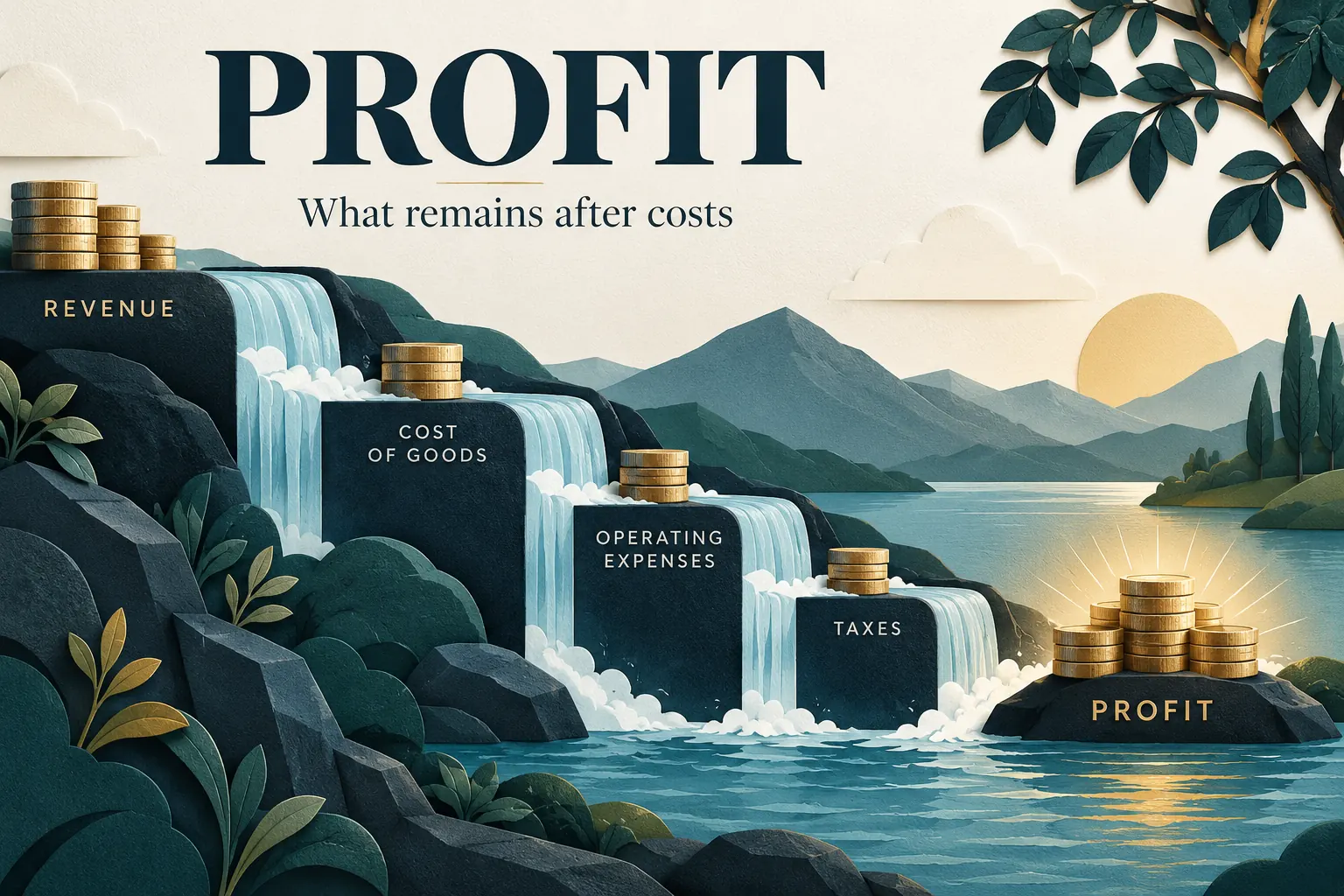
Profit in business is the financial surplus remaining after a company subtracts the costs of earning revenue from that revenue. Profit meaning in business includes several measures, including gross profit, operating profit, and net profit, because each one reveals a different layer of pricing, production, overhead, financing, and tax performance.
Key Facts at a Glance
- Profit equals revenue minus expenses, but the result depends on which expenses the calculation includes.
- Gross profit measures revenue left after direct production or delivery costs.
- Operating profit, or EBIT, measures earnings after ordinary operating expenses but before interest and income tax.
- Net profit is the bottom-line amount remaining after operating costs, financing costs, non-operating items, and taxes.
- Profit is not cash flow: accrual accounting can record revenue before the customer pays.
- A higher revenue figure does not prove a healthier business if costs grow faster than sales.
What Does Profit Mean in Business?
Profit means the amount by which business income exceeds the expenses required to generate that income during a defined accounting period. If a company earns $100,000 in revenue and incurs $82,000 of total expenses, its accounting profit is $18,000 and its net profit margin is 18%.
Profit is measured over a period such as a month, quarter, or financial year. The period matters because sales, inventory purchases, annual insurance, bonuses, depreciation, and tax charges may fall in different months. A single profitable month therefore cannot prove that a company has a durable business model.
Profit can be positive, zero, or negative. A negative result is normally called a loss. A loss may be planned during a startup’s investment phase, but repeated losses eventually require additional equity, borrowing, asset sales, or a change in the operating model.
Why Does a Business Need Profit?
Profit gives a business internal funding for replacement equipment, product development, hiring, debt reduction, reserves, and owner distributions. A company can survive temporarily without profit through investor funding or borrowing, but those sources do not replace a sustainable operating model.
Profit also provides a measurement system. Management can compare product margins, locations, customer groups, sales channels, and periods to identify where value is created or destroyed. Investors use profit alongside cash flow and return metrics to judge whether deployed capital is earning an adequate return.
Profit is not automatically proof of good management. A company can increase profit by delaying maintenance, underpaying owners, cutting research, or selling assets. Those actions may improve one reporting period while weakening future capacity.
How Is Business Profit Calculated?
Business profit is calculated by subtracting the relevant cost layer from revenue. The income statement moves from revenue to gross profit, operating profit, and net profit, with each step answering a different management question.
- Calculate revenue: Add sales, service income, subscriptions, royalties, and other operating income for the period.
- Subtract COGS: Remove materials, inventory costs, direct labor, payment processing tied directly to sales, and other direct delivery costs.
- Calculate gross profit: Revenue minus COGS shows the surplus available to fund overhead.
- Subtract operating expenses: Deduct rent, administration, marketing, software, insurance, research, and other operating costs.
- Calculate operating profit: Gross profit minus operating expenses produces EBIT.
- Adjust for non-operating items: Include interest income, interest expense, gains, losses, depreciation, and amortization according to the reporting framework.
- Subtract income tax: The remainder is net profit or net income.
| Income statement level | Formula | Example amount |
|---|---|---|
| Revenue | Product sales plus service income | $500,000 |
| Gross profit | $500,000 revenue minus $300,000 COGS | $200,000 |
| Operating profit | $200,000 gross profit minus $125,000 OPEX | $75,000 |
| Pre-tax profit | $75,000 EBIT minus $15,000 interest | $60,000 |
| Net profit | $60,000 pre-tax profit minus $12,000 tax | $48,000 |
Accounting standards affect classification. For example, depreciation is an expense in profit calculations even though no payment occurs when depreciation is recorded. Taxable profit can also differ from book profit because tax authorities apply jurisdiction-specific rules.
What Are the Main Types of Profit?
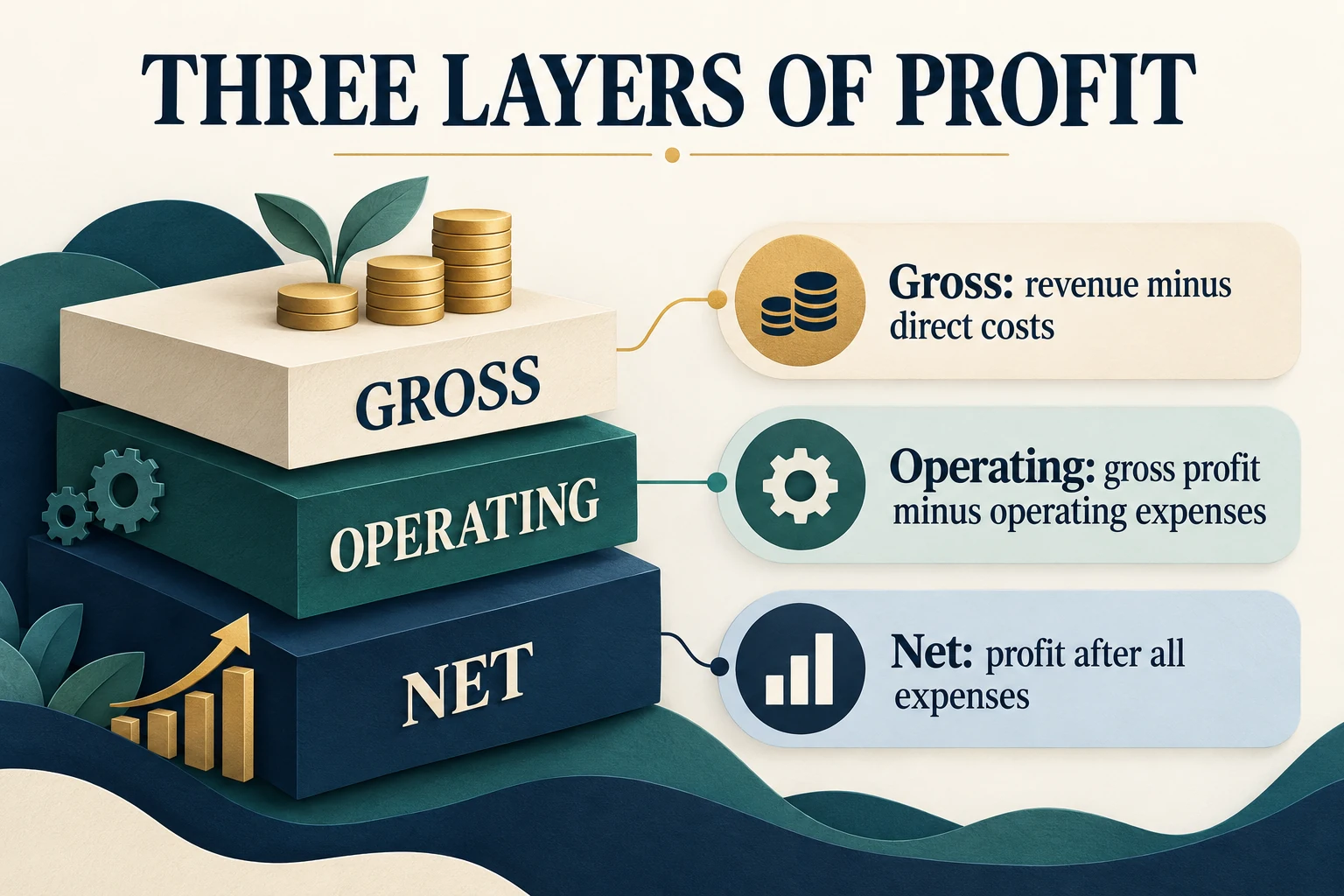
Gross profit, operating profit, and net profit are the three core profit levels. EBITDA is a supplemental earnings measure rather than a replacement for net profit, because EBITDA excludes depreciation, amortization, interest, and taxes.
| Profit measure | Formula | Primary question | Example |
|---|---|---|---|
| Gross profit | Revenue minus COGS | Does the offer cover direct delivery costs? | $200,000 |
| Operating profit | Gross profit minus OPEX | Can normal operations fund overhead? | $75,000 |
| EBIT | Operating profit before interest and tax | How profitable are operations independent of financing? | $75,000 |
| Net profit | Pre-tax profit minus income tax | What remains after all recorded charges? | $48,000 |
| EBITDA | EBIT plus depreciation and amortization | What are operating earnings before selected non-cash charges? | $92,000 |
Gross Profit
Gross profit measures the money left after costs directly attributable to goods or services sold. A manufacturer may include raw materials and direct factory labor; a retailer generally includes the purchase cost of inventory; a software company may include hosting, customer support, and third-party infrastructure.
Gross margin is:
Gross margin = Gross profit ÷ Revenue × 100
In the example, $200,000 divided by $500,000 produces a 40% gross margin. A low gross margin leaves less money for marketing, administration, financing, and product development.
Operating Profit
Operating profit measures earnings from ordinary operations before interest and income tax. It includes indirect costs such as rent, sales salaries, advertising, office software, accounting, insurance, and research.
Operating margin is:
Operating margin = Operating profit ÷ Revenue × 100
The example produces a 15% operating margin. Operating profit is useful for comparing businesses with different debt levels, provided accounting policies and cost classifications are reasonably comparable.
Net Profit
Net profit is the amount reported after operating costs, interest, non-operating gains or losses, and income tax. Net margin is:
Net margin = Net profit ÷ Revenue × 100
A company with $48,000 of net profit on $500,000 of revenue has a 9.6% net margin. Owners may distribute some of that amount, while the rest may remain as retained earnings.
EBITDA
EBITDA means earnings before interest, taxes, depreciation, and amortization. Analysts often use it to compare operating performance across companies with different financing and asset structures.
EBITDA is not cash flow. It excludes capital expenditure, changes in working capital, debt principal, and taxes. An airline, factory, or telecom company can report substantial EBITDA while needing large cash investments to maintain its assets.
What Is a Profit Margin?
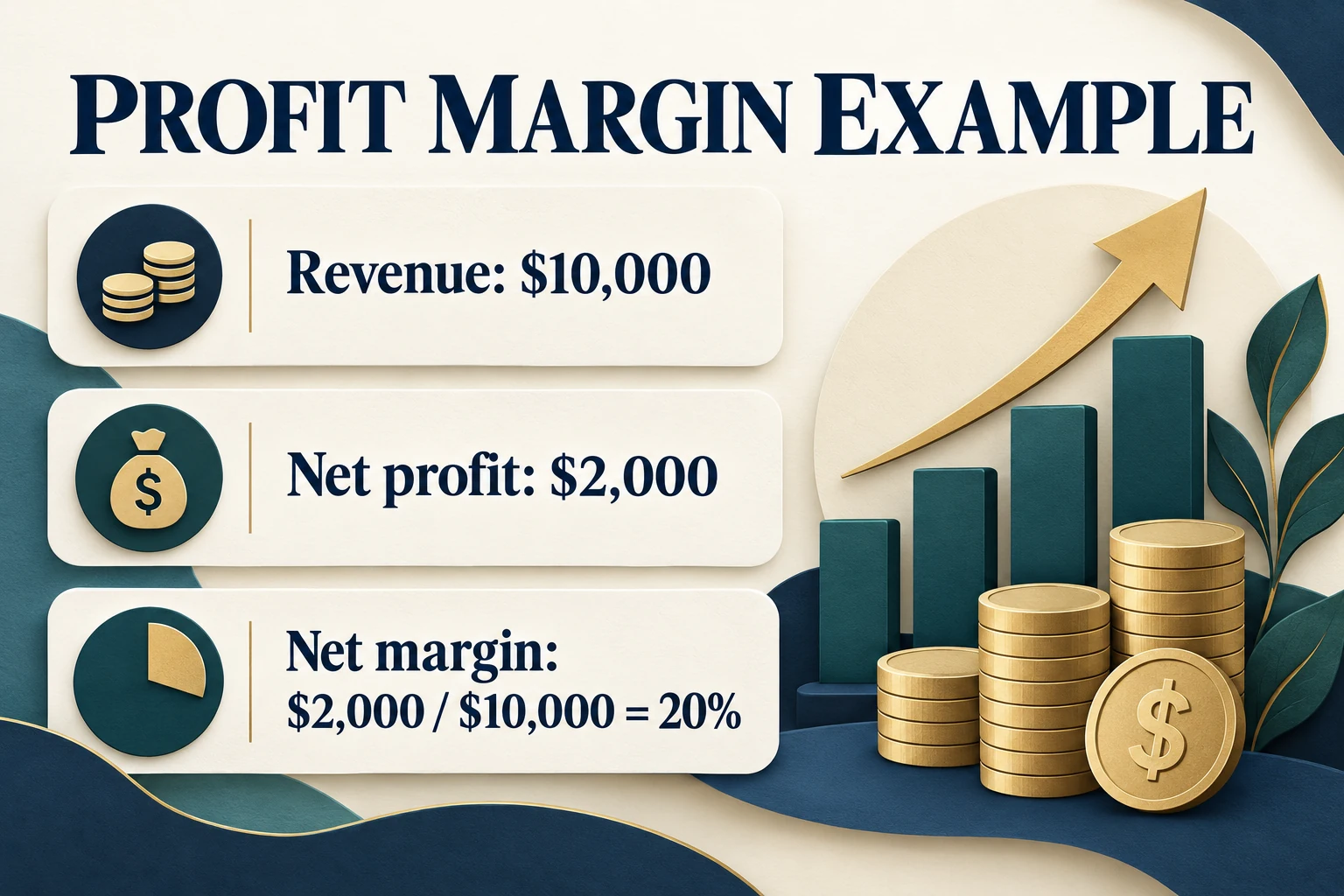
A profit margin expresses profit as a percentage of revenue, allowing businesses of different sizes to compare efficiency. A $50,000 profit may be strong for a $100,000 business, producing a 50% margin, but weak for a $10 million business, producing only 0.5%.
| Margin | Formula | Example | What it diagnoses |
|---|---|---|---|
| Gross margin | Gross profit ÷ revenue | 40% | Pricing and direct cost control |
| Operating margin | EBIT ÷ revenue | 15% | Overhead and operating efficiency |
| Pre-tax margin | Pre-tax profit ÷ revenue | 12% | Financing and non-operating effects |
| Net margin | Net profit ÷ revenue | 9.6% | Final accounting profitability |
| Contribution margin | Revenue minus variable costs, divided by revenue | 55% | Unit economics and break-even capacity |
Industry comparisons require caution. The figures below are broad typical ranges, not universal standards, and may vary with geography, company maturity, accounting policy, and business model.
| Business model | Typical gross margin | Typical net margin | Main margin pressure |
|---|---|---|---|
| Grocery retail | 20-30% | 1-5% | Inventory, spoilage, labor, rent |
| SaaS software | 70-85% | 5-25% | Sales, research, support, stock compensation |
| Professional services | 40-70% | 10-30% | Billable utilization and compensation |
| Restaurants | 55-70% | 3-10% | Food waste, labor, occupancy |
| Wholesale distribution | 10-30% | 1-6% | Freight, inventory, price competition |
The useful benchmark is usually the company’s own trend and peer group, not an internet average. A grocery operator with a 4% net margin may outperform its sector, while a consulting firm with a 12% margin may have a utilization or pricing problem.
Is Profit the Same as Revenue, Markup, or Cash Flow?
Profit is different from revenue, markup, and cash flow. Revenue is the money earned from sales before expenses; markup is the increase from cost to selling price; cash flow records actual cash movement; profit applies accounting recognition rules to income and expenses.
| Concept | Calculation or definition | Example | What it cannot prove |
|---|---|---|---|
| Revenue | Total recognized sales | $500,000 | Whether the company made money |
| Markup | Selling price minus product cost, divided by product cost | 66.7% on $60 to $100 | Whether overhead is covered |
| Gross profit | Revenue minus direct costs | $200,000 | Final owner earnings |
| Net profit | Revenue minus all recognized expenses | $48,000 | Available bank cash |
| Operating cash flow | Cash generated by ordinary operations | $20,000 | Long-term return on capital |
A product costing $60 and selling for $100 has a $40 markup, or 66.7% of cost. Its gross margin is 40%, because the $40 gross profit is divided by the $100 selling price. Markup and margin answer different questions.
Why Can a Profitable Business Run Out of Cash?
A profitable business can run out of cash when accounting earnings arrive before customer payments or when cash is committed to inventory, equipment, debt repayment, or tax payments. A company invoicing $300,000 on 90-day terms may record revenue and profit while having insufficient cash to pay payroll next Friday.
Managers should monitor accounts receivable days, inventory days, accounts payable days, debt maturities, and a rolling 13-week cash forecast. Profit improves long-term earning capacity; liquidity determines whether obligations can be paid on time.
How Do Unit Economics Explain Profit?
Unit economics explain whether one product, order, subscription, or customer creates enough contribution to support fixed costs and profit. The core calculation subtracts variable costs from unit revenue.
A subscription sold for $100 per month with $25 of hosting and support costs creates a $75 contribution before sales, administration, and product development. If customer acquisition costs $300, the simple acquisition payback period is four months, assuming the customer remains active and produces no additional variable costs.
| Unit metric | Formula | Example | Interpretation |
|---|---|---|---|
| Contribution per unit | Price minus variable cost | $75 | Amount available for fixed costs |
| Contribution margin | Contribution divided by price | 75% | Unit-level efficiency |
| CAC payback | CAC divided by monthly contribution | 4 months | Time to recover acquisition cost |
| Break-even units | Fixed costs divided by contribution | 1,334 units | Volume needed before profit |
| Customer lifetime value | Contribution per period multiplied by expected periods | $900 | Potential account economics |
Customer acquisition cost should include paid media, sales commissions, onboarding labor, promotions, and the relevant share of sales operations. Ignoring those costs can make an apparently attractive product unprofitable at scale.
A scaling rule follows: if each additional unit loses money after variable costs, growth increases losses. If each unit produces contribution but overhead is too high, growth may help, provided capacity and working capital can support it.
How Should Different Businesses Use Profit Metrics?
Different users should emphasize different measures because their decisions and risks differ. A startup needs unit economics and runway, an established small business needs operating control, and an investor needs sustainable earnings plus returns on capital.
| User | Primary metric | Review frequency | Practical decision |
|---|---|---|---|
| Startup founder | Contribution margin and runway | Weekly | Whether to scale acquisition |
| Small-business owner | Operating margin and cash conversion | Monthly | Whether to reprice or cut overhead |
| Retail manager | Gross margin and inventory turnover | Weekly | Whether to change purchasing |
| Corporate executive | EBIT, free cash flow, ROIC | Monthly or quarterly | Whether capital allocation creates value |
| Investor | Normalized net profit and free cash flow | Quarterly | Whether earnings are durable |
Startups
Startups may report losses while investing in product, engineering, and customer acquisition. That does not make profit irrelevant. Management should know gross margin, contribution margin, CAC payback, monthly cash burn, and runway.
A startup with $1 million of cash and $100,000 monthly net cash burn has approximately 10 months of runway before new funding or cost reduction, ignoring changes in working capital. A business can postpone net profitability, but it cannot postpone understanding whether its unit economics improve with scale.
Small Businesses
Small businesses should reconcile the profit and loss statement to bank balances each month. Owners often miss subscriptions, insurance renewals, owner labor, inventory shrinkage, repairs, and tax reserves when estimating profitability.
A practical review separates price, volume, direct cost, labor utilization, overhead, and financing. If revenue rises 20% while operating profit rises only 2%, the owner should investigate cost inflation, discounting, overtime, and customer mix.
Investors and Executives
Investors typically examine normalized earnings, free cash flow, debt, capital expenditure, working capital, and return on invested capital. One-time litigation gains, asset sales, restructuring charges, or unusually low marketing spend can distort reported net profit.
ROIC compares after-tax operating profit with the capital invested in the business. Growth creates economic value when returns on new capital exceed the company’s cost of capital, not merely when revenue or accounting profit increases.
What Is Economic Profit?
Economic profit is accounting profit after subtracting the opportunity cost of the capital and resources used. Accounting profit may show $200,000, while economic profit is only $50,000 if the business uses $1 million of capital that could reasonably earn $150,000 elsewhere.
Economic profit also considers unpaid owner labor, owned premises, and foregone alternatives. A sole proprietor reporting $80,000 of profit may actually be earning $30,000 after assigning a market wage of $50,000 to the owner’s work.
This measure is valuable for investment decisions, but it is harder to calculate because opportunity costs are estimates. Small businesses should use it when deciding whether to expand, buy property, retain capital, or pursue a different venture.
What Problems Commonly Distort Profit?
Profit becomes misleading when costs are omitted, timing is misunderstood, or a temporary result is treated as permanent. The most common failures involve revenue recognition, inventory, owner compensation, customer acquisition, and one-time events.
- Confusing sales with earnings: A $1 million sales target says nothing about profit without a complete cost model.
- Ignoring owner labor: A business may appear profitable because the owner works unpaid overtime.
- Treating EBITDA as cash: Debt principal, capital expenditure, tax, and working capital still require cash.
- Capitalizing ordinary costs improperly: Moving an expense to an asset can inflate current profit while creating future charges.
- Using averages instead of cohorts: A profitable average customer can conceal loss-making acquisition channels.
- Ignoring returns and refunds: Recognized sales may later become credits, cancellations, or bad debts.
- Forgetting inventory write-downs: Unsold or obsolete inventory can overstate assets and profit.
- Using one month as evidence: Seasonality can make a temporary peak look like a permanent margin improvement.
A reliable monthly close compares actual results with budget and prior year, explains material variances, verifies receivables, reviews inventory aging, and reconciles profit with operating cash flow.
How Can a Business Increase Profit?
A business increases profit by raising profitable revenue, improving price realization, reducing direct costs, increasing productivity, or removing unnecessary fixed expenses. The best action depends on which profit layer is weak.
| Problem | Diagnostic signal | First action | Risk to monitor |
|---|---|---|---|
| Weak gross margin | Gross margin below target | Reprice or renegotiate inputs | Customer churn |
| High acquisition cost | CAC payback above target | Improve conversion and channel mix | Slower growth |
| Excess overhead | OPEX rises faster than revenue | Remove low-use costs | Capacity loss |
| Low utilization | Paid hours exceed billable hours | Improve scheduling and pricing | Employee strain |
| Cash shortage | Profit exceeds operating cash flow | Tighten terms and collections | Customer friction |
| Inventory drag | Stock grows faster than sales | Reduce purchasing and clear aging stock | Stockouts |
Price increases often improve profit faster than volume growth because each additional dollar of price can carry a high incremental margin. However, price changes should be tested by segment, channel, and customer sensitivity rather than applied uniformly.
Cost cutting can damage profit if it removes maintenance, quality control, customer support, or productive sales capacity. The relevant question is not whether a cost is large, but whether its future contribution exceeds its total economic cost.
The Bottom Line
Profit meaning in business is the surplus created when recognized revenue exceeds the costs required to produce and operate the business. Gross profit explains direct economics, operating profit explains operational performance, and net profit shows the accounting result after financing and tax.
Profit should be read with cash flow, working capital, unit economics, margin trends, and return on invested capital. Revenue growth without contribution, cash conversion, or adequate returns can make a business larger without making it stronger.
How Often Should a Small Business Calculate Profit?
A small business should review a simplified profit report monthly and complete a more rigorous year-end close with an accountant. Weekly tracking of sales, gross margin, payroll, cash, and overdue invoices is useful for businesses with thin margins or rapid inventory movement.
Is a 10% Net Profit Margin Good?
A 10% net profit margin can be strong, average, or weak depending on the industry, capital intensity, risk, and growth rate. Grocery businesses often operate near low single digits, while some software and professional-service models can achieve materially higher margins.
Does Profit Include the Owner’s Salary?
Profit includes the owner’s salary when the salary is recorded as a business expense. An owner draw or distribution usually reduces equity rather than operating profit, so treating withdrawals as wages can distort comparisons and tax reporting.
What Does Negative Profit Mean?
Negative profit means recognized expenses exceed recognized revenue for the measured period. The result may be acceptable during planned investment, seasonal downturns, or a temporary restructuring, but repeated losses require a credible path to higher margins, lower costs, additional funding, or closure.
Is Retained Profit the Same as Cash in the Bank?
Retained profit is accumulated accounting income left in the business after declared distributions. It is not necessarily bank cash because earnings may be tied up in receivables, inventory, equipment, prepaid costs, or other assets.