
Revenue in business means the total income a company earns from selling goods or services during a reporting period, before operating expenses are deducted. Revenue is called the “top line” because it appears near the top of the income statement, while profit remains after costs, interest, and taxes are subtracted.
Key Facts at a Glance
- Revenue measures earned sales activity; cash flow measures money moving into and out of bank accounts.
- Gross revenue is reduced by returns, allowances, discounts, and similar adjustments to produce net revenue.
- Accrual accounting records revenue when the business earns it, not necessarily when the customer pays.
- Deferred revenue is a liability because a customer has paid before the company delivers the promised goods or services.
- Recurring revenue is predictable contractual income, while total revenue can also include one-time and non-operating amounts.
- High revenue does not prove profitability, liquidity, or healthy customer economics.
What Does Revenue Mean in Business?
Revenue is the monetary value of goods or services a business has earned by selling to customers. A retailer earns revenue when it sells inventory, a consultant earns revenue as contracted services are delivered, and a software company earns revenue as customers receive access under its contract.
The Financial Accounting Standards Board describes revenue in ASC 606 as “income arising in the course of an entity’s ordinary activities.” That definition separates ordinary customer income from financing proceeds, owner investment, and many gains from asset sales.
Revenue is not the same as total money received. A company can collect a deposit before completing work, or record a credit sale before receiving cash. The accounting treatment depends on the contract, delivery status, payment terms, and whether the business uses cash or accrual accounting.
Where Revenue Appears on Financial Statements
Revenue normally appears at the top of the income statement. The statement then subtracts direct costs to calculate gross profit, followed by operating expenses to calculate operating income.
| Financial measure | Calculation | Example amount | What it indicates |
|---|---|---|---|
| Gross revenue | 1,000 units × $50 | $50,000 | Sales before deductions |
| Net revenue | $50,000 − $2,500 returns | $47,500 | Reported sales after reductions |
| Gross profit | $47,500 − $19,000 COGS | $28,500 | Value left after direct costs |
| Operating income | $28,500 − $21,000 expenses | $7,500 | Earnings from operations |
Revenue is therefore a scale measure, not a complete performance measure. A company with $1 million in sales can lose money if fulfillment, payroll, advertising, interest, and other costs exceed its gross profit.
How Does Revenue Recognition Work?
Revenue recognition records revenue when a business satisfies its obligation to provide a promised good or service. Under accrual accounting, the customer’s payment date is secondary to delivery and control of the product or service, although cash collection remains important for liquidity.
ASC 606 in the United States and IFRS 15 internationally use a broadly similar contract-based framework. The accounting team identifies the contract, identifies performance obligations, determines the transaction price, allocates that price, and records revenue when each obligation is satisfied.
The Revenue Lifecycle
A commercial sale typically moves through five connected stages:
- Create value and set a price. The business defines the product, service, license, usage unit, or contract deliverable.
- Agree to the transaction. A customer accepts an order, signs a contract, or completes a point-of-sale purchase.
- Fulfill the obligation. The business ships goods, performs services, or provides continuing access.
- Bill the customer. An invoice or receipt records the amount due, unless payment occurs immediately.
- Collect cash. The customer settles the receivable according to the agreed terms.
These stages can occur on the same day or over several years. A restaurant sale may involve one receipt and immediate revenue. A $120,000 annual software contract may produce monthly revenue even when the customer pays the full amount upfront.
Cash Basis Versus Accrual Basis
| Event | Cash accounting | Accrual accounting | Typical account effect |
|---|---|---|---|
| Customer pays before delivery | Revenue recorded immediately | Cash and deferred revenue recorded | Liability increases |
| Product ships on credit | No revenue until payment | Revenue recorded when control transfers | Accounts receivable increases |
| Monthly service delivered | Revenue recorded when paid | Revenue recorded for month delivered | Revenue increases |
| Customer pays an invoice | Revenue recorded at payment | Receivable becomes cash | Asset classification changes |
Cash accounting can be easier for a small operation, but it can distort performance when payment timing differs from delivery timing. Accrual accounting gives lenders, investors, and managers a clearer period-by-period view of earned sales.
What Are the Main Types of Business Revenue?
The main revenue categories are operating, non-operating, recurring, transactional, and service or project revenue. A single company can use several categories at once, but financial statements should classify them consistently and explain material changes.
| Revenue type | Concrete example | Typical timing | Main management use |
|---|---|---|---|
| Operating revenue | Bakery sells 4,000 loaves at $4 | At sale or delivery | Measures core commercial activity |
| Non-operating revenue | Bank interest of $850 per quarter | As interest accrues | Separates secondary income |
| Recurring revenue | SaaS plan at $99 per month | Monthly over access period | Forecasts contracted income |
| Transactional revenue | Appliance sold for $1,200 | On delivery or control transfer | Measures discrete purchases |
| Service revenue | Legal retainer of $6,000 per month | As work or access is provided | Tracks professional delivery |
| Project revenue | Construction contract worth $240,000 | By milestones or completion | Matches sales to progress |
Operating and Non-Operating Revenue
Operating revenue comes from the company’s ordinary business activity. Product sales, subscription fees, consulting fees, shipping charges, and usage fees can qualify when they are part of normal operations.
Non-operating income comes from activities outside the core customer offering. Examples include interest income, dividends, and some gains on asset disposals. Asset-sale gains are often presented separately from revenue because selling equipment is not the company’s ordinary business activity.
Recurring and One-Time Revenue
Recurring revenue repeats under a subscription, maintenance agreement, license renewal, or other continuing arrangement. Recurrence improves forecasting, but it does not guarantee retention: a customer can cancel, downgrade, fail to renew, or consume less under a usage contract.
One-time revenue comes from an individual sale or discrete project. It can be valuable for cash generation, but management must replace completed sales continuously unless the business creates follow-on purchases.
How Are Revenue Models Compared?
Subscription models generally provide stronger forecasting, while transactional models offer simpler billing and faster recognition. Usage-based, project-based, and freemium models can fit specific customer behaviors, but each introduces different volatility, delivery, and measurement risks.
| Model | Typical price pattern | Revenue predictability | Primary risk | Suitable example |
|---|---|---|---|---|
| Subscription | $20-$500 per user monthly | High before churn | Cancellation and support cost | Productivity software |
| Transactional | $15-$5,000 per sale | Medium to low | Demand volatility | Consumer electronics |
| Usage-based | $0.01-$2 per unit consumed | Medium | Uncertain customer usage | Cloud computing |
| Project-based | $5,000-$5 million per contract | Low to medium | Scope and cost overruns | Engineering firm |
| Freemium or advertising | $0 paid entry, ads by impression | Low until scale | Low conversion rate | Consumer mobile app |
How Should a Business Choose a Revenue Model?
A business should choose the model that matches how customers receive value, how often they buy, and how reliably the company can deliver. A monthly subscription is poorly suited to an infrequent purchase that customers expect to own permanently, while a one-time sale may underprice software that provides ongoing value.
Evaluate five factors:
- Customer behavior: Does the customer buy once, repeatedly, or according to usage?
- Delivery cost: Does each additional customer create support, hosting, labor, or shipping costs?
- Cash timing: Does the business need payment before production or after delivery?
- Forecastability: Can management estimate demand, churn, and consumption?
- Contract complexity: Can the team track renewals, milestones, refunds, and obligations accurately?
A practical rule is to avoid adding recurring billing merely to make revenue look predictable. Subscription revenue is useful only when the customer receives continuing value and the business can retain the account profitably.
How Is Revenue Calculated?
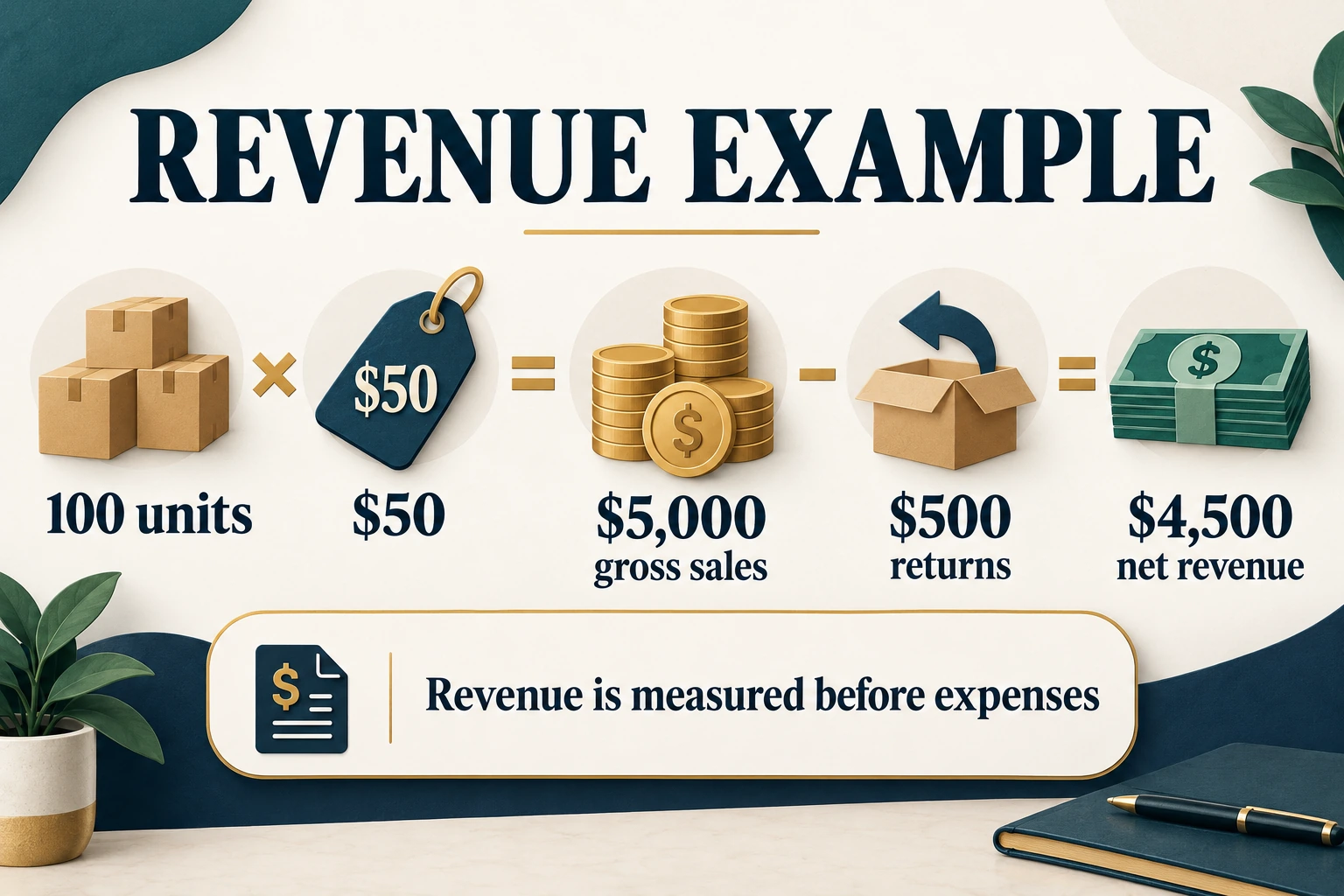
Revenue is calculated by multiplying the quantity sold by the applicable price, then adjusting for returns, allowances, discounts, rebates, and other contractual reductions. The exact calculation depends on whether the business sells products, services, subscriptions, usage, or bundled obligations.
| Metric | Formula | Worked example | Result |
|---|---|---|---|
| Gross revenue | Units × listed price | 2,000 × $30 | $60,000 |
| Net revenue | Gross revenue − deductions | $60,000 − $4,500 | $55,500 |
| Gross profit | Net revenue − COGS | $55,500 − $22,200 | $33,300 |
| Gross margin | Gross profit ÷ net revenue × 100 | $33,300 ÷ $55,500 | 60% |
| Average revenue per order | Net revenue ÷ orders | $55,500 ÷ 1,500 | $37 |
Gross Revenue Versus Net Revenue
Gross revenue is the sales amount before reductions. Net revenue is the amount remaining after returns, discounts, allowances, refunds, rebates, and sometimes chargebacks, depending on the reporting policy.
For example, a retailer sells 500 products at $80, creating $40,000 of gross sales. If customers return $1,600 of goods and receive $400 in discounts, net revenue is $38,000. Reporting $40,000 without the reductions overstates the amount retained from sales.
Revenue and Gross Margin
Gross margin shows how much net revenue remains after the direct cost of producing or delivering the offering. A company with 80% revenue growth but a margin decline from 55% to 25% may be expanding sales while weakening its unit economics.
The basic formula is:
Gross margin = (Net revenue − cost of goods sold) ÷ net revenue × 100
Selling price alone does not determine revenue quality. A $10 product with $9.50 of direct cost creates less economic value than a $7 product with $1.50 of direct cost, even if the first product generates a higher sales total.
How Are MRR and ARR Calculated?
Monthly recurring revenue, or MRR, is the normalized monthly value of active recurring contracts. Annual recurring revenue, or ARR, is usually MRR multiplied by 12, although neither metric should include one-time fees, professional services, or uncertain usage unless the company defines those inclusions clearly.
| SaaS measure | Formula | Example | Result |
|---|---|---|---|
| New MRR | New monthly contracts | 20 × $100 | $2,000 |
| Expansion MRR | Upgrades and add-ons | 10 × $30 | $300 |
| Churned MRR | Cancelled monthly contracts | 8 × $75 | -$600 |
| Ending MRR | Starting + new + expansion − churn | $10,000 + $2,000 + $300 − $600 | $11,700 |
| ARR | Ending MRR × 12 | $11,700 × 12 | $140,400 |
MRR and ARR are operating metrics, not automatic substitutes for GAAP or IFRS revenue. A prepaid annual contract may create $12,000 of cash immediately but approximately $1,000 of monthly recognized revenue when service is delivered evenly.
Net revenue retention provides a stronger view of existing-customer quality:
NRR = (Starting MRR + expansion MRR − contraction MRR − churned MRR) ÷ starting MRR × 100
If starting MRR is $100,000, expansion is $12,000, contraction is $5,000, and churn is $8,000, NRR equals 99%. New customer sales do not enter that calculation.
How Is Revenue Different From Cash Flow?
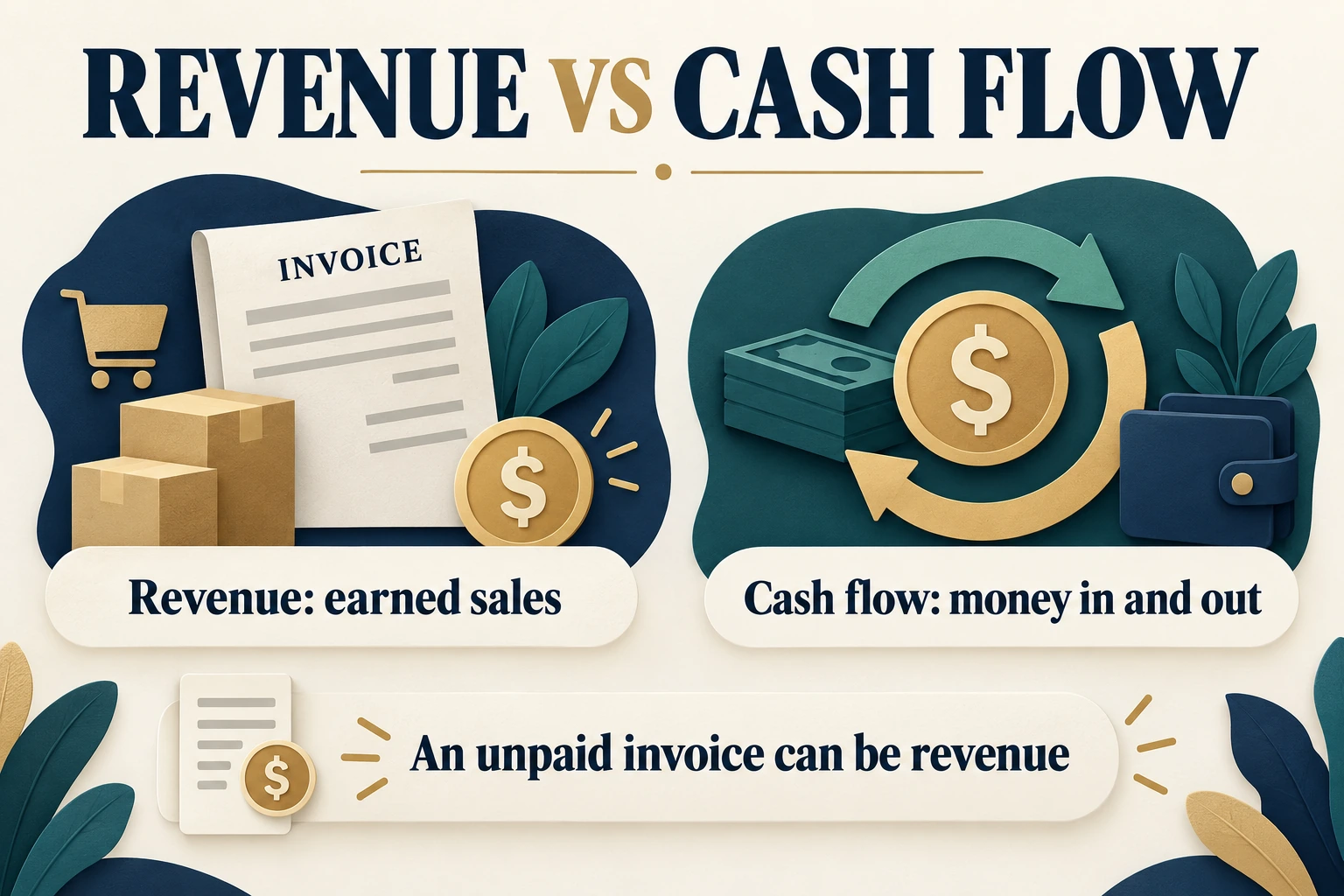
Revenue records earned sales, while cash flow records actual cash movements. A business can report $100,000 of revenue from invoices due in 60 days and still lack enough cash to pay payroll, suppliers, rent, or taxes this week.
Consider a consulting firm that completes a $100,000 project in March and invoices the client on net-60 terms. Accrual revenue may be $100,000 in March, but operating cash inflow may not occur until May. Accounts receivable rises in March, and cash rises in May.
| Situation | Revenue effect | Cash-flow effect | Financial warning |
|---|---|---|---|
| Credit sale, unpaid | +$100,000 | $0 | Receivable concentration |
| Customer pays invoice | $0 new revenue | +$100,000 | Collection timing improves |
| Annual prepayment before service | $0 immediate earned revenue | +$12,000 | Deferred revenue liability |
| Refund issued | Revenue decreases | Cash decreases | Return rate increases |
The indirect cash-flow statement reconciles net income to operating cash flow by adjusting for receivables, inventory, payables, depreciation, and deferred revenue. Revenue growth without operating cash conversion deserves investigation.
What Revenue Mistakes Cause Misleading Results?
The most damaging revenue mistakes are premature recognition, confusing cash with earned income, ignoring deductions, and pricing for volume without testing contribution margin. These errors can mislead owners, lenders, investors, and tax authorities.
Premature Recognition
A company should not record revenue simply because it signed a contract or received a deposit. If a customer pays $24,000 for 12 months of support, the unearned portion generally remains deferred revenue until the company provides the support.
Principal Versus Agent Reporting
A marketplace may collect $100 from a buyer but retain only a $15 commission. If the marketplace controls the product before transfer, gross reporting may be appropriate; if it arranges another party’s sale, net commission reporting may be required. The contract and control analysis determine the presentation.
Refunds, Chargebacks, and Negative Revenue
Returns and chargebacks reduce revenue rather than becoming ordinary operating expenses when they reverse customer sales. A month can therefore show negative net revenue if refunds exceed current-period sales, particularly after a product recall or billing correction.
Underpricing to Increase Sales
Revenue growth can destroy value when incremental sales have weak contribution margins. If a product sells for $50, variable cost is $35, and payment and fulfillment fees total $5, each sale contributes $10 before fixed costs. A discount to $42 cuts contribution to $2, an 80% reduction.
How Does Revenue Differ Across Industries?
Revenue recognition differs by delivery pattern, contract structure, return rights, and control transfer. Retail usually records sales at shipment or checkout, SaaS recognizes service over access periods, and construction may recognize revenue over time when performance creates customer-controlled value.
| Industry | Revenue event | Common complication | Useful metric |
|---|---|---|---|
| Retail | Customer receives product | Returns and markdowns | Same-store sales |
| SaaS | Customer receives access | Churn and deferred revenue | MRR, ARR, NRR |
| Construction | Contract milestones or progress | Estimates and cost overruns | Backlog, percent complete |
| Consulting | Hours, milestones, or deliverables | Unbilled work and scope changes | Billable utilization |
| Marketplace | Facilitated transaction | Gross versus net presentation | Take rate |
| Advertising | Impression, click, or campaign delivery | Make-goods and cancellations | Revenue per impression |
A construction company should not treat an unsigned change order as certain revenue. A consulting firm should not count unbilled future work as earned sales. An online marketplace should disclose whether reported revenue is the customer’s full payment or only the platform’s commission.
Which Revenue Metrics Matter Most?
The right revenue metrics depend on the business model, but most companies should monitor net revenue, growth rate, gross margin, collection speed, customer concentration, and forecast variance. Subscription businesses should add churn, expansion, MRR, ARR, and net revenue retention.
| Metric | Formula or measurement | Typical review frequency | Diagnostic question |
|---|---|---|---|
| Revenue growth | Current period versus prior period | Monthly | Are sales expanding? |
| Gross margin | Gross profit ÷ net revenue | Monthly | Does each sale create value? |
| Days sales outstanding | Receivables ÷ credit sales × days | Weekly or monthly | Are customers paying on time? |
| Customer concentration | Largest customer revenue ÷ total revenue | Monthly | Could one loss damage the business? |
| Forecast variance | Actual revenue − forecast revenue | Monthly | Are assumptions reliable? |
| Churn rate | Cancelled customers ÷ opening customers | Monthly | Is recurring demand weakening? |
A practitioner rule is to review revenue by customer, product, channel, geography, and cohort rather than relying on one total. The same $500,000 increase can mean healthy expansion, a single temporary contract, or aggressive discounting.
A Practical Revenue Review Checklist
Business owners can review revenue accurately by completing these steps each month:
- Reconcile sales orders, invoices, payment processor reports, and bank deposits.
- Separate gross sales from returns, discounts, refunds, allowances, and chargebacks.
- Identify deposits and prepaid contracts that remain deferred revenue.
- Compare recognized revenue with accounts receivable and overdue invoices.
- Calculate gross margin by product, service line, and major customer.
- Review the largest five customers for concentration and renewal risk.
- Compare actual revenue with forecast by channel and contract type.
- Investigate unusual end-of-period sales, manual journal entries, and negative adjustments.
- Confirm that tax reporting and financial reporting use appropriate, documented policies.
- Update pricing only after testing demand, direct cost, churn, and contribution margin.
Small businesses can perform this review in accounting software and a spreadsheet. Larger organizations typically connect billing, customer relationship management, enterprise resource planning, and revenue-recognition systems.
Frequently Asked Questions
Is Revenue the Same as Sales?
Revenue and sales often describe the same core activity, but revenue is the formal financial-reporting term. Sales may refer to individual transactions or the commercial department, while reported revenue includes the accounting adjustments required for returns, discounts, timing, and contract obligations.
Is Revenue the Same as Income?
Revenue is not the same as net income. Revenue is earned sales before expenses, while net income remains after cost of goods sold, payroll, rent, marketing, depreciation, interest, and taxes. Some people use “income” informally to mean revenue, but financial statements distinguish the terms.
Can Revenue Be Negative?
Net revenue can be negative for a period when refunds, returns, chargebacks, or accounting corrections exceed new sales. Gross revenue is generally not negative, but contra-revenue accounts can reduce reported net revenue below zero during an unusual adjustment period.
Should Taxes Be Included in Revenue?
Taxes collected for a government, such as sales tax or value-added tax, are generally excluded from revenue because the business acts as a collection agent. The exact treatment depends on the jurisdiction, tax type, and reporting rules, so businesses should document the policy with their accountant.
What Is Deferred Revenue?
Deferred revenue is cash received before a company has delivered the related goods or services. Deferred revenue appears as a liability because the business still owes performance to the customer. As delivery occurs, the liability decreases and earned revenue increases.
Why Can Revenue Increase While Profit Falls?
Revenue can rise while profit falls when direct costs, discounts, customer acquisition costs, payroll, interest, or overhead grow faster than sales. Management should compare revenue growth with gross margin, contribution margin, operating expenses, and cash conversion rather than treating higher sales as automatic success.
The Bottom Line
Revenue meaning in business is the earned value of goods and services sold during a defined period, before expenses are deducted. Revenue is the top line, but reliable decisions require separating gross from net revenue, earned income from cash collections, recurring contracts from one-time sales, and sales growth from profitable growth.